 Add to Chrome
 Add to Firefox
 Add to Edge
EnTransformer: A Deep Generative Transformer for Multivariate Probabilistic Forecasting
Mar 12, 2026
Reliable uncertainty quantification is critical in multivariate time series forecasting problems arising in domains such as energy systems and transportation networks, among many others. Although Transformer-based architectures have recently achieved strong performance for sequence modeling, most probabilistic forecasting approaches rely on restrictive parametric likelihoods or quantile-based objectives. They can struggle to capture complex joint predictive distributions across multiple correlated time series. This work proposes EnTransformer, a deep generative forecasting framework that integrates engression, a stochastic learning paradigm for modeling conditional distributions, with the expressive sequence modeling capabilities of Transformers. The proposed approach injects stochastic noise into the model representation and optimizes an energy-based scoring objective to directly learn the conditional predictive distribution without imposing parametric assumptions. This design enables EnTransformer to generate coherent multivariate forecast trajectories while preserving Transformers' capacity to effectively model long-range temporal dependencies and cross-series interactions. We evaluate our proposed EnTransformer on several widely used benchmarks for multivariate probabilistic forecasting, including Electricity, Traffic, Solar, Taxi, KDD-cup, and Wikipedia datasets. Experimental results demonstrate that EnTransformer produces well-calibrated probabilistic forecasts and consistently outperforms the benchmark models.

Area-norm COBRA on Conditional Survival Prediction
Sep 09, 2023The paper explores a different variation of combined regression strategy to calculate the conditional survival function. We use regression based weak learners to create the proposed ensemble technique. The proposed combined regression strategy uses proximity measure as area between two survival curves. The proposed model shows a construction which ensures that it performs better than the Random Survival Forest. The paper discusses a novel technique to select the most important variable in the combined regression setup. We perform a simulation study to show that our proposition for finding relevance of the variables works quite well. We also use three real-life datasets to illustrate the model.
Concordance based Survival Cobra with regression type weak learners
Oct 11, 2022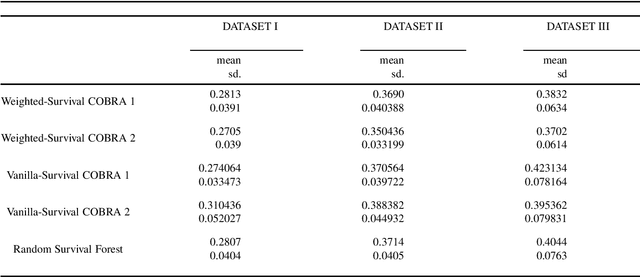
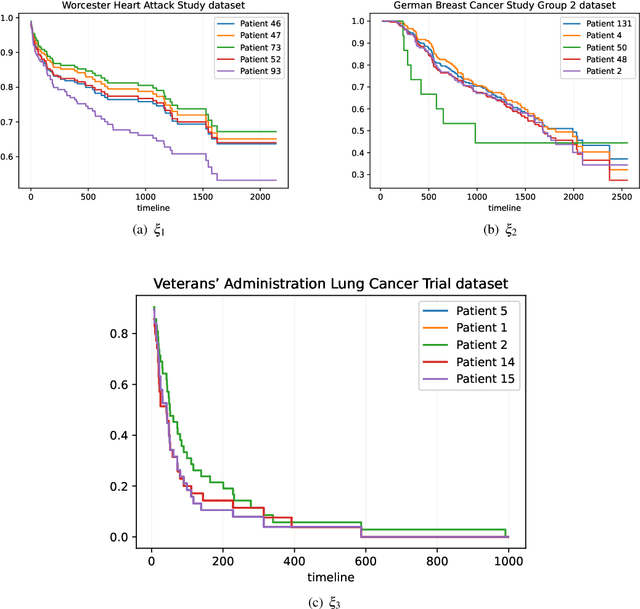
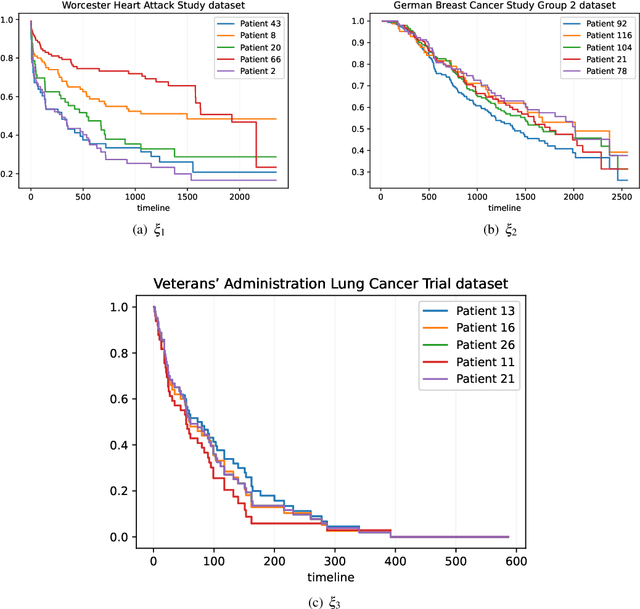
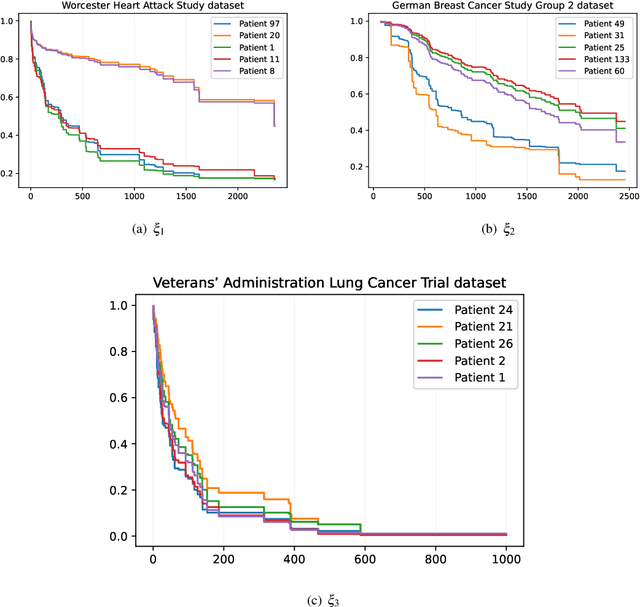
In this paper, we predict conditional survival functions through a combined regression strategy. We take weak learners as different random survival trees. We propose to maximize concordance in the right-censored set up to find the optimal parameters. We explore two approaches, a usual survival cobra and a novel weighted predictor based on the concordance index. Our proposed formulations use two different norms, say, Max-norm and Frobenius norm, to find a proximity set of predictions from query points in the test dataset. We illustrate our algorithms through three different real-life dataset implementations.