 Add to Chrome
 Add to Firefox
 Add to Edge
BayMOTH: Bayesian optiMizatiOn with meTa-lookahead -- a simple approacH
Apr 13, 2026
Bayesian optimization (BO) has for sequential optimization of expensive black-box functions demonstrated practicality and effectiveness in many real-world settings. Meta-Bayesian optimization (meta-BO) focuses on improving the sample efficiency of BO by making use of information from related tasks. Although meta-BO is sample-efficient when task structure transfers, poor alignment between meta-training and test tasks can cause suboptimal queries to be suggested during online optimization. To this end, we propose a simple meta-BO algorithm that utilizes related-task information when determined useful, falling back to lookahead otherwise, within a unified framework. We demonstrate competitiveness of our method with existing approaches on function optimization tasks, while retaining strong performance in low task-relatedness regimes where test tasks share limited structure with the meta-training set.

Can Kans (re)discover predictive models for Direct-Drive Laser Fusion?
Sep 13, 2024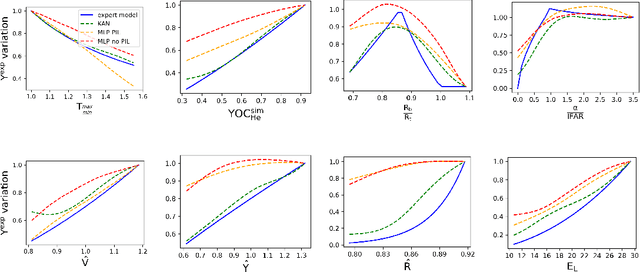
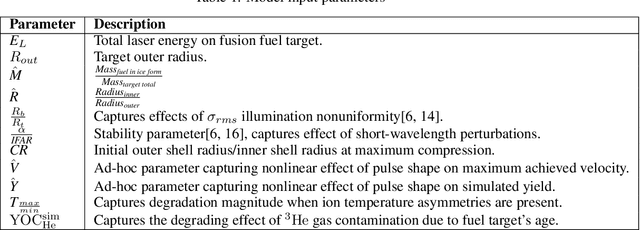
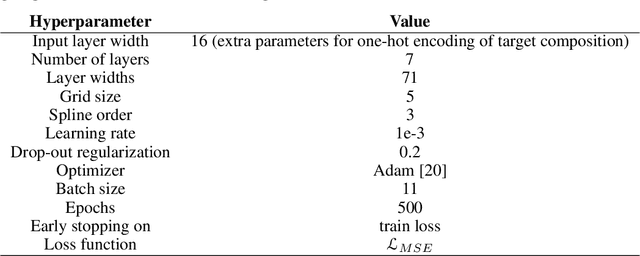
The domain of laser fusion presents a unique and challenging predictive modeling application landscape for machine learning methods due to high problem complexity and limited training data. Data-driven approaches utilizing prescribed functional forms, inductive biases and physics-informed learning (PIL) schemes have been successful in the past for achieving desired generalization ability and model interpretation that aligns with physics expectations. In complex multi-physics application domains, however, it is not always obvious how architectural biases or discriminative penalties can be formulated. In this work, focusing on nuclear fusion energy using high powered lasers, we present the use of Kolmogorov-Arnold Networks (KANs) as an alternative to PIL for developing a new type of data-driven predictive model which is able to achieve high prediction accuracy and physics interpretability. A KAN based model, a MLP with PIL, and a baseline MLP model are compared in generalization ability and interpretation with a domain expert-derived symbolic regression model. Through empirical studies in this high physics complexity domain, we show that KANs can potentially provide benefits when developing predictive models for data-starved physics applications.