 Add to Chrome
 Add to Firefox
 Add to Edge
MM++: Unsupervised Scale-Invariant Multilayer OOD Detection via Top-K Gated Feature Fusion
Jun 15, 2026
We introduce MM++ (Multilayer Mahalanobis++), a fully unsupervised, strictly post-hoc, and scale-invariant framework for Out-of-Distribution (OOD) detection. To address the trade-off between scale invariance and hierarchical expressivity, MM++ constructs a principled joint feature space. It first identifies discriminative intermediate layers by measuring entropy density drops, which mark the boundaries of sharp semantic compression. By fusing these selected layers with the terminal representation, the framework captures latent cross-layer correlations while mitigating early-layer noise. Crucially, a Ledoit-Wolf regularized tied covariance matrix stabilizes this unified space, enabling reliable distance estimation. Requiring no auxiliary OOD data, classifier fine-tuning, or architectural modifications, MM++ delivers robust performance across distinct architectures for both near- and far-OOD detection.

Unified Alignment Protocol: Making Sense of the Unlabeled Data in New Domains
May 27, 2025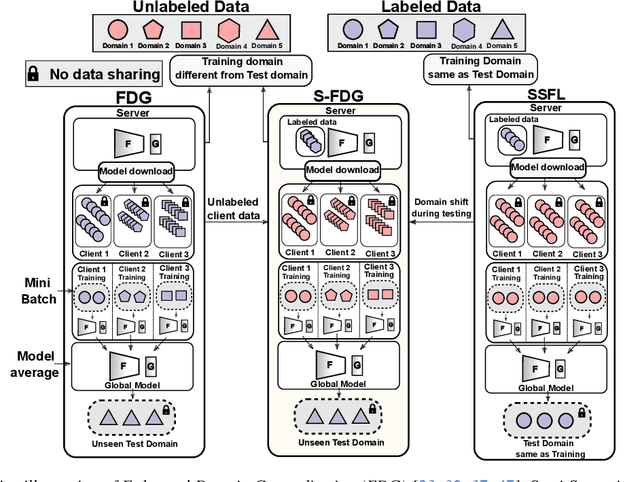
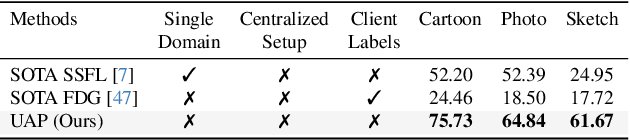
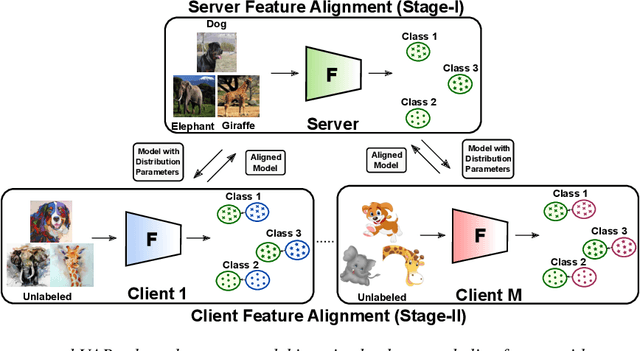
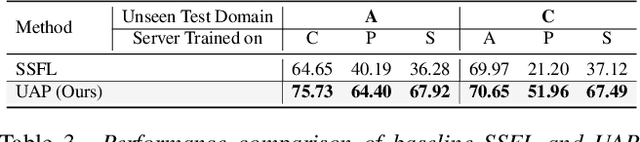
Semi-Supervised Federated Learning (SSFL) is gaining popularity over conventional Federated Learning in many real-world applications. Due to the practical limitation of limited labeled data on the client side, SSFL considers that participating clients train with unlabeled data, and only the central server has the necessary resources to access limited labeled data, making it an ideal fit for real-world applications (e.g., healthcare). However, traditional SSFL assumes that the data distributions in the training phase and testing phase are the same. In practice, however, domain shifts frequently occur, making it essential for SSFL to incorporate generalization capabilities and enhance their practicality. The core challenge is improving model generalization to new, unseen domains while the client participate in SSFL. However, the decentralized setup of SSFL and unsupervised client training necessitates innovation to achieve improved generalization across domains. To achieve this, we propose a novel framework called the Unified Alignment Protocol (UAP), which consists of an alternating two-stage training process. The first stage involves training the server model to learn and align the features with a parametric distribution, which is subsequently communicated to clients without additional communication overhead. The second stage proposes a novel training algorithm that utilizes the server feature distribution to align client features accordingly. Our extensive experiments on standard domain generalization benchmark datasets across multiple model architectures reveal that proposed UAP successfully achieves SOTA generalization performance in SSFL setting.