 Add to Chrome
 Add to Firefox
 Add to Edge
Fairness-Aware Network Embeddings: Methods, Applications, and Challenges
Aug 19, 2026
Network embedding methods learn low-dimensional representations of graph-structured data to support downstream tasks such as node classification, link prediction, and influence maximization. However, real-world networks often reflect structural inequalities arising from demographic imbalances, homophily, and other societal biases, which fairness-agnostic embedding methods can encode and amplify. To address this issue, numerous fairness-aware network embedding methods have been proposed to mitigate bias while preserving embedding utility. This survey presents a comprehensive overview of fairness-aware network embeddings for complex networks. We propose a taxonomy that categorizes existing methods along three main complementary dimensions: underlying embedding approach (spectral, random walk, graph neural network, Bayesian, and method-agnostic), fairness intervention strategy (pre-processing, in-processing, and post-processing), and fairness objective criterion (embedding- or task-level). We further compare methods with respect to group versus individual fairness and assumptions regarding sensitive attributes. Finally, we discuss current limitations and highlight promising future research directions. This survey provides a unified perspective on fairness-aware network embedding and serves as a reference for developing fair and trustworthy network representation learning methods.

Multi-Objective Compliance-Integrated Coevolution For Simulated And Real-World Deployment Of Multi-Robot Marine Autonomy
Jul 28, 2026Collaborative robots are well-suited to maritime missions that benefit from coordination, such as the exploration of unknown reef structures, inspection of subsea infrastructure, or search-and-rescue operations. These missions typically provide sparse feedback signals for measuring progress and require adherence to safety and regulatory norms, turning a mission into a multi-objective optimization problem. Coevolutionary algorithms can process these sparse feedback signals to generate coordinated behaviors, and in some cases extend behaviors to multiple objectives. However, incorporating high-level team objectives with low-level compliance considerations on the fly to balance norm adherence with team performance remains elusive. This paper introduces a multi-objective framework that blends coevolved behaviors with compliance behaviors to achieve a balance between maximizing team progress and minimizing norm violations. The key insight is to decouple learning from compliance since operational norms are prescribed rather than discovered. We demonstrate that our framework achieves high team performance while avoiding collisions on a collaborative swimmer rescue mission with up to 8 vehicles in a hardware deployment, and 12 vehicles in simulation. The key contribution of this paper is Marine Multi-Objective Compliance-Integrated Coevolution (MMOCIC), a framework that blends team-wide optimization with established norms for real-world deployments of learning-based coordination.
Post Hoc Extraction of Pareto Fronts for Continuous Control
Mar 03, 2026Agents in the real world must often balance multiple objectives, such as speed, stability, and energy efficiency in continuous control. To account for changing conditions and preferences, an agent must ideally learn a Pareto frontier of policies representing multiple optimal trade-offs. Recent advances in multi-policy multi-objective reinforcement learning (MORL) enable learning a Pareto front directly, but require full multi-objective consideration from the start of training. In practice, multi-objective preferences often arise after a policy has already been trained on a single specialised objective. Existing MORL methods cannot leverage these pre-trained `specialists' to learn Pareto fronts and avoid incurring the sample costs of retraining. We introduce Mixed Advantage Pareto Extraction (MAPEX), an offline MORL method that constructs a frontier of policies by reusing pre-trained specialist policies, critics, and replay buffers. MAPEX combines evaluations from specialist critics into a mixed advantage signal, and weights a behaviour cloning loss with it to train new policies that balance multiple objectives. MAPEX's post hoc Pareto front extraction preserves the simplicity of single-objective off-policy RL, and avoids retrofitting these algorithms into complex MORL frameworks. We formally describe the MAPEX procedure and evaluate MAPEX on five multi-objective MuJoCo environments. Given the same starting policies, MAPEX produces comparable fronts at $0.001\%$ the sample cost of established baselines.
Contrastive Identification of Covariate Shift in Image Data
Aug 19, 2021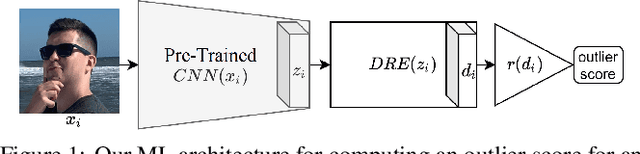
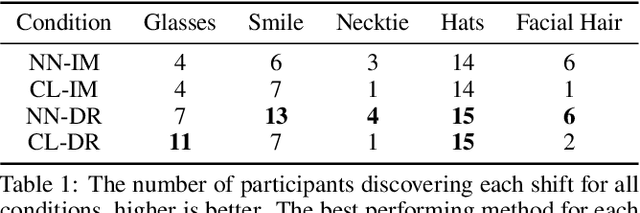
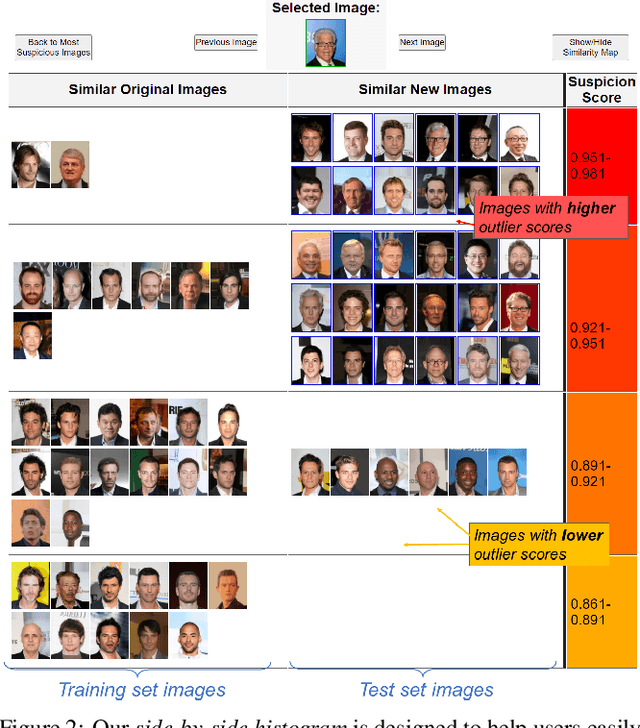
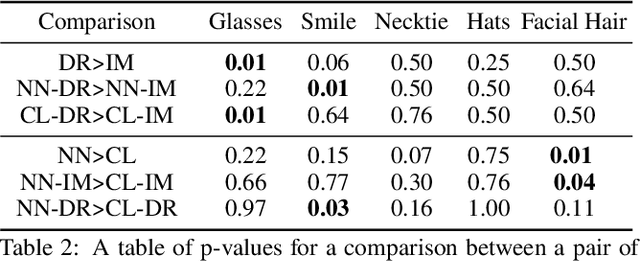
Identifying covariate shift is crucial for making machine learning systems robust in the real world and for detecting training data biases that are not reflected in test data. However, detecting covariate shift is challenging, especially when the data consists of high-dimensional images, and when multiple types of localized covariate shift affect different subspaces of the data. Although automated techniques can be used to detect the existence of covariate shift, our goal is to help human users characterize the extent of covariate shift in large image datasets with interfaces that seamlessly integrate information obtained from the detection algorithms. In this paper, we design and evaluate a new visual interface that facilitates the comparison of the local distributions of training and test data. We conduct a quantitative user study on multi-attribute facial data to compare two different learned low-dimensional latent representations (pretrained ImageNet CNN vs. density ratio) and two user analytic workflows (nearest-neighbor vs. cluster-to-cluster). Our results indicate that the latent representation of our density ratio model, combined with a nearest-neighbor comparison, is the most effective at helping humans identify covariate shift.