 Add to Chrome
 Add to Firefox
 Add to Edge
ReDAG-RT: Global Rate-Priority Scheduling for Real-Time Multi-DAG Execution in ROS 2
Mar 18, 2026
ROS 2 has become a dominant middleware for robotic systems, where perception, estimation, planning, and control pipelines are structured as directed acyclic graphs of callbacks executed under a shared executor. However, default ROS 2 executors use best-effort dispatch without cross-DAG priority enforcement, leading to callback contention, structural priority inversion, and deadline instability under concurrent workloads. These limitations restrict deployment in time-critical and safety-sensitive cyber-physical systems. This paper presents ReDAGRT, a user-space global scheduling framework for deterministic multi-DAG execution in unmodified ROS 2. The framework introduces a Rate-Priority driven global ready queue that orders callbacks by activation rate, enforces per-DAG concurrency bounds, and mitigates cross-graph priority inversion without modifying the ROS 2 API, executor interface, or underlying operating system scheduler. We formalize a multi-DAG task model for ROS 2 callback pipelines and analyze cross-DAG interference under Rate-Priority scheduling. Response-time recurrences and schedulability conditions are derived within classical Rate-Monotonic theory. Experiments in a ROS 2 Humble environment compare ReDAGRT against SingleThreadedExecutor and MultiThreadedExecutor using synthetic multi-DAG workloads. Results show up to 29.7 percent reduction in deadline miss rate, 42.9 percent reduction in 99th percentile response time, and 13.7 percent improvement over MultiThreadedExecutor under comparable utilization. Asymmetric per-DAG concurrency bounds further reduce interference by 40.8 percent. These results demonstrate that deterministic and analyzable multi-DAG scheduling can be achieved entirely in the ROS 2 user-space execution layer, providing a practical foundation for real-time robotic middleware in safety-critical systems.

CLIN-LLM: A Safety-Constrained Hybrid Framework for Clinical Diagnosis and Treatment Generation
Oct 26, 2025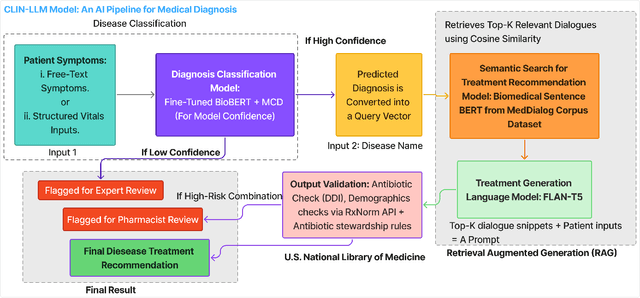
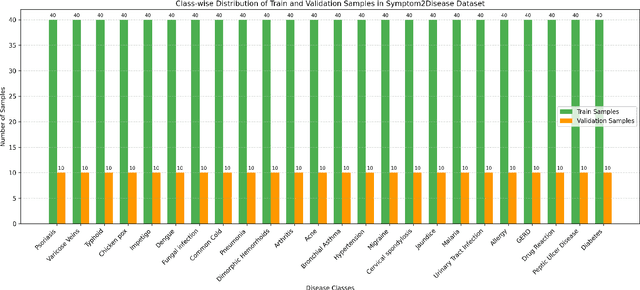
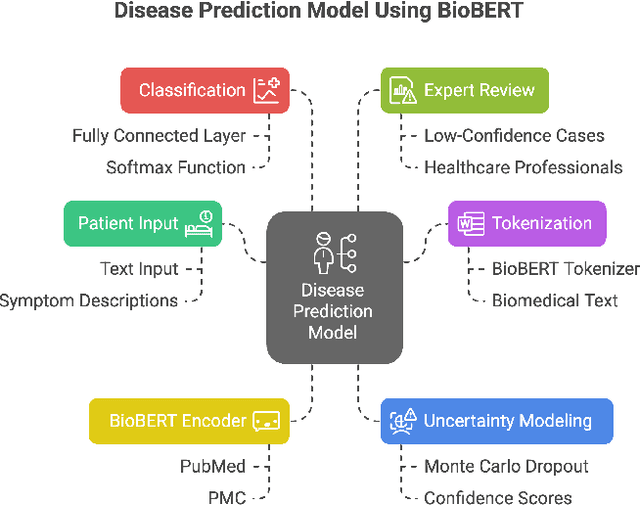
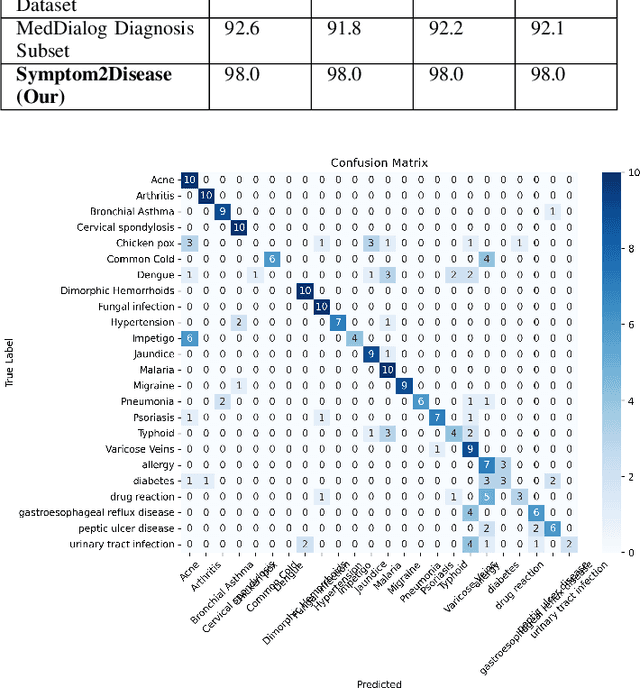
Accurate symptom-to-disease classification and clinically grounded treatment recommendations remain challenging, particularly in heterogeneous patient settings with high diagnostic risk. Existing large language model (LLM)-based systems often lack medical grounding and fail to quantify uncertainty, resulting in unsafe outputs. We propose CLIN-LLM, a safety-constrained hybrid pipeline that integrates multimodal patient encoding, uncertainty-calibrated disease classification, and retrieval-augmented treatment generation. The framework fine-tunes BioBERT on 1,200 clinical cases from the Symptom2Disease dataset and incorporates Focal Loss with Monte Carlo Dropout to enable confidence-aware predictions from free-text symptoms and structured vitals. Low-certainty cases (18%) are automatically flagged for expert review, ensuring human oversight. For treatment generation, CLIN-LLM employs Biomedical Sentence-BERT to retrieve top-k relevant dialogues from the 260,000-sample MedDialog corpus. The retrieved evidence and patient context are fed into a fine-tuned FLAN-T5 model for personalized treatment generation, followed by post-processing with RxNorm for antibiotic stewardship and drug-drug interaction (DDI) screening. CLIN-LLM achieves 98% accuracy and F1 score, outperforming ClinicalBERT by 7.1% (p < 0.001), with 78% top-5 retrieval precision and a clinician-rated validity of 4.2 out of 5. Unsafe antibiotic suggestions are reduced by 67% compared to GPT-5. These results demonstrate CLIN-LLM's robustness, interpretability, and clinical safety alignment. The proposed system provides a deployable, human-in-the-loop decision support framework for resource-limited healthcare environments. Future work includes integrating imaging and lab data, multilingual extensions, and clinical trial validation.
Sentra-Guard: A Multilingual Human-AI Framework for Real-Time Defense Against Adversarial LLM Jailbreaks
Oct 26, 2025This paper presents a real-time modular defense system named Sentra-Guard. The system detects and mitigates jailbreak and prompt injection attacks targeting large language models (LLMs). The framework uses a hybrid architecture with FAISS-indexed SBERT embedding representations that capture the semantic meaning of prompts, combined with fine-tuned transformer classifiers, which are machine learning models specialized for distinguishing between benign and adversarial language inputs. It identifies adversarial prompts in both direct and obfuscated attack vectors. A core innovation is the classifier-retriever fusion module, which dynamically computes context-aware risk scores that estimate how likely a prompt is to be adversarial based on its content and context. The framework ensures multilingual resilience with a language-agnostic preprocessing layer. This component automatically translates non-English prompts into English for semantic evaluation, enabling consistent detection across over 100 languages. The system includes a HITL feedback loop, where decisions made by the automated system are reviewed by human experts for continual learning and rapid adaptation under adversarial pressure. Sentra-Guard maintains an evolving dual-labeled knowledge base of benign and malicious prompts, enhancing detection reliability and reducing false positives. Evaluation results show a 99.96% detection rate (AUC = 1.00, F1 = 1.00) and an attack success rate (ASR) of only 0.004%. This outperforms leading baselines such as LlamaGuard-2 (1.3%) and OpenAI Moderation (3.7%). Unlike black-box approaches, Sentra-Guard is transparent, fine-tunable, and compatible with diverse LLM backends. Its modular design supports scalable deployment in both commercial and open-source environments. The system establishes a new state-of-the-art in adversarial LLM defense.