 Add to Chrome
 Add to Firefox
 Add to Edge
SUNSET -- A Sensor-fUsioN based semantic SegmEnTation exemplar for ROS-based self-adaptation
Jan 20, 2026
The fact that robots are getting deployed more often in dynamic environments, together with the increasing complexity of their software systems, raises the need for self-adaptive approaches. In these environments robotic software systems increasingly operate amid (1) uncertainties, where symptoms are easy to observe but root causes are ambiguous, or (2) multiple uncertainties appear concurrently. We present SUNSET, a ROS2-based exemplar that enables rigorous, repeatable evaluation of architecture-based self-adaptation in such conditions. It implements a sensor fusion semantic-segmentation pipeline driven by a trained Machine Learning (ML) model whose input preprocessing can be perturbed to induce realistic performance degradations. The exemplar exposes five observable symptoms, where each can be caused by different root causes and supports concurrent uncertainties spanning self-healing and self-optimisation. SUNSET includes the segmentation pipeline, a trained ML model, uncertainty-injection scripts, a baseline controller, and step-by-step integration and evaluation documentation to facilitate reproducible studies and fair comparison.

Combining Quality of Service and System Health Metrics in MAPE-K based ROS Systems through Behavior Trees
Apr 29, 2025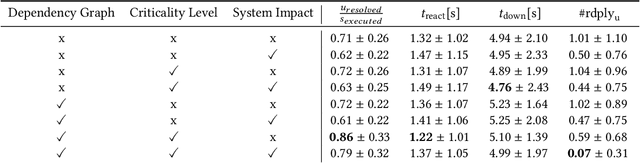
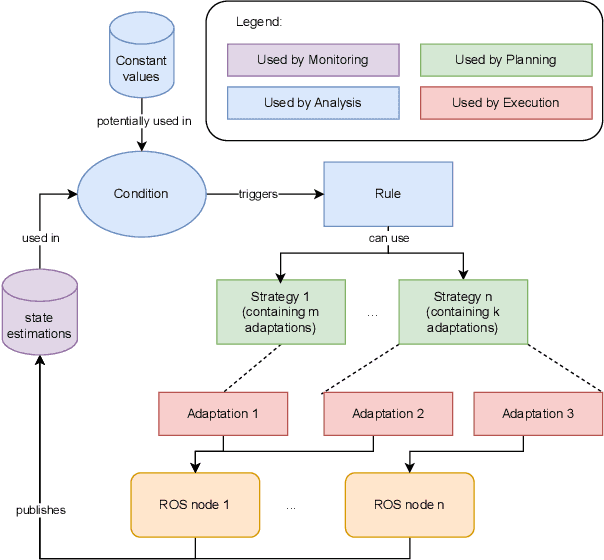
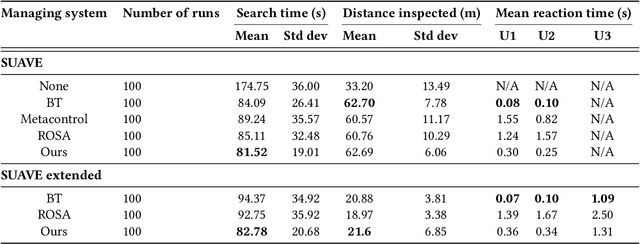

In recent years, the field of robotics has witnessed a significant shift from operating in structured environments to handling dynamic and unpredictable settings. To tackle these challenges, methodologies from the field of self-adaptive systems enabling these systems to react to unforeseen circumstances during runtime have been applied. The Monitoring-Analysis- Planning-Execution over Knowledge (MAPE-K) feedback loop model is a popular approach, often implemented in a managing subsystem, responsible for monitoring and adapting a managed subsystem. This work explores the implementation of the MAPE- K feedback loop based on Behavior Trees (BTs) within the Robot Operating System 2 (ROS2) framework. By delineating the managed and managing subsystems, our approach enhances the flexibility and adaptability of ROS-based systems, ensuring they not only meet Quality-of-Service (QoS), but also system health metric requirements, namely availability of ROS nodes and communication channels. Our implementation allows for the application of the method to new managed subsystems without needing custom BT nodes as the desired behavior can be configured within a specific rule set. We demonstrate the effectiveness of our method through various experiments on a system showcasing an aerial perception use case. By evaluating different failure cases, we show both an increased perception quality and a higher system availability. Our code is open source