 Add to Chrome
 Add to Firefox
 Add to Edge
$f$-FUM: Federated Unlearning via min--max and $f$-divergence
Feb 05, 2026
Federated Learning (FL) has emerged as a powerful paradigm for collaborative machine learning across decentralized data sources, preserving privacy by keeping data local. However, increasing legal and ethical demands, such as the "right to be forgotten", and the need to mitigate data poisoning attacks have underscored the urgent necessity for principled data unlearning in FL. Unlike centralized settings, the distributed nature of FL complicates the removal of individual data contributions. In this paper, we propose a novel federated unlearning framework formulated as a min-max optimization problem, where the objective is to maximize an $f$-divergence between the model trained with all data and the model retrained without specific data points, while minimizing the degradation on retained data. Our framework could act like a plugin and be added to almost any federated setup, unlike SOTA methods like (\cite{10269017} which requires model degradation in server, or \cite{khalil2025notfederatedunlearningweight} which requires to involve model architecture and model weights). This formulation allows for efficient approximation of data removal effects in a federated setting. We provide empirical evaluations to show that our method achieves significant speedups over naive retraining, with minimal impact on utility.

Robust Semi-supervised Learning via $f$-Divergence and $α$-Rényi Divergence
May 01, 2024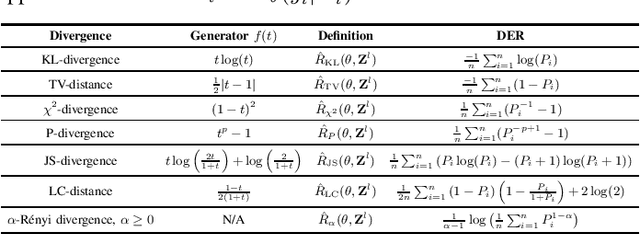
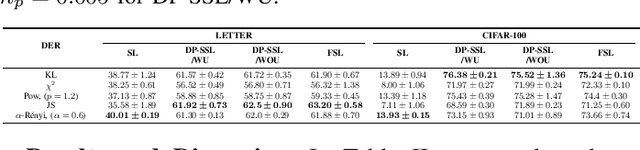
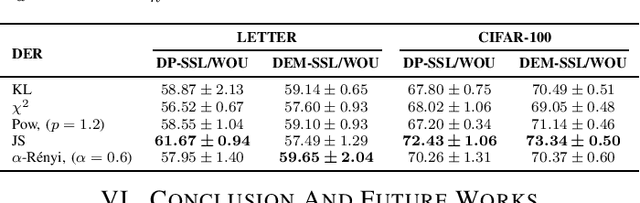
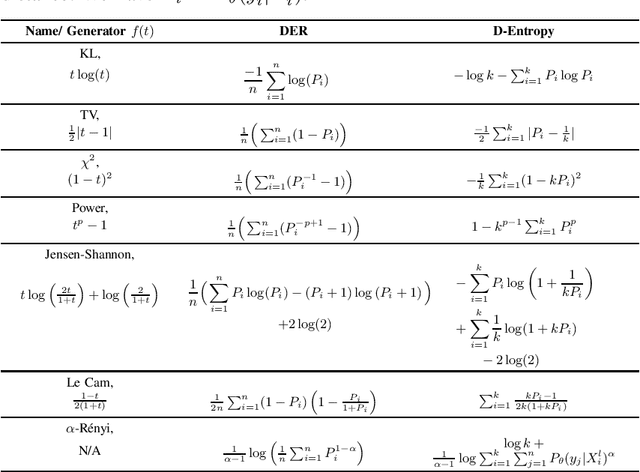
This paper investigates a range of empirical risk functions and regularization methods suitable for self-training methods in semi-supervised learning. These approaches draw inspiration from various divergence measures, such as $f$-divergences and $\alpha$-R\'enyi divergences. Inspired by the theoretical foundations rooted in divergences, i.e., $f$-divergences and $\alpha$-R\'enyi divergence, we also provide valuable insights to enhance the understanding of our empirical risk functions and regularization techniques. In the pseudo-labeling and entropy minimization techniques as self-training methods for effective semi-supervised learning, the self-training process has some inherent mismatch between the true label and pseudo-label (noisy pseudo-labels) and some of our empirical risk functions are robust, concerning noisy pseudo-labels. Under some conditions, our empirical risk functions demonstrate better performance when compared to traditional self-training methods.