 Add to Chrome
 Add to Firefox
 Add to Edge
Learning Subsystem Dynamics in Nonlinear Systems via Port-Hamiltonian Neural Networks
Nov 08, 2024
Port-Hamiltonian neural networks (pHNNs) are emerging as a powerful modeling tool that integrates physical laws with deep learning techniques. While most research has focused on modeling the entire dynamics of interconnected systems, the potential for identifying and modeling individual subsystems while operating as part of a larger system has been overlooked. This study addresses this gap by introducing a novel method for using pHNNs to identify such subsystems based solely on input-output measurements. By utilizing the inherent compositional property of the port-Hamiltonian systems, we developed an algorithm that learns the dynamics of individual subsystems, without requiring direct access to their internal states. On top of that, by choosing an output error (OE) model structure, we have been able to handle measurement noise effectively. The effectiveness of the proposed approach is demonstrated through tests on interconnected systems, including multi-physics scenarios, demonstrating its potential for identifying subsystem dynamics and facilitating their integration into new interconnected models.

Identification of the nonlinear steering dynamics of an autonomous vehicle
May 10, 2021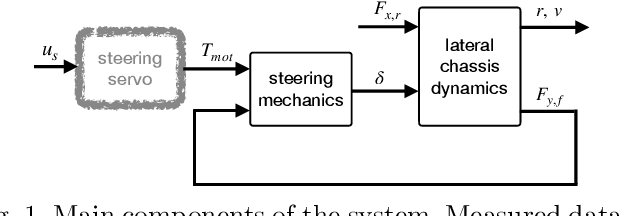
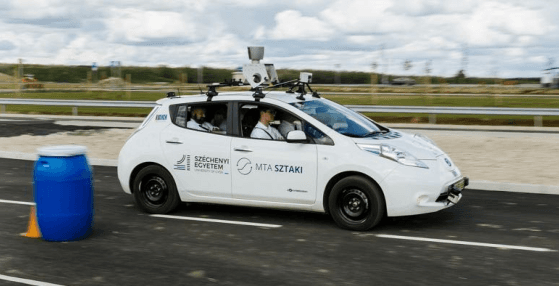
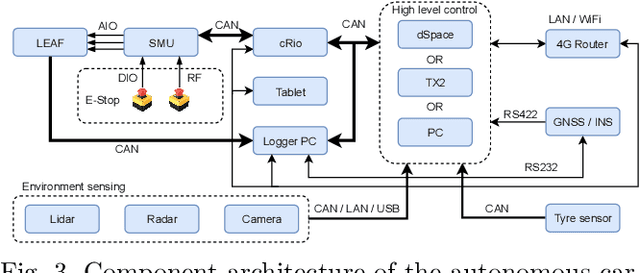
Automated driving applications require accurate vehicle specific models to precisely predict and control the motion dynamics. However, modern vehicles have a wide array of digital and mechatronic components that are difficult to model, manufactures do not disclose all details required for modelling and even existing models of subcomponents require coefficient estimation to match the specific characteristics of each vehicle and their change over time. Hence, it is attractive to use data-driven modelling to capture the relevant vehicle dynamics and synthesise model-based control solutions. In this paper, we address identification of the steering system of an autonomous car based on measured data. We show that the underlying dynamics are highly nonlinear and challenging to be captured, necessitating the use of data-driven methods that fuse the approximation capabilities of learning and the efficiency of dynamic system identification. We demonstrate that such a neural network based subspace-encoder method can successfully capture the underlying dynamics while other methods fall short to provide reliable results.