 Add to Chrome
 Add to Firefox
 Add to Edge
PGUDA: Pressure-Guided Unsupervised Domain Adaptation with Cross-Modal Knowledge Distillation for sEMG-Based Gesture Recognition
Jun 30, 2026
Surface electromyography (sEMG)-based gesture recognition has emerged as a promising technology for natural human-computer interaction. However, its practical deployment remains challenging due to severe performance degradation caused by feature distribution discrepancies across different subjects and recording sessions. Although domain adaptation (DA) techniques are commonly employed to mitigate such discrepancies, conventional methods often struggle to effectively aligning sEMG features, primarily due to their inherent stochasticity and the scarcity of labeled data. To address these limitations, this paper proposes a novel Pressure-Guided Unsupervised Domain Adaptation (PGUDA) framework, which leverages the robustness and stability of pressure signals to introduce a cross-modal knowledge distillation strategy that transfers consistent physical semantics across modalities. Specifically, a teacher network trained on pressure signals guides an sEMG student network on unlabeled target domains, thereby regularizing the representation learning process with transferable and modality-invariant knowledge. Extensive experiments conducted on a self-collected multimodal dataset involving eleven subjects validate the effectiveness of the proposed PGUDA framework. The results demonstrate that our proposed PGUDA achieves leading performance in both cross-subject and cross-session classification tasks, achieving average accuracies of 58.08% and substantially outperforming existing DA approaches. Notably, PGUDA exhibits remarkable label efficiency: it attains classification accuracy comparable to fully supervised benchmarks while requiring only 5% of labeled data for teacher network training. This framework offers a robust and data-efficient solution that can significantly reduce the calibration burden in practical sEMG-based gesture recognition systems.

EEG-DG: A Multi-Source Domain Generalization Framework for Motor Imagery EEG Classification
Nov 09, 2023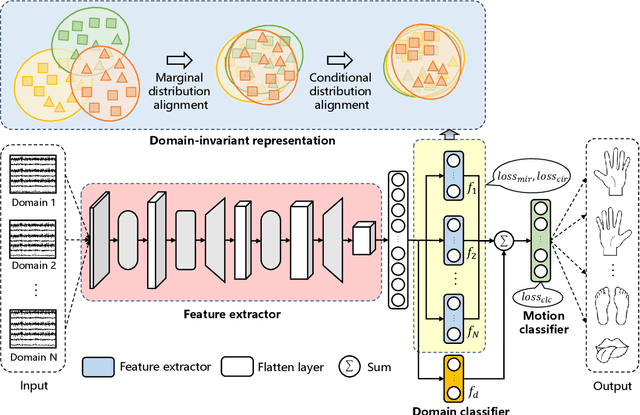
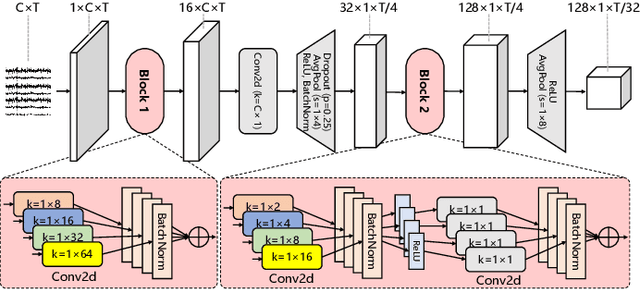

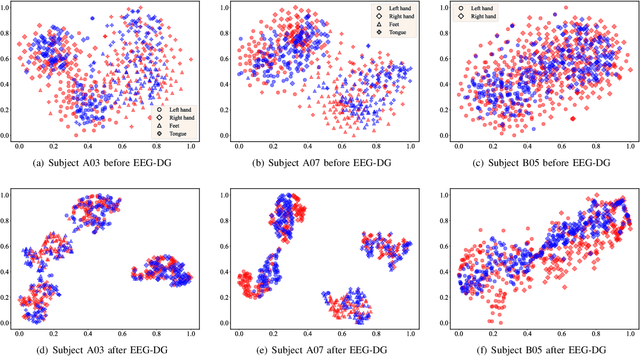
Motor imagery EEG classification plays a crucial role in non-invasive Brain-Computer Interface (BCI) research. However, the classification is affected by the non-stationarity and individual variations of EEG signals. Simply pooling EEG data with different statistical distributions to train a classification model can severely degrade the generalization performance. To address this issue, the existing methods primarily focus on domain adaptation, which requires access to the target data during training. This is unrealistic in many EEG application scenarios. In this paper, we propose a novel multi-source domain generalization framework called EEG-DG, which leverages multiple source domains with different statistical distributions to build generalizable models on unseen target EEG data. We optimize both the marginal and conditional distributions to ensure the stability of the joint distribution across source domains and extend it to a multi-source domain generalization framework to achieve domain-invariant feature representation, thereby alleviating calibration efforts. Systematic experiments on a simulative dataset and BCI competition datasets IV-2a and IV-2b demonstrate the superiority of our proposed EEG-DG over state-of-the-art methods. Specifically, EEG-DG achieves an average classification accuracy/kappa value of 81.79%/0.7572 and 87.12%/0.7424 on datasets IV-2a and IV-2b, respectively, which even outperforms some domain adaptation methods. Our code is available at https://github.com/XC-ZhongHIT/EEG-DG for free download and evaluation.