 Add to Chrome
 Add to Firefox
 Add to Edge
Tractable Weighted First-Order Model Counting with Bounded Treewidth Binary Evidence
Nov 12, 2025
The Weighted First-Order Model Counting Problem (WFOMC) asks to compute the weighted sum of models of a given first-order logic sentence over a given domain. Conditioning WFOMC on evidence -- fixing the truth values of a set of ground literals -- has been shown impossible in time polynomial in the domain size (unless $\mathsf{\#P \subseteq FP}$) even for fragments of logic that are otherwise tractable for WFOMC without evidence. In this work, we address the barrier by restricting the binary evidence to the case where the underlying Gaifman graph has bounded treewidth. We present a polynomial-time algorithm in the domain size for computing WFOMC for the two-variable fragments $\text{FO}^2$ and $\text{C}^2$ conditioned on such binary evidence. Furthermore, we show the applicability of our algorithm in combinatorial problems by solving the stable seating arrangement problem on bounded-treewidth graphs of bounded degree, which was an open problem. We also conducted experiments to show the scalability of our algorithm compared to the existing model counting solvers.

Bridging Weighted First Order Model Counting and Graph Polynomials
Jul 16, 2024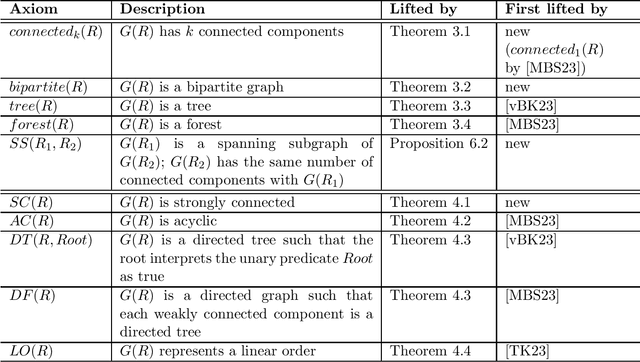


The Weighted First-Order Model Counting Problem (WFOMC) asks to compute the weighted sum of models of a given first-order logic sentence over a given domain. It can be solved in time polynomial in the domain size for sentences from the two-variable fragment with counting quantifiers, known as $C^2$. This polynomial-time complexity is also retained when extending $C^2$ by one of the following axioms: linear order axiom, tree axiom, forest axiom, directed acyclic graph axiom or connectedness axiom. An interesting question remains as to which other axioms can be added to the first-order sentences in this way. We provide a new perspective on this problem by associating WFOMC with graph polynomials. Using WFOMC, we define Weak Connectedness Polynomial and Strong Connectedness Polynomials for first-order logic sentences. It turns out that these polynomials have the following interesting properties. First, they can be computed in polynomial time in the domain size for sentences from $C^2$. Second, we can use them to solve WFOMC with all of the existing axioms known to be tractable as well as with new ones such as bipartiteness, strong connectedness, being a spanning subgraph, having $k$ connected components, etc. Third, the well-known Tutte polynomial can be recovered as a special case of the Weak Connectedness Polynomial, and the Strict and Non-Strict Directed Chromatic Polynomials can be recovered from the Strong Connectedness Polynomials, which allows us to show that these important graph polynomials can be computed in time polynomial in the number of vertices for any graph that can be encoded by a fixed $C^2$ sentence and a conjunction of an arbitrary number of ground unary literals.