 Add to Chrome
 Add to Firefox
 Add to Edge
Latent-Hysteresis Graph ODEs: Modeling Coupled Topology-Feature Evolution via Continuous Phase Transitions
Apr 27, 2026
Graph neural ordinary differential equations (Graph ODEs) extend graph learning from discrete message-passing layers to continuous-time representation flows. While it supports adaptive long-range propagation, we show that Graph ODEs with strictly positive irreducible mixing operators face an inherent \emph{monostability trap}: in the long-time regime, information leakage is unavoidable and the dynamics converge to a single global consensus attractor. We propose the \textbf{Hysteresis Graph ODE (HGODE)}, which couples feature evolution with a latent topological potential driven by a learned pairwise force. A double-well edge potential and bipolarized gate allow edge states to polarize into connected or insulated phases while preserving differentiability. We provide asymptotic analysis of the collapse mechanism and the proposed hysteretic topology dynamics, and validate HGODE on theory-driven synthetic diagnostics and real-world graph benchmarks.

Distance-Misaligned Training in Graph Transformers and Adaptive Graph-Aware Control
Apr 24, 2026Graph Transformers can mix information globally, but this flexibility also creates failure modes: some tasks require long-range communication while others are better served by local interaction. We study this through a synthetic node-classification benchmark on contextual stochastic block model graphs, where labels are generated by a controllable mixture of local and far-shell signals. We define distance-misaligned training as a mismatch between where label-relevant information lies and where the model allocates communication over graph distance. On this benchmark, we find three points. First, the preferred graph-distance bias changes systematically with task locality. Second, an oracle adaptive controller, given offline access to the task-side distance target, nearly matches the best fixed bias across regimes and strongly improves over a neutral baseline on mixed and local tasks. Third, a task-agnostic zero-gap controller is weaker, indicating that adaptation alone is not enough and that the control target matters. These results suggest that distance-resolved diagnosis is useful for understanding Graph Transformer failures and for designing graph-aware control.
Diff-ETS: Learning a Diffusion Probabilistic Model for Electromyography-to-Speech Conversion
May 11, 2024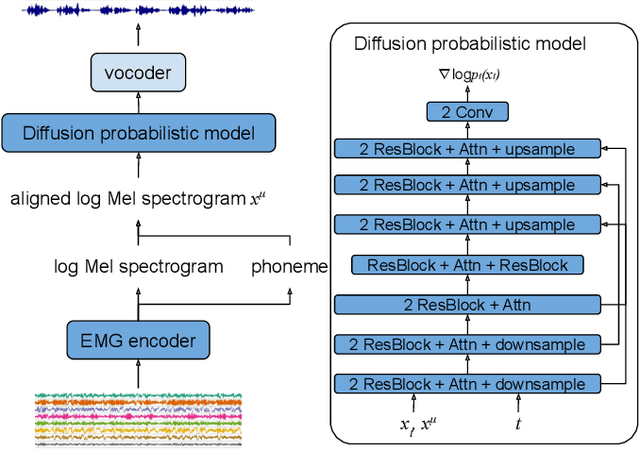
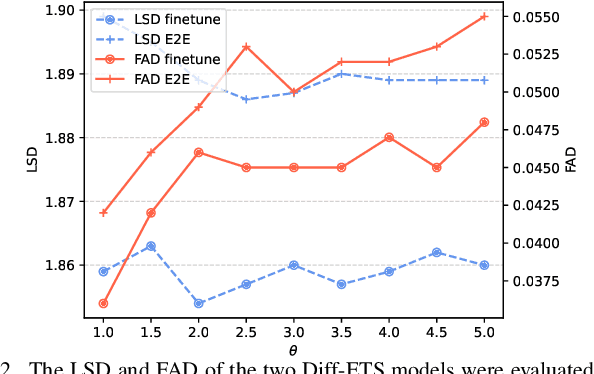
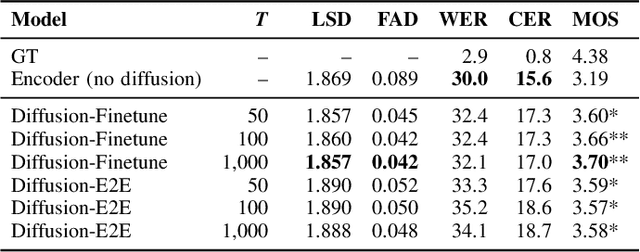
Electromyography-to-Speech (ETS) conversion has demonstrated its potential for silent speech interfaces by generating audible speech from Electromyography (EMG) signals during silent articulations. ETS models usually consist of an EMG encoder which converts EMG signals to acoustic speech features, and a vocoder which then synthesises the speech signals. Due to an inadequate amount of available data and noisy signals, the synthesised speech often exhibits a low level of naturalness. In this work, we propose Diff-ETS, an ETS model which uses a score-based diffusion probabilistic model to enhance the naturalness of synthesised speech. The diffusion model is applied to improve the quality of the acoustic features predicted by an EMG encoder. In our experiments, we evaluated fine-tuning the diffusion model on predictions of a pre-trained EMG encoder, and training both models in an end-to-end fashion. We compared Diff-ETS with a baseline ETS model without diffusion using objective metrics and a listening test. The results indicated the proposed Diff-ETS significantly improved speech naturalness over the baseline.