 Add to Chrome
 Add to Firefox
 Add to Edge
MSCGC-KAN: Multi-scale Causal Graph Convolution and Kolmogorov-Arnold Feature Mapping for EEG Emotion Recognition
May 27, 2026
Electroencephalogram (EEG)-based emotion recognition is an important affective computing task, and recent EEG foundation models provide useful generic representations for downstream adaptation. However, under the fine-tuning setting, three limitations remain prominent: insufficient modeling of multi-scale emotional dynamics, inadequate exploitation of inter-channel functional connectivity, and the limited expressive power of simple linear classification heads. To address these issues, this paper proposes a new EEG emotion recognition method, termed MSCGC-KAN, which introduces a structured task head composed of multi-scale causal graph convolution and Kolmogorov--Arnold feature mapping. Built on a pre-trained CBraMod backbone, MSCGC-KAN enhances downstream adaptation by jointly strengthening multi-scale temporal modeling, learnable inter-channel connectivity modeling, and nonlinear discriminative mapping within a compact task-specific head. This design preserves the representation advantage of the foundation model while making the classifier more sensitive to emotion-related spatiotemporal patterns. Extensive experiments are conducted on the public FACED and SEED-VII datasets. The proposed method achieves a balanced accuracy of 60.66\%, a Cohen's Kappa of 0.5525, and a weighted F1-score of 60.40\% on FACED, and obtains 33.27\%, 0.2223, and 33.64\%, respectively, on SEED-VII. Compared with the CBraMod+Linear baseline, the balanced accuracy is improved by 5.91 and 2.03 percentage points on the two datasets, respectively. These results indicate that structured task-head design is an effective way to improve EEG emotion recognition when fine-tuning pre-trained EEG models.

Subject-Aware Multi-Granularity Alignment for Zero-Shot EEG-to-Image Retrieval
Apr 20, 2026Zero-shot EEG-to-image retrieval aims to decode perceived visual content from electroencephalography (EEG) by aligning neural responses with pretrained visual representations, providing a promising route toward scalable visual neural decoding and practical brain-computer interfaces. However, robust EEG-to-image retrieval remains challenging, because prior methods usually rely on either a single fixed visual target or a subject-invariant target construction scheme. Such designs overlook two important properties of visually evoked EEG signals: they preserve information across multiple representational scales, and the visual granularity best matched to EEG may vary across subjects. To address these issues, subject-aware multi-granularity alignment (SAMGA) framework is proposed for zero-shot EEG-to-image retrieval. SAMGA first constructs a subject-aware visual supervision target by adaptively aggregating multiple intermediate representations from a pretrained vision encoder, allowing the model to absorb subject-dependent granularity deviations during training while preserving subject-agnostic inference. Building on this adaptive target construction, a coarse-to-fine cross-modal alignment strategy is further designed with a shared encoder wherein the coarse stage stabilizes the shared semantic geometry and reduces subject-induced distribution shift, and the fine stage further improves instance-level retrieval discrimination. Extensive experiments on the THINGS-EEG benchmark demonstrate that the proposed method achieves 91.3% Top-1 and 98.8% Top-5 accuracy in the intra-subject setting, and 34.4% Top-1 and 64.8% Top-5 accuracy in the inter-subject setting, outperforming recent state-of-the-art methods.
LUCF-Net: Lightweight U-shaped Cascade Fusion Network for Medical Image Segmentation
Apr 11, 2024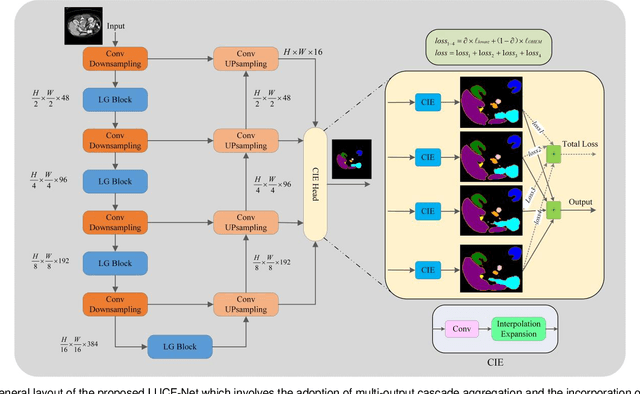
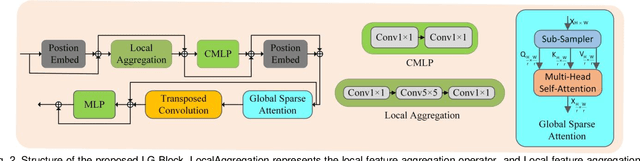
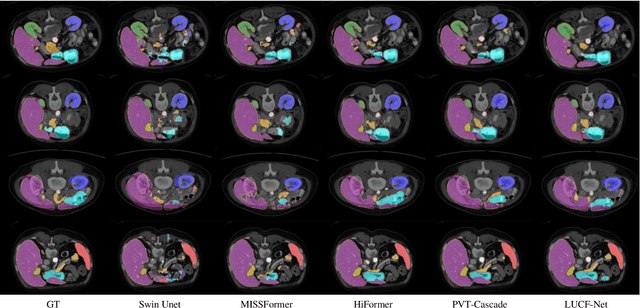
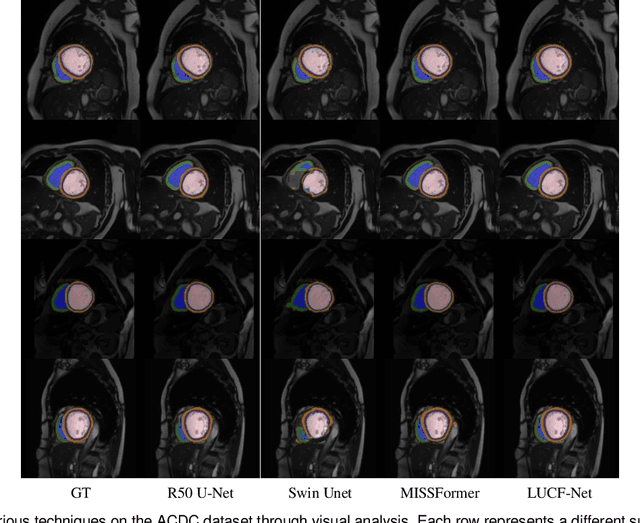
In this study, the performance of existing U-shaped neural network architectures was enhanced for medical image segmentation by adding Transformer. Although Transformer architectures are powerful at extracting global information, its ability to capture local information is limited due to its high complexity. To address this challenge, we proposed a new lightweight U-shaped cascade fusion network (LUCF-Net) for medical image segmentation. It utilized an asymmetrical structural design and incorporated both local and global modules to enhance its capacity for local and global modeling. Additionally, a multi-layer cascade fusion decoding network was designed to further bolster the network's information fusion capabilities. Validation results achieved on multi-organ datasets in CT format, cardiac segmentation datasets in MRI format, and dermatology datasets in image format demonstrated that the proposed model outperformed other state-of-the-art methods in handling local-global information, achieving an improvement of 1.54% in Dice coefficient and 2.6 mm in Hausdorff distance on multi-organ segmentation. Furthermore, as a network that combines Convolutional Neural Network and Transformer architectures, it achieves competitive segmentation performance with only 6.93 million parameters and 6.6 gigabytes of floating point operations, without the need of pre-training. In summary, the proposed method demonstrated enhanced performance while retaining a simpler model design compared to other Transformer-based segmentation networks.