 Add to Chrome
 Add to Firefox
 Add to Edge
Chronicle: A Multimodal Foundation Model for Joint Language and Time Series Understanding
May 18, 2026
Real-world time series come with text: metadata, descriptions, news, reports. Yet time series foundation models process numerical sequences in isolation, and the multimodal text-and-time-series models that attempt to bridge the two all adapt a pretrained language model post hoc, inheriting representations shaped without ever seeing temporal data. These models are also evaluated almost exclusively against other multimodal baselines, not against the strongest unimodal foundation models in either domain, leaving open whether joint training is needed at all. We present Chronicle, a compact 324M-parameter decoder-only transformer trained from scratch on natural language and time series within a single unified architecture. Both modalities share the same transformer blocks, attention mechanism, and residual stream; the bulk of pretraining uses unimodal batches so cross-modal capability emerges purely from shared parameters, with a short alignment stage that interleaves the two. To our knowledge, Chronicle is the first model jointly pretrained on text and time series from scratch, and the first multimodal model evaluated against dedicated foundation models in both domains. It matches Gemma-3-270M-PT on 19 NLU tasks, sets a new bar for frozen-embedding time series classification on 24 UCR/UEA datasets, and produces multimodal forecasts on Time-MMD that beat every supervised fusion baseline, all from a single backbone.

ADAPTive Input Training for Many-to-One Pre-Training on Time-Series Classification
Apr 09, 2026Recent work on time-series models has leveraged self-supervised training to learn meaningful features and patterns in order to improve performance on downstream tasks and generalize to unseen modalities. While these pretraining methods have shown great promise in one-to-many scenarios, where a model is pre-trained on one dataset and fine-tuned on a downstream dataset, they have struggled to generalize to new datasets when more datasets are added during pre-training. This is a fundamental challenge in building foundation models for time-series data, as it limits the ability to develop models that can learn from a large variety of diverse datasets available. To address this challenge, we present a new pre-training paradigm for time-series data called ADAPT, which can efficiently align the physical properties of data in the time-series domain, enabling mixed-batch pre-training despite the extreme discrepancies in the input sizes and channel dimensions of pre-training data. We trained on 162 time-series classification datasets and set new state-of-the-art performance for classification benchmarks. We successfully train a model within the time-series domain on a wide range of datasets simultaneously, which is a major building block for building generalist foundation models in time-series domains.
Chat-TS: Enhancing Multi-Modal Reasoning Over Time-Series and Natural Language Data
Mar 13, 2025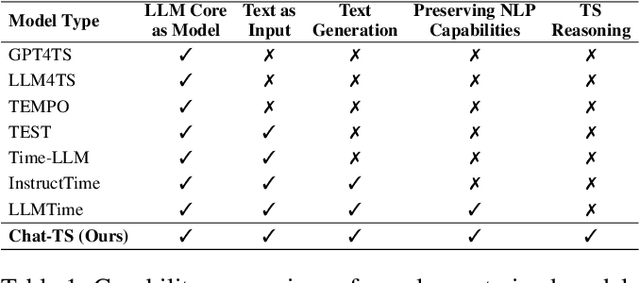
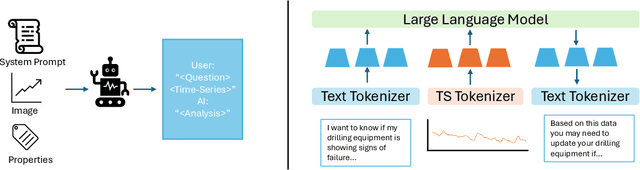
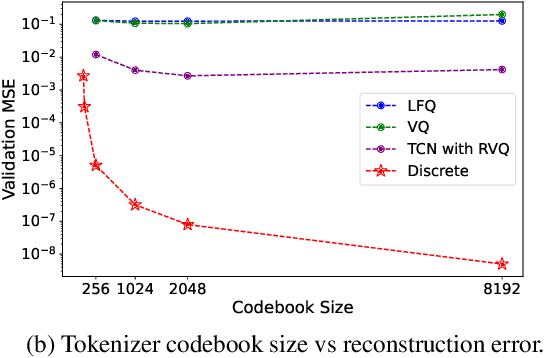
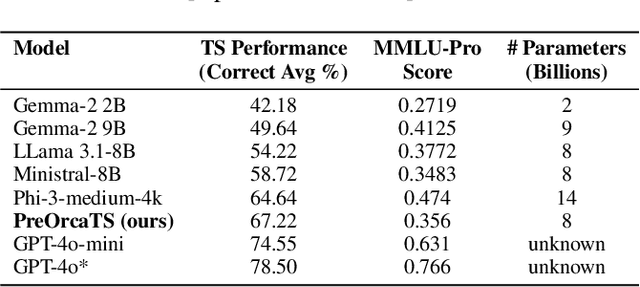
Time-series analysis is critical for a wide range of fields such as healthcare, finance, transportation, and energy, among many others. The practical applications often involve analyzing time-series data alongside contextual information in the form of natural language to support informed decisions. However, current time-series models are limited in their ability to perform reasoning that involves both time-series and their textual content. In this work, we address this gap by introducing \textit{Chat-TS}, a large language model (LLM) based framework, designed to support reasoning over time series and textual data. Unlike traditional models, Chat-TS integrates time-series tokens into LLMs' vocabulary, enhancing its reasoning ability over both modalities without compromising the core natural language capabilities, enabling practical analysis and reasoning across modalities. To support learning and evaluation in this setup, we contribute new datasets: the \textit{TS Instruct Training Dataset} which pairs diverse time-series data with relevant text instructions and responses for instruction tuning, the \textit{TS Instruct Question and Answer (QA) Gold Dataset} which provides multiple-choice questions designed to evaluate multimodal reasoning, and a \textit{TS Instruct Quantitative Probing Set} which contains a small subset of the TS Instruct QA tasks alongside math and decision-making questions for LLM evaluation. We designed a training strategy to preserve the inherent reasoning capabilities of LLMs while augmenting them for time-series reasoning. Experiments show that Chat-TS achieves state-of-the-art performance in multi-modal reasoning tasks by maintaining strong natural language proficiency while improving time-series reasoning. ~\footnote{To ensure replicability and facilitate future research, all models, datasets, and code will be available at [\texttt{Github-URL}].}
GFDC: A Granule Fusion Density-Based Clustering with Evidential Reasoning
May 20, 2023
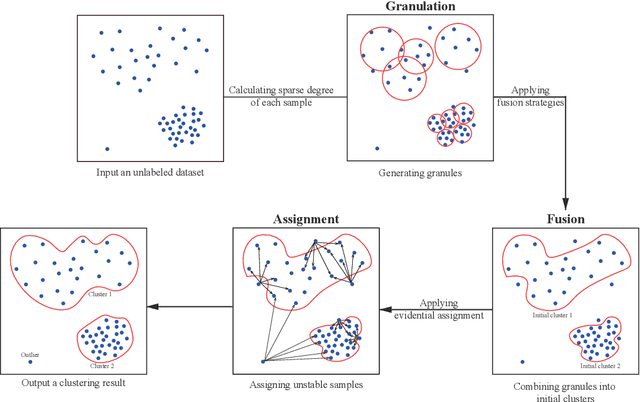
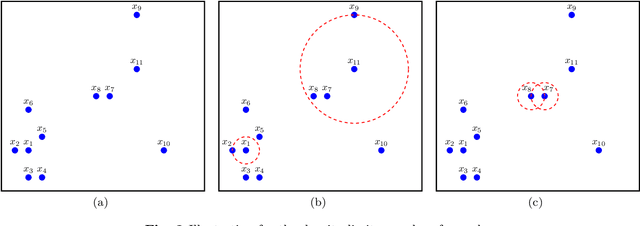
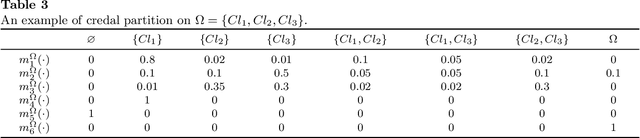
Currently, density-based clustering algorithms are widely applied because they can detect clusters with arbitrary shapes. However, they perform poorly in measuring global density, determining reasonable cluster centers or structures, assigning samples accurately and handling data with large density differences among clusters. To overcome their drawbacks, this paper proposes a granule fusion density-based clustering with evidential reasoning (GFDC). Both local and global densities of samples are measured by a sparse degree metric first. Then information granules are generated in high-density and low-density regions, assisting in processing clusters with significant density differences. Further, three novel granule fusion strategies are utilized to combine granules into stable cluster structures, helping to detect clusters with arbitrary shapes. Finally, by an assignment method developed from Dempster-Shafer theory, unstable samples are assigned. After using GFDC, a reasonable clustering result and some identified outliers can be obtained. The experimental results on extensive datasets demonstrate the effectiveness of GFDC.