 Add to Chrome
 Add to Firefox
 Add to Edge
FAME: Forecastability-Aware Mixture of Experts for Heterogeneous Time Series Forecasting
Jun 08, 2026
Large-scale retail and industrial forecasting systems contain many heterogeneous time series whose lifecycle, sparsity, volatility, seasonality, spectral patterns, and contextual sensitivity differ substantially. A single forecasting model rarely performs well across all regimes, while dense ensembles increase inference cost and provide limited insight into expert suitability. This paper studies forecastability-aware expert routing: learning how data characteristics determine the suitability of forecasting experts. We propose \method{}, a sparse mixture-of-experts framework that represents each series with a multidimensional forecastability fingerprint, mines expert-suitability targets from validation performance, and trains a cost-aware sparse router to activate a small budgeted set of experts for each series. Using a production-scale vending-machine sales dataset from Shandong New Beiyang (SNBC), where the forecasting component has been integrated into the replenishment-planning pipeline, together with public retail benchmarks, we show that expert suitability varies systematically across data regimes. On the industrial dataset with 5,000+ machines and 60M+ transactions, \method{} Top-2 reduces MSE by 12.4\% over the strongest single expert, LightGBM, while executing 1.92 experts per series on average. The deployed component produces demand forecasts, while inventory-oriented gains are estimated by an offline replay simulator under a fixed replenishment policy rather than by online intervention. The framework turns heterogeneous sales forecasting from heuristic model selection into data mining of forecastability patterns and expert specialization. Code is available at https://github.com/hit636/FAME

ASGMamba: Adaptive Spectral Gating Mamba for Multivariate Time Series Forecasting
Feb 02, 2026Long-term multivariate time series forecasting (LTSF) plays a crucial role in various high-performance computing applications, including real-time energy grid management and large-scale traffic flow simulation. However, existing solutions face a dilemma: Transformer-based models suffer from quadratic complexity, limiting their scalability on long sequences, while linear State Space Models (SSMs) often struggle to distinguish valuable signals from high-frequency noise, leading to wasted state capacity. To bridge this gap, we propose ASGMamba, an efficient forecasting framework designed for resource-constrained supercomputing environments. ASGMamba integrates a lightweight Adaptive Spectral Gating (ASG) mechanism that dynamically filters noise based on local spectral energy, enabling the Mamba backbone to focus its state evolution on robust temporal dynamics. Furthermore, we introduce a hierarchical multi-scale architecture with variable-specific Node Embeddings to capture diverse physical characteristics. Extensive experiments on nine benchmarks demonstrate that ASGMamba achieves state-of-the-art accuracy. While keeping strictly $$\mathcal{O}(L)$$ complexity we significantly reduce the memory usage on long-horizon tasks, thus establishing ASGMamba as a scalable solution for high-throughput forecasting in resource limited environments.The code is available at https://github.com/hit636/ASGMamba
AWEMixer: Adaptive Wavelet-Enhanced Mixer Network for Long-Term Time Series Forecasting
Nov 06, 2025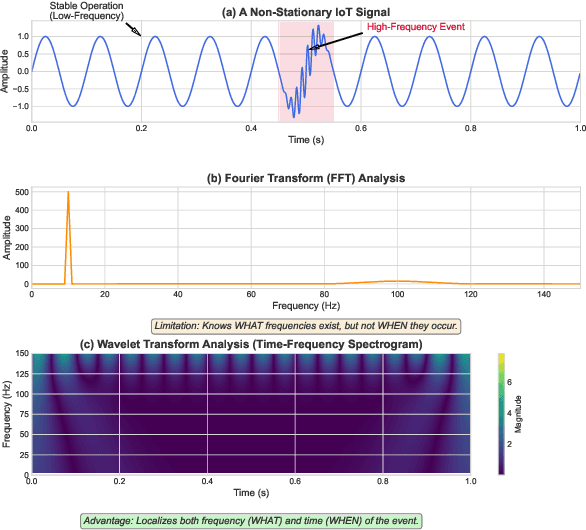
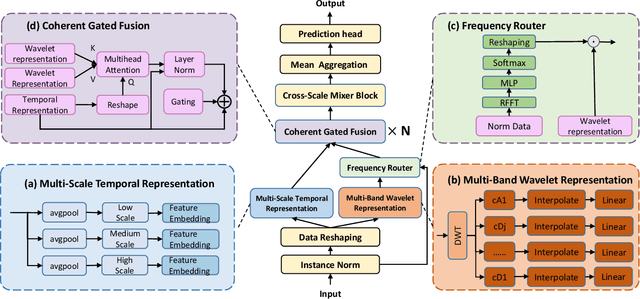
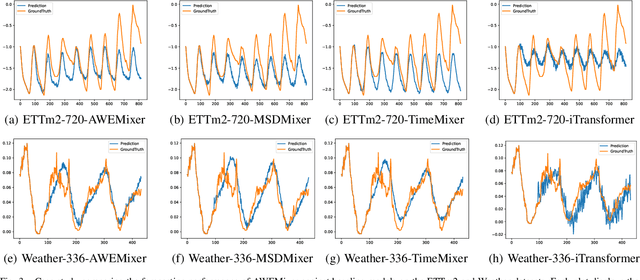
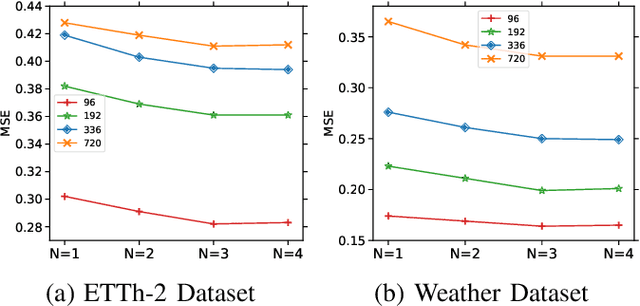
Forecasting long-term time series in IoT environments remains a significant challenge due to the non-stationary and multi-scale characteristics of sensor signals. Furthermore, error accumulation causes a decrease in forecast quality when predicting further into the future. Traditional methods are restricted to operate in time-domain, while the global frequency information achieved by Fourier transform would be regarded as stationary signals leading to blur the temporal patterns of transient events. We propose AWEMixer, an Adaptive Wavelet-Enhanced Mixer Network including two innovative components: 1) a Frequency Router designs to utilize the global periodicity pattern achieved by Fast Fourier Transform to adaptively weight localized wavelet subband, and 2) a Coherent Gated Fusion Block to achieve selective integration of prominent frequency features with multi-scale temporal representation through cross-attention and gating mechanism, which realizes accurate time-frequency localization while remaining robust to noise. Seven public benchmarks validate that our model is more effective than recent state-of-the-art models. Specifically, our model consistently achieves performance improvement compared with transformer-based and MLP-based state-of-the-art models in long-sequence time series forecasting. Code is available at https://github.com/hit636/AWEMixer
DPANet: Dual Pyramid Attention Network for Multivariate Time Series Forecasting
Sep 18, 2025We conducted rigorous ablation studies to validate DPANet's key components (Table \ref{tab:ablation-study}). The full model consistently outperforms all variants. To test our dual-domain hypothesis, we designed two specialized versions: a Temporal-Only model (fusing two identical temporal pyramids) and a Frequency-Only model (fusing two spectral pyramids). Both variants underperformed significantly, confirming that the fusion of heterogeneous temporal and frequency information is critical. Furthermore, replacing the cross-attention mechanism with a simpler method (w/o Cross-Fusion) caused the most severe performance degradation. This result underscores that our interactive fusion block is the most essential component.