 Add to Chrome
 Add to Firefox
 Add to Edge
Wnuan: Staged Post-Training for Question Answering over Proprietary Enterprise Knowledge
Aug 03, 2026
Enterprise question answering requires models to acquire proprietary knowledge without discarding general capabilities. We present Wnuan, a three-stage pipeline that constructs task-oriented supervision from documents, performs supervised fine-tuning with general-data replay, and applies reinforcement learning to residual errors. On the 707-question WnuanBench, the primary 32B route raises acceptable-answer rate (AAR) from 52.76% before adaptation to 80.06% after SFT and 91.51% after RL. Under a matched 100-update protocol, residual-error sampling outperforms full-pool and size-matched random sampling by 3.11 and 2.97 points, respectively. Source-cluster bootstrap intervals remain above zero for both contrasts, and a same-domain validation set preserves the ordering. The general-benchmark average decreases by 5.17 points across the route, concentrated in instruction following. The automatic evaluation ensemble agrees with an authoritative domain expert on 90.5% of a stratified Wnuan-Inst response sample. These results characterize both the gains and the general-capability cost of staged enterprise adaptation.

ChartWalker: Benchmarking the Cross-Chart RAG Task with Hierarchical Knowledge Graphs
Jun 22, 2026Cross-Chart Retrieval-Augmented Generation (RAG) is critical for complex multi-modal analytical tasks in scientific, business, and political domains. However, existing benchmarks either focus on tables, which are well-structured and textualized, or generate cross-chart questions by simply extracting key points, which often induces lexical overlap between queries and evidence and yields logically inconsistent reasoning chains. To address this, we introduce ChartWalker, a novel framework for constructing challenging cross-chart RAG tasks. ChartWalker features a hierarchical knowledge graph construction method tailored to charts, which organizes entities and relations by granularity to preserve analytical structure. We then propose a structure-aware sampling algorithm that synthesizes semantically coherent, multi-hop reasoning paths, enabling explicit control over query difficulty and granularity for QA generation. Built with this framework, we release ChartWalker-Bench, a comprehensive benchmark spanning diverse domains and cross-chart query types. Extensive evaluations across major RAG paradigms reveal significant performance gaps, underscoring the benchmark's difficulty and utility. Furthermore, we provide ChartWalker-Agent, an agentic baseline to facilitate analysis and inspire future system design.
MechVQA: Benchmarking and Enhancing Multimodal LLMs on Comprehensive Mechanical Drawing Understanding
May 29, 2026Multimodal Large Language Models (MLLMs) have demonstrated significant achievements in general visual question answering (VQA) tasks. However, they remain brittle on mechanical engineering drawings, where high annotation density and weak domain knowledge, compounded by unreliable spatial relation reasoning under strict projection rules and geometric constraints, make decisive cues easy to miss and frequently lead to wrong answers. To bridge this gap, we introduce the first comprehensive mechanical drawing understanding dataset, MechVQA, created through a semi-automated construction and quality-control pipeline. MechVQA contains 3.3k high-density pictures with 21K question-answer pairs, spanning 10 different fine-grained tasks across three capability levels: Recognition, Reasoning, and Judging, providing a testbed to evaluate and improve MLLM understanding on real-world mechanical drawings. On top of MechVQA, we then develop the MechVL model through a multi-stage training paradigm, building a strong domain-specialized baseline. Extensive experimental results demonstrate that MechVL outperforms the strongest closed-source baseline by 7.57 percentage points on the MechVQA total score, significantly enhancing mechanical drawing understanding ability and providing a reusable foundation for deploying MLLMs in mechanical design and inspection scenarios.
RAFT: Data Refinement and Adaptive Distillation for Domain Fine-Tuning with Alleviated Forgetting
May 29, 2026Domain-specific supervised fine-tuning (SFT) often improves in-domain performance at the cost of degrading a model's general capabilities. We view this degradation through two practical gaps in domain SFT: a supervision-compatibility gap, where domain targets differ in style and reasoning format from the original model's natural responses, and a trajectory-preservation gap, where teacher-forced SFT optimizes fixed target tokens without constraining the model's behavior on its own generated prefixes. This process fails to preserve the model's original behavior. We propose RAFT (Data Refinement and Adaptive Distillation for Domain Fine-Tuning with Alleviated Forgetting), a two-stage framework that addresses both factors. First, RAFT constructs model-compatible supervision through self-conditioned rewriting, semantic filtering, and answer fusion. Second, RAFT performs Answer-Conditioned On-Policy Distillation, where the original instruction-tuned model provides soft targets on student-generated trajectories while being conditioned on the fused answer as helpful context. We further introduce top-K temperature distillation and EMA-based adaptive loss balancing to stabilize the domain-general trade-off. Across three instruction-tuned backbones and five domains, RAFT improves average domain accuracy by 23.2% over standard SFT, while recovering part of the SFT-induced degradation on MS-Bench and IFEval, with relative improvements of 18.2% and 10.2%, respectively. These results show that coupling data refinement with trajectory-level preservation provides an effective recipe for domain fine-tuning with alleviated forgetting.
Rethinking Supervised Fine-Tuning: Emphasizing Key Answer Tokens for Improved LLM Accuracy
Dec 24, 2025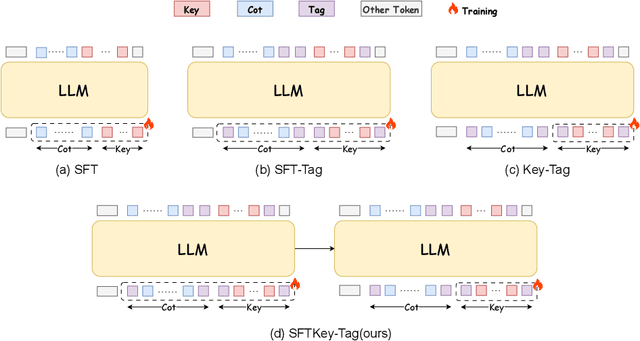
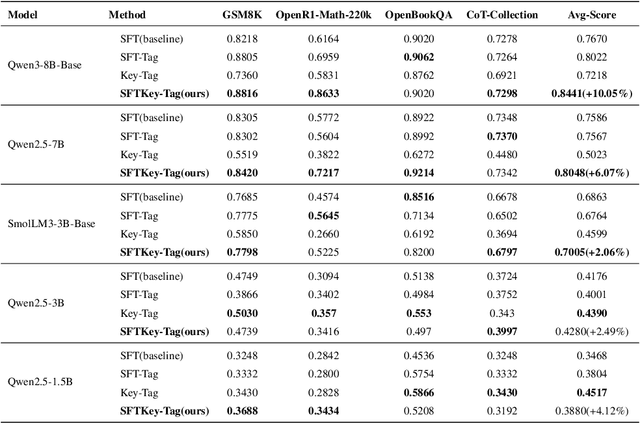
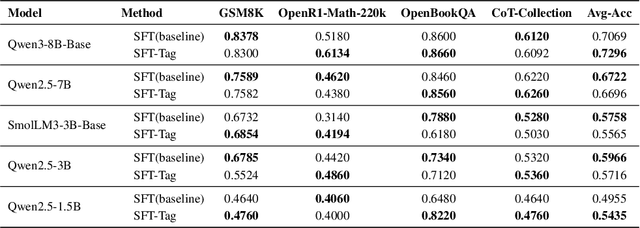
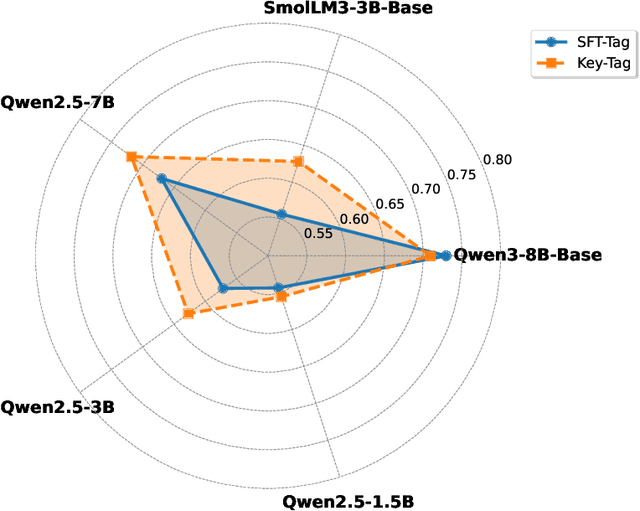
With the rapid advancement of Large Language Models (LLMs), the Chain-of-Thought (CoT) component has become significant for complex reasoning tasks. However, in conventional Supervised Fine-Tuning (SFT), the model could allocate disproportionately more attention to CoT sequences with excessive length. This reduces focus on the much shorter but essential Key portion-the final answer, whose correctness directly determines task success and evaluation quality. To address this limitation, we propose SFTKey, a two-stage training scheme. In the first stage, conventional SFT is applied to ensure proper output format, while in the second stage, only the Key portion is fine-tuned to improve accuracy. Extensive experiments across multiple benchmarks and model families demonstrate that SFTKey achieves an average accuracy improvement exceeding 5\% over conventional SFT, while preserving the ability to generate correct formats. Overall, this study advances LLM fine-tuning by explicitly balancing CoT learning with additional optimization on answer-relevant tokens.
SciSage: A Multi-Agent Framework for High-Quality Scientific Survey Generation
Jun 15, 2025The rapid growth of scientific literature demands robust tools for automated survey-generation. However, current large language model (LLM)-based methods often lack in-depth analysis, structural coherence, and reliable citations. To address these limitations, we introduce SciSage, a multi-agent framework employing a reflect-when-you-write paradigm. SciSage features a hierarchical Reflector agent that critically evaluates drafts at outline, section, and document levels, collaborating with specialized agents for query interpretation, content retrieval, and refinement. We also release SurveyScope, a rigorously curated benchmark of 46 high-impact papers (2020-2025) across 11 computer science domains, with strict recency and citation-based quality controls. Evaluations demonstrate that SciSage outperforms state-of-the-art baselines (LLM x MapReduce-V2, AutoSurvey), achieving +1.73 points in document coherence and +32% in citation F1 scores. Human evaluations reveal mixed outcomes (3 wins vs. 7 losses against human-written surveys), but highlight SciSage's strengths in topical breadth and retrieval efficiency. Overall, SciSage offers a promising foundation for research-assistive writing tools.