 Add to Chrome
 Add to Firefox
 Add to Edge
CTIFoundry: An Agent-Native Corpus Scaffold for Cyber Threat Intelligence
Aug 19, 2026
Cyber threat intelligence (CTI) is increasingly consumed not by human analysts but by LLM agents that compose multi-step investigations at query time. The harness side of this shift has matured rapidly (planning loops, tool protocols, context management), but the corpus side has not: threat reports and vulnerability databases are still packaged for retrieval-augmented generation, as opaque chunks behind an embedding index. We argue that this substrate, not model capability, is the bottleneck on agentic CTI investigation, and present CTIFoundry, an agent-native corpus scaffold. At build time, CTIFoundry materializes the latent structure of a CTI corpus: a deterministic ontology graph over four authoritative knowledge bases (CVE, CWE, CAPEC, ATT&CK) whose official cross-references become typed, traversable edges; a span-grounded report layer whose canonical, alias-resolved cross-vendor entities index provenance-carrying chunks; and hybrid dense+lexical retrieval surfaces. At query time this structure is exposed through seven typed tools and three procedural skills mounted on a stock open-source agent harness. On the public CTIConnect benchmark, swapping only the action surface lifts the identically-harnessed agent by +0.19 to +0.28 overall F1 across a four-model, two-provider panel: a small model on CTIFoundry surpasses a flagship on the flat substrate, and the gain is not bought with search effort, since on both Claude models the scaffolded agent is more accurate at roughly half the tool calls. An ablation attributes it: typed structure carries the larger share, procedural skills convert structure into discipline, and the two compose super-additively, because skills bind only to structure that exists.

TTPrint: Evidence-Grounded TTP Extraction via Diverge-then-Converge Verification
May 25, 2026Extracting MITRE ATT&CK techniques from cyber threat intelligence (CTI) reports is an open-set, multi-label problem requiring both high recall (not missing techniques) and high precision (not hallucinating unsupported ones). Existing methods--rule-based, supervised, and LLM-based--struggle to achieve both: rule-based and supervised approaches lack generalizability across diverse attack descriptions, while LLM-based approaches that couple candidate generation and validation within a single inference step suffer from limited recall and precision simultaneously. We propose TTPrint, which addresses this challenge through a diverge-then-converge design inspired by how human analysts work: first extracting broadly, then verifying rigorously. In the divergent phase, reports are decomposed into atomic behaviors and candidate techniques are proposed broadly. A deterministic span localization stage then anchors each candidate to a specific evidence window in the source text. A convergent verification stage retains only candidates supported by both the localized evidence and the authoritative MITRE definition. We contribute two evaluation resources--a cleaned TRAM benchmark (TRAM-Clean) and a new annotated dataset (TTPrint-Bench)--to address known annotation noise in existing benchmarks and elevate the task to document-level TTP extraction. On TRAM-Clean and TTPrint-Bench, TTPrint achieves 76.48% and 87.39% macro-F1 respectively, outperforming the leading baseline by 63.5% and 29.4%. A multi-backbone analysis across six LLMs and a threshold sensitivity study further demonstrate generalizability across model choices and provide practical guidance for parameter selection.
Deep Context-Conditioned Anomaly Detection for Tabular Data
Sep 10, 2025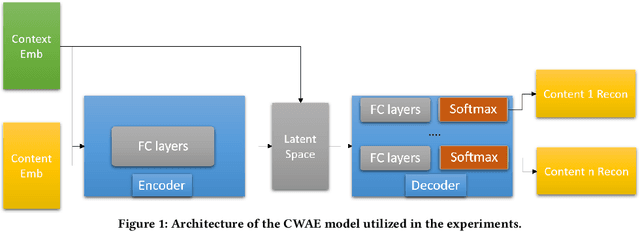
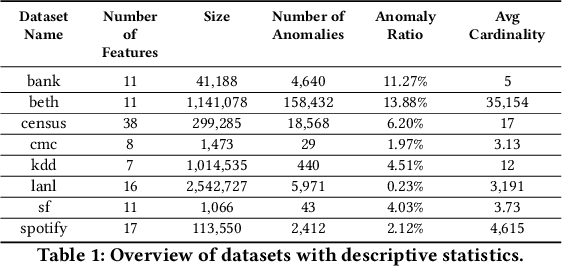
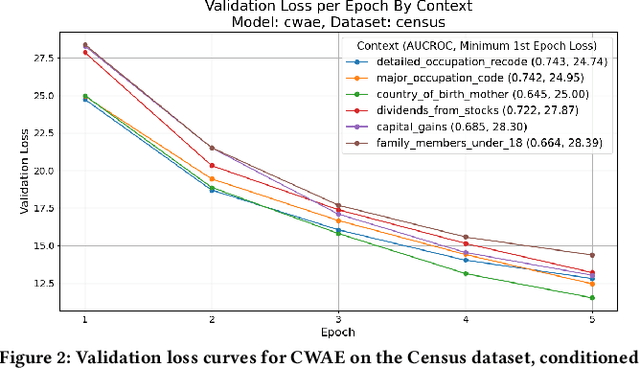
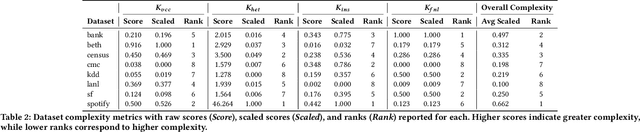
Anomaly detection is critical in domains such as cybersecurity and finance, especially when working with large-scale tabular data. Yet, unsupervised anomaly detection -- where no labeled anomalies are available -- remains a significant challenge. Although various deep learning methods have been proposed to model a dataset's joint distribution, real-world tabular data often contain heterogeneous contexts (e.g., different users), making globally rare events normal under certain contexts. Consequently, relying on a single global distribution can overlook these contextual nuances, degrading detection performance. In this paper, we present a context-conditional anomaly detection framework tailored for tabular datasets. Our approach automatically identifies context features and models the conditional data distribution using a simple deep autoencoder. Extensive experiments on multiple tabular benchmark datasets demonstrate that our method outperforms state-of-the-art approaches, underscoring the importance of context in accurately distinguishing anomalous from normal instances.
Basket-Enhanced Heterogenous Hypergraph for Price-Sensitive Next Basket Recommendation
Sep 18, 2024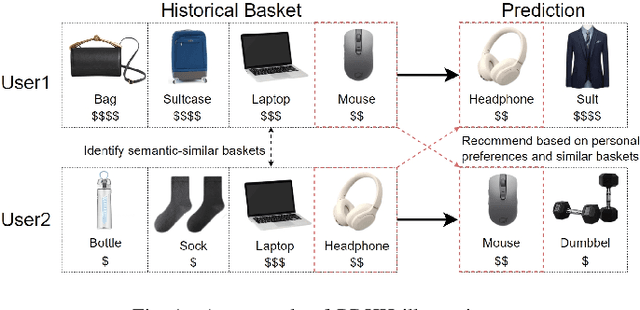
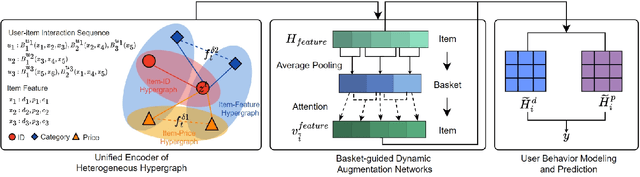
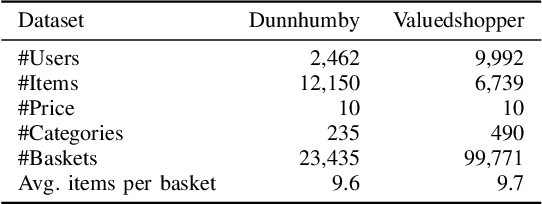
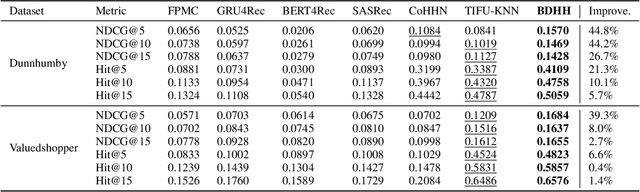
Next Basket Recommendation (NBR) is a new type of recommender system that predicts combinations of items users are likely to purchase together. Existing NBR models often overlook a crucial factor, which is price, and do not fully capture item-basket-user interactions. To address these limitations, we propose a novel method called Basket-augmented Dynamic Heterogeneous Hypergraph (BDHH). BDHH utilizes a heterogeneous multi-relational graph to capture the intricate relationships among item features, with price as a critical factor. Moreover, our approach includes a basket-guided dynamic augmentation network that could dynamically enhances item-basket-user interactions. Experiments on real-world datasets demonstrate that BDHH significantly improves recommendation accuracy, providing a more comprehensive understanding of user behavior.