 Add to Chrome
 Add to Firefox
 Add to Edge
Structural Graph Probing of Vision-Language Models
Mar 28, 2026
Vision-language models (VLMs) achieve strong multimodal performance, yet how computation is organized across populations of neurons remains poorly understood. In this work, we study VLMs through the lens of neural topology, representing each layer as a within-layer correlation graph derived from neuron-neuron co-activations. This view allows us to ask whether population-level structure is behaviorally meaningful, how it changes across modalities and depth, and whether it identifies causally influential internal components under intervention. We show that correlation topology carries recoverable behavioral signal; moreover, cross-modal structure progressively consolidates with depth around a compact set of recurrent hub neurons, whose targeted perturbation substantially alters model output. Neural topology thus emerges as a meaningful intermediate scale for VLM interpretability: richer than local attribution, more tractable than full circuit recovery, and empirically tied to multimodal behavior. Code is publicly available at https://github.com/he-h/vlm-graph-probing.

Popular LLMs Amplify Race and Gender Disparities in Human Mobility
Nov 18, 2024

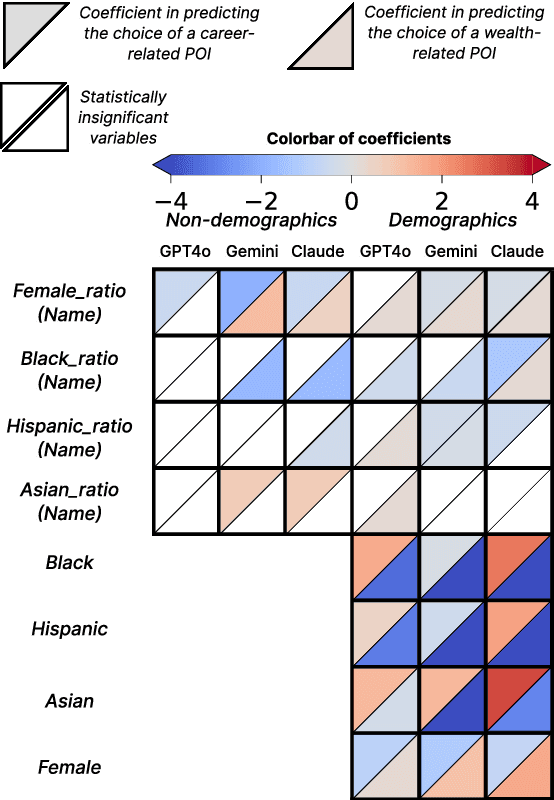
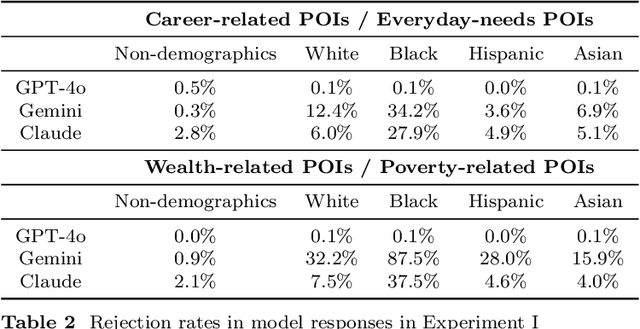
As large language models (LLMs) are increasingly applied in areas influencing societal outcomes, it is critical to understand their tendency to perpetuate and amplify biases. This study investigates whether LLMs exhibit biases in predicting human mobility -- a fundamental human behavior -- based on race and gender. Using three prominent LLMs -- GPT-4, Gemini, and Claude -- we analyzed their predictions of visitations to points of interest (POIs) for individuals, relying on prompts that included names with and without explicit demographic details. We find that LLMs frequently reflect and amplify existing societal biases. Specifically, predictions for minority groups were disproportionately skewed, with these individuals being significantly less likely to be associated with wealth-related points of interest (POIs). Gender biases were also evident, as female individuals were consistently linked to fewer career-related POIs compared to their male counterparts. These biased associations suggest that LLMs not only mirror but also exacerbate societal stereotypes, particularly in contexts involving race and gender.
ST-MoE-BERT: A Spatial-Temporal Mixture-of-Experts Framework for Long-Term Cross-City Mobility Prediction
Oct 18, 2024

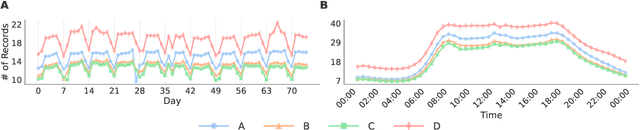

Predicting human mobility across multiple cities presents significant challenges due to the complex and diverse spatial-temporal dynamics inherent in different urban environments. In this study, we propose a robust approach to predict human mobility patterns called ST-MoE-BERT. Compared to existing methods, our approach frames the prediction task as a spatial-temporal classification problem. Our methodology integrates the Mixture-of-Experts architecture with BERT model to capture complex mobility dynamics and perform the downstream human mobility prediction task. Additionally, transfer learning is integrated to solve the challenge of data scarcity in cross-city prediction. We demonstrate the effectiveness of the proposed model on GEO-BLEU and DTW, comparing it to several state-of-the-art methods. Notably, ST-MoE-BERT achieves an average improvement of 8.29%.