 Add to Chrome
 Add to Firefox
 Add to Edge
Beyond Noisy Signals: Dual-Level Denoising for Multi-modal Sequential Recommendation
Jul 21, 2026
Multi-modal Sequential Recommendation (SR) incorporates rich side information (e.g., textual and visual features) to enhance dynamic user preference modeling. However, existing frameworks inevitably suffer from a \textbf{Dual-Noise Dilemma}: (1) \textit{Feature-level redundancy} stemming from the semantic gap between generic pre-trained representations and fine-grained recommendation intent; and (2) \textit{Sequence-level stochasticity} induced by spurious interactions such as accidental clicks. To break this bottleneck, we propose \textbf{DDMSR}, a novel \textbf{D}ual-level \textbf{D}enoising \textbf{M}ulti-modal \textbf{S}equential \textbf{R}ecommendation framework that systematically purifies signals from both feature-topological and sequence-frequency perspectives. Specifically, we first design a graph-based feature denoising module that leverages Laplacian smoothing on item semantic graphs as a structural low-pass filter, effectively suppressing high-frequency semantic noise while preserving salient features. For sequence purification, we introduce a frequency-domain sequence denoising module, utilizing the Fast Fourier Transform and a learnable frequency filter to adaptively modulate the interaction spectrum and attenuate anomalous signals. Furthermore, a multi-modal contrastive alignment objective is incorporated to bridge the heterogeneity gap and enforce cross-modal semantic consistency. Extensive experiments on four public benchmark datasets demonstrate that DDMSR consistently outperforms state-of-the-art baselines, providing a highly robust and efficient solution for multi-modal sequential recommendation. The source code is available at: ~\href{https://github.com/jluo00/DDMSR}{\textcolor{blue}{https://github.com/jluo00/DDMSR}}.

Sensor-Based Temporal Logic Planning in Uncertain Semantic Maps
Dec 18, 2020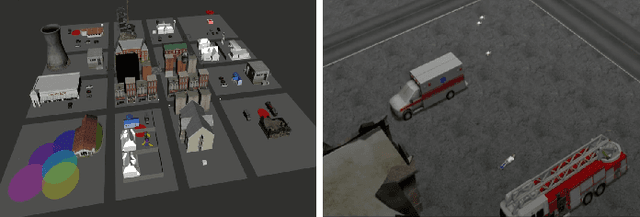
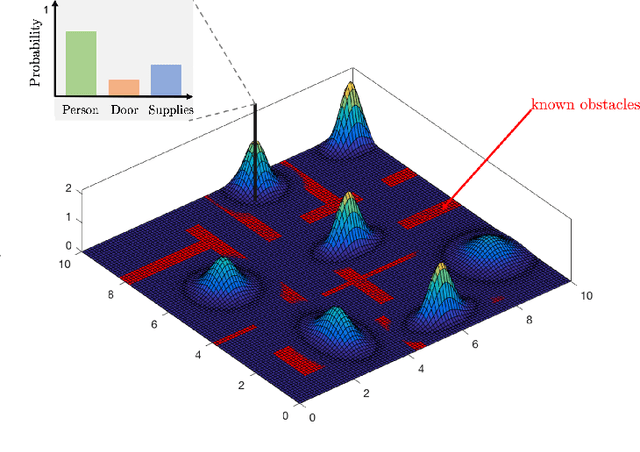
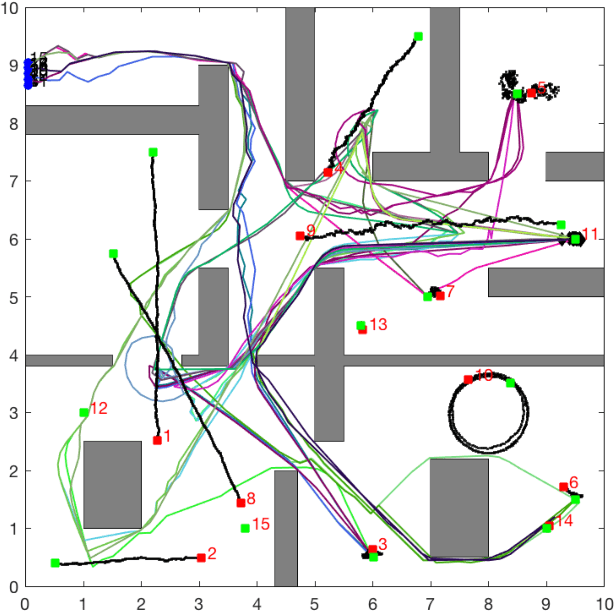
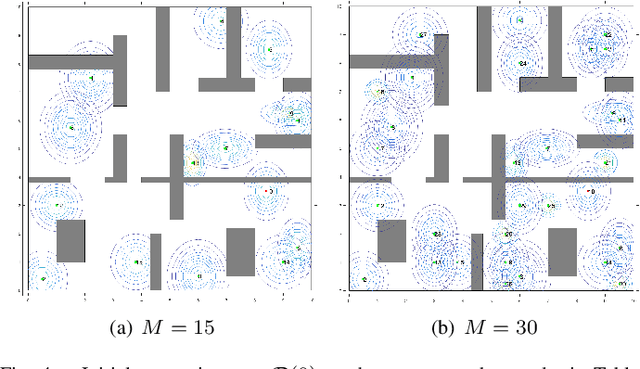
This paper addresses a multi-robot mission planning problem in uncertain semantic environments. The environment is modeled by static labeled landmarks with uncertain positions and classes giving rise to an uncertain semantic map generated by semantic SLAM algorithms. Our goal is to design control policies for sensing robots so that they can accomplish complex collaborative high level tasks captured by global temporal logic specifications. To account for environmental and sensing uncertainty, we extend Linear Temporal Logic (LTL) by including sensor-based predicates allowing us to incorporate uncertainty and probabilistic satisfaction requirements directly into the task specification. The sensor-based LTL planning problem gives rise to an optimal control problem, solved by a novel sampling-based algorithm, that generates open-loop control policies that can be updated online to adapt to the map that is continuously learned by existing semantic SLAM methods. We provide extensive experiments that corroborate the theoretical analysis and show that the proposed algorithm can address large-scale planning tasks in the presence of uncertainty.