 Add to Chrome
 Add to Firefox
 Add to Edge
Benchmarking Energy Efficiency of Large Language Models Using vLLM
Sep 10, 2025
The prevalence of Large Language Models (LLMs) is having an growing impact on the climate due to the substantial energy required for their deployment and use. To create awareness for developers who are implementing LLMs in their products, there is a strong need to collect more information about the energy efficiency of LLMs. While existing research has evaluated the energy efficiency of various models, these benchmarks often fall short of representing realistic production scenarios. In this paper, we introduce the LLM Efficiency Benchmark, designed to simulate real-world usage conditions. Our benchmark utilizes vLLM, a high-throughput, production-ready LLM serving backend that optimizes model performance and efficiency. We examine how factors such as model size, architecture, and concurrent request volume affect inference energy efficiency. Our findings demonstrate that it is possible to create energy efficiency benchmarks that better reflect practical deployment conditions, providing valuable insights for developers aiming to build more sustainable AI systems.

Tensor Networks for Dimensionality Reduction and Large-Scale Optimizations. Part 2 Applications and Future Perspectives
Aug 30, 2017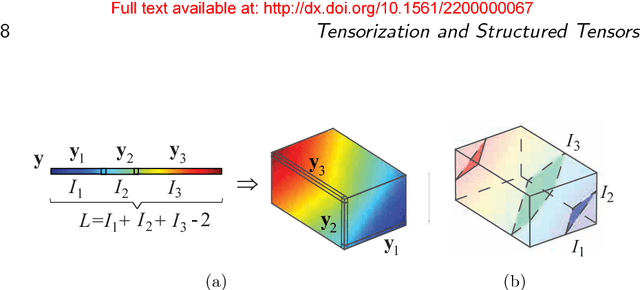

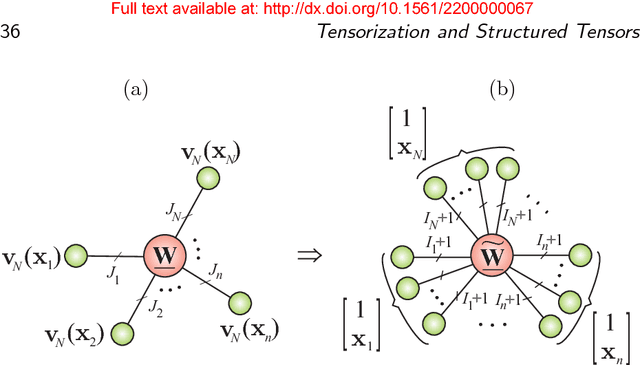
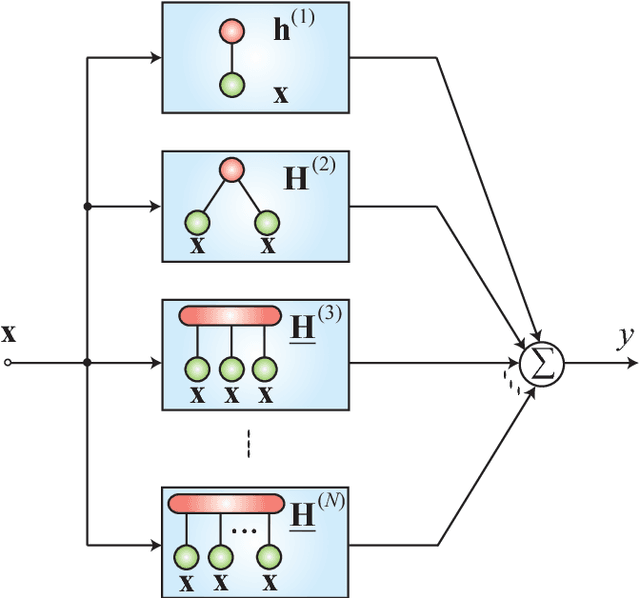
Part 2 of this monograph builds on the introduction to tensor networks and their operations presented in Part 1. It focuses on tensor network models for super-compressed higher-order representation of data/parameters and related cost functions, while providing an outline of their applications in machine learning and data analytics. A particular emphasis is on the tensor train (TT) and Hierarchical Tucker (HT) decompositions, and their physically meaningful interpretations which reflect the scalability of the tensor network approach. Through a graphical approach, we also elucidate how, by virtue of the underlying low-rank tensor approximations and sophisticated contractions of core tensors, tensor networks have the ability to perform distributed computations on otherwise prohibitively large volumes of data/parameters, thereby alleviating or even eliminating the curse of dimensionality. The usefulness of this concept is illustrated over a number of applied areas, including generalized regression and classification (support tensor machines, canonical correlation analysis, higher order partial least squares), generalized eigenvalue decomposition, Riemannian optimization, and in the optimization of deep neural networks. Part 1 and Part 2 of this work can be used either as stand-alone separate texts, or indeed as a conjoint comprehensive review of the exciting field of low-rank tensor networks and tensor decompositions.
* 232 pages
Using Qualitative Hypotheses to Identify Inaccurate Data
Aug 01, 1995


Identifying inaccurate data has long been regarded as a significant and difficult problem in AI. In this paper, we present a new method for identifying inaccurate data on the basis of qualitative correlations among related data. First, we introduce the definitions of related data and qualitative correlations among related data. Then we put forward a new concept called support coefficient function (SCF). SCF can be used to extract, represent, and calculate qualitative correlations among related data within a dataset. We propose an approach to determining dynamic shift intervals of inaccurate data, and an approach to calculating possibility of identifying inaccurate data, respectively. Both of the approaches are based on SCF. Finally we present an algorithm for identifying inaccurate data by using qualitative correlations among related data as confirmatory or disconfirmatory evidence. We have developed a practical system for interpreting infrared spectra by applying the method, and have fully tested the system against several hundred real spectra. The experimental results show that the method is significantly better than the conventional methods used in many similar systems.
* See http://www.jair.org/ for any accompanying files