 Add to Chrome
 Add to Firefox
 Add to Edge
Beyond Human Performance: A Vision-Language Multi-Agent Approach for Quality Control in Pharmaceutical Manufacturing
Feb 24, 2026
Colony-forming unit (CFU) detection is critical in pharmaceutical manufacturing, serving as a key component of Environmental Monitoring programs and ensuring compliance with stringent quality standards. Manual counting is labor-intensive and error-prone, while deep learning (DL) approaches, though accurate, remain vulnerable to sample quality variations and artifacts. Building on our earlier CNN-based framework (Beznik et al., 2020), we evaluated YOLOv5, YOLOv7, and YOLOv8 for CFU detection; however, these achieved only 97.08 percent accuracy, insufficient for pharmaceutical-grade requirements. A custom Detectron2 model trained on GSK's dataset of over 50,000 Petri dish images achieved 99 percent detection rate with 2 percent false positives and 0.6 percent false negatives. Despite high validation accuracy, Detectron2 performance degrades on outlier cases including contaminated plates, plastic artifacts, or poor optical clarity. To address this, we developed a multi-agent framework combining DL with vision-language models (VLMs). The VLM agent first classifies plates as valid or invalid. For valid samples, both DL and VLM agents independently estimate colony counts. When predictions align within 5 percent, results are automatically recorded in Postgres and SAP; otherwise, samples are routed for expert review. Expert feedback enables continuous retraining and self-improvement. Initial DL-based automation reduced human verification by 50 percent across vaccine manufacturing sites. With VLM integration, this increased to 85 percent, delivering significant operational savings. The proposed system provides a scalable, auditable, and regulation-ready solution for microbiological quality control, advancing automation in biopharmaceutical production.

Performance Prediction of Hub-Based Swarms
Aug 09, 2024A hub-based colony consists of multiple agents who share a common nest site called the hub. Agents perform tasks away from the hub like foraging for food or gathering information about future nest sites. Modeling hub-based colonies is challenging because the size of the collective state space grows rapidly as the number of agents grows. This paper presents a graph-based representation of the colony that can be combined with graph-based encoders to create low-dimensional representations of collective state that can scale to many agents for a best-of-N colony problem. We demonstrate how the information in the low-dimensional embedding can be used with two experiments. First, we show how the information in the tensor can be used to cluster collective states by the probability of choosing the best site for a very small problem. Second, we show how structured collective trajectories emerge when a graph encoder is used to learn the low-dimensional embedding, and these trajectories have information that can be used to predict swarm performance.
Towards End-to-End In-Image Neural Machine Translation
Oct 20, 2020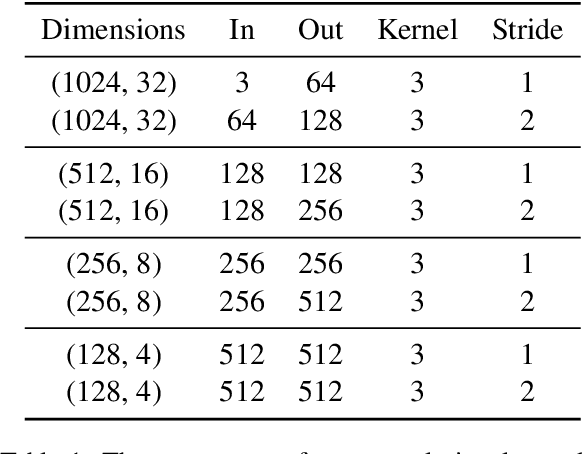
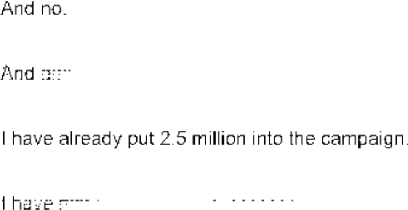
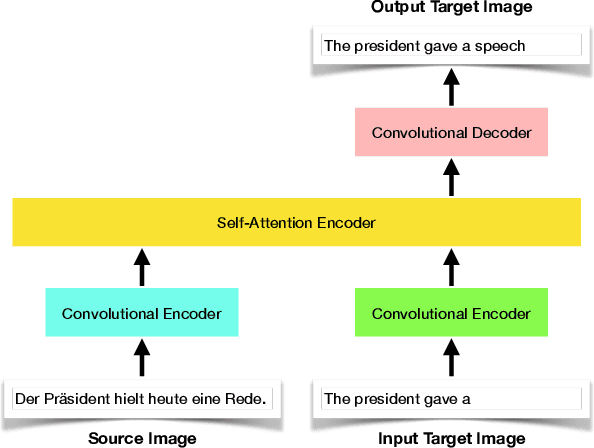
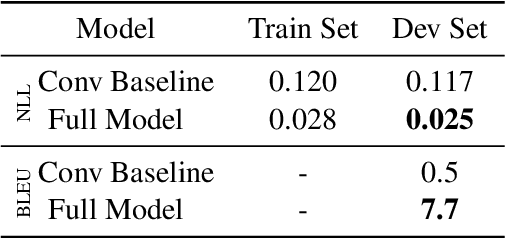
In this paper, we offer a preliminary investigation into the task of in-image machine translation: transforming an image containing text in one language into an image containing the same text in another language. We propose an end-to-end neural model for this task inspired by recent approaches to neural machine translation, and demonstrate promising initial results based purely on pixel-level supervision. We then offer a quantitative and qualitative evaluation of our system outputs and discuss some common failure modes. Finally, we conclude with directions for future work.