 Add to Chrome
 Add to Firefox
 Add to Edge
On the Reliability of Cue Conflict and Beyond
Mar 12, 2026
Understanding how neural networks rely on visual cues offers a human-interpretable view of their internal decision processes. The cue-conflict benchmark has been influential in probing shape-texture preference and in motivating the insight that stronger, human-like shape bias is often associated with improved in-domain performance. However, we find that the current stylization-based instantiation can yield unstable and ambiguous bias estimates. Specifically, stylization may not reliably instantiate perceptually valid and separable cues nor control their relative informativeness, ratio-based bias can obscure absolute cue sensitivity, and restricting evaluation to preselected classes can distort model predictions by ignoring the full decision space. Together, these factors can confound preference with cue validity, cue balance, and recognizability artifacts. We introduce REFINED-BIAS, an integrated dataset and evaluation framework for reliable and interpretable shape-texture bias diagnosis. REFINED-BIAS constructs balanced, human- and model- recognizable cue pairs using explicit definitions of shape and texture, and measures cue-specific sensitivity over the full label space via a ranking-based metric, enabling fairer cross-model comparisons. Across diverse training regimes and architectures, REFINED-BIAS enables fairer cross-model comparison, more faithful diagnosis of shape and texture biases, and clearer empirical conclusions, resolving inconsistencies that prior cue-conflict evaluations could not reliably disambiguate.

TopP&R: Robust Support Estimation Approach for Evaluating Fidelity and Diversity in Generative Models
Jun 21, 2023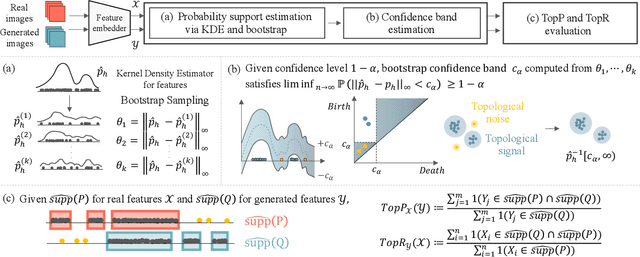
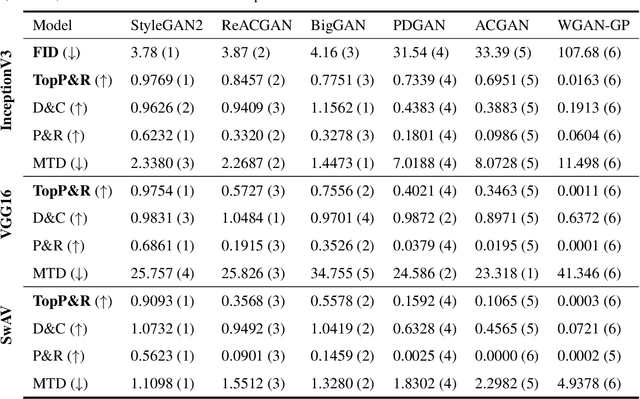

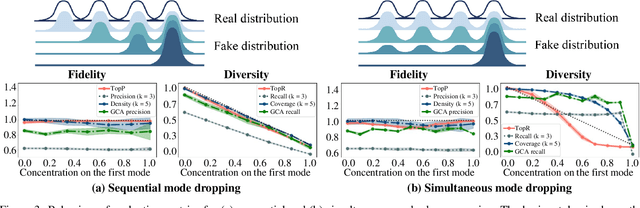
We propose a robust and reliable evaluation metric for generative models by introducing topological and statistical treatments for rigorous support estimation. Existing metrics, such as Inception Score (IS), Frechet Inception Distance (FID), and the variants of Precision and Recall (P&R), heavily rely on supports that are estimated from sample features. However, the reliability of their estimation has not been seriously discussed (and overlooked) even though the quality of the evaluation entirely depends on it. In this paper, we propose Topological Precision and Recall (TopP&R, pronounced 'topper'), which provides a systematic approach to estimating supports, retaining only topologically and statistically important features with a certain level of confidence. This not only makes TopP&R strong for noisy features, but also provides statistical consistency. Our theoretical and experimental results show that TopP&R is robust to outliers and non-independent and identically distributed (Non-IID) perturbations, while accurately capturing the true trend of change in samples. To the best of our knowledge, this is the first evaluation metric focused on the robust estimation of the support and provides its statistical consistency under noise.