 Add to Chrome
 Add to Firefox
 Add to Edge
From Hubs to Deserts: Urban Cultural Accessibility Patterns with Explainable AI
Nov 08, 2025
Cultural infrastructures, such as libraries, museums, theaters, and galleries, support learning, civic life, health, and local economies, yet access is uneven across cities. We present a novel, scalable, and open-data framework to measure spatial equity in cultural access. We map cultural infrastructures and compute a metric called Cultural Infrastructure Accessibility Score (CIAS) using exponential distance decay at fine spatial resolution, then aggregate the score per capita and integrate socio-demographic indicators. Interpretable tree-ensemble models with SHapley Additive exPlanation (SHAP) are used to explain associations between accessibility, income, density, and tract-level racial/ethnic composition. Results show a pronounced core-periphery gradient, where non-library cultural infrastructures cluster near urban cores, while libraries track density and provide broader coverage. Non-library accessibility is modestly higher in higher-income tracts, and library accessibility is slightly higher in denser, lower-income areas.

Are You Misinformed? A Study of Covid-Related Fake News in Bengali on Facebook
Mar 22, 2022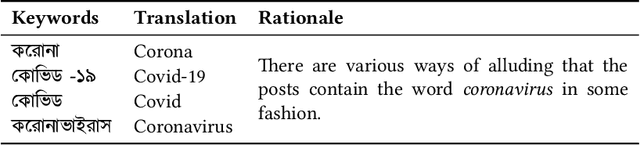


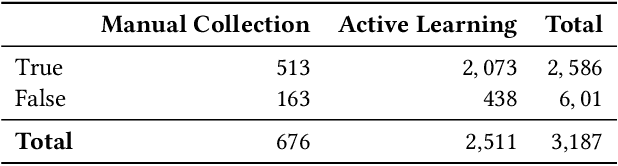
Our opinions and views of life can be shaped by how we perceive the opinions of others on social media like Facebook. This dependence has increased during COVID-19 periods when we have fewer means to connect with others. However, fake news related to COVID-19 has become a significant problem on Facebook. Bengali is the seventh most spoken language worldwide, yet we are aware of no previous research that studied the prevalence of COVID-19 related fake news in Bengali on Facebook. In this paper, we develop machine learning models to detect fake news in Bengali automatically. The best performing model is BERT, with an F1-score of 0.97. We apply BERT on all Facebook Bengali posts related to COVID-19. We find 10 topics in the COVID-19 Bengali fake news grouped into three categories: System (e.g., medical system), belief (e.g., religious rituals), and social (e.g., scientific awareness).