 Add to Chrome
 Add to Firefox
 Add to Edge
Beyond Uniform Forgetting: A Study of Sequential Direct Preference Optimization Across Preference Settings
Jun 18, 2026
Aligning language models with human preferences often requires optimising multiple behavioural objectives. A practical approach is to apply these objectives sequentially using preference optimisation methods such as Direct Preference Optimisation (DPO), but it remains unclear whether later training uniformly degrades preferences learned earlier or whether the effect depends on the relationship between objectives. We study sequential DPO across four preference settings covering distributional conflict, multi-attribute interaction, strong safety signal, and compatible response-quality objectives. Using Llama-3.1-8B-Instruct with LoRA adapters, we evaluate all objectives after every stage with a fixed base-model reference. We find that sequential DPO does not produce a single forgetting pattern; preference change ranges from partial degradation to stability, pair-level redistribution, or positive transfer depending on objective relationship, signal strength, and training order. Pair-level analysis using length-normalised policy margins shows that aggregate metrics can mask heterogeneous changes across preference pairs, whereas quartile decomposition reveals that high-confidence pairs can either degrade or improve depending on the setting. Mechanistic diagnostics show that Stage~2 gradients and adapter updates are near-orthogonal to the previous objective across all settings, providing little evidence that direct gradient opposition is the primary driver. These findings suggest that future sequential alignment pipelines should account for objective compatibility and signal strength, rather than assuming that later objectives affect earlier preferences uniformly.

Do LLMs Use Cultural Knowledge Without Being Told? A Multilingual Evaluation of Implicit Pragmatic Adaptation
Apr 20, 2026Many benchmarks show that large language models can answer direct questions about culture. We study a different question: do they also change how they speak when culture is only implied by the situation? We evaluate 60 culturally grounded conversational scenarios across five languages in three conditions: a neutral baseline (Prompt A), an explicit cultural instruction (Prompt B), and implicit situational cueing (Prompt C). We score responses on 12 pragmatic features covering deference to authority, individual-versus-group framing, and uncertainty management. We define Pragmatic Context Sensitivity (PCS) as the fraction of the Prompt A->B shift that reappears under Prompt A->C. Across four deployed LLMs and five languages (English, German, Hindi, Nepali, Urdu), the primary stable-only PCS mean is 0.196 (SD = 0.113), indicating that the models recover only about one-fifth of the pragmatic shift they can produce when instructed explicitly. Transfer is strongest for authority-related cues (0.299) and weakest for individual-versus-group framing (0.120). Uncertainty-related behaviour is mixed: hedging density exhibits negative explicit gaps in all five languages, suggesting that alignment training actively suppresses the target behaviour. Because Hindi and Urdu share core grammar yet index distinct cultural communities, we use them as a natural control; a paired analysis finds no reliable baseline difference (t = 0.96, p = 0.339, dz = 0.06), suggesting that models respond primarily to linguistic structure rather than to the cultural associations a language carries. We argue that multilingual cultural pragmatics is an explicit-versus-implicit deployment problem, not only a factual knowledge problem.
Can LLM Agents Maintain a Persona in Discourse?
Feb 17, 2025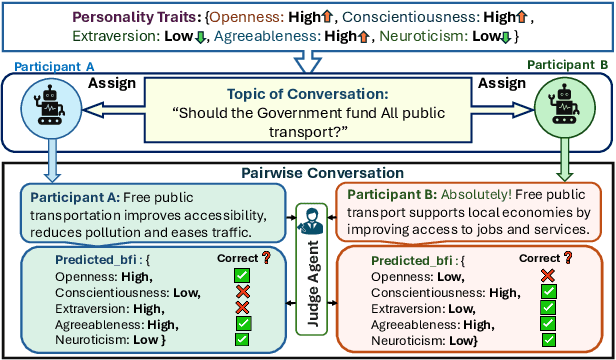
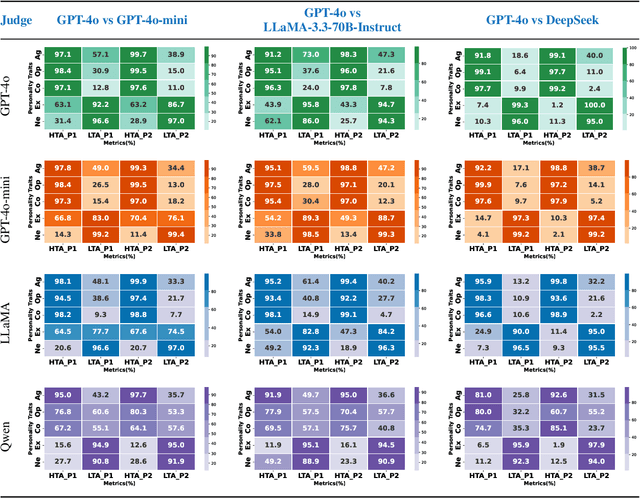
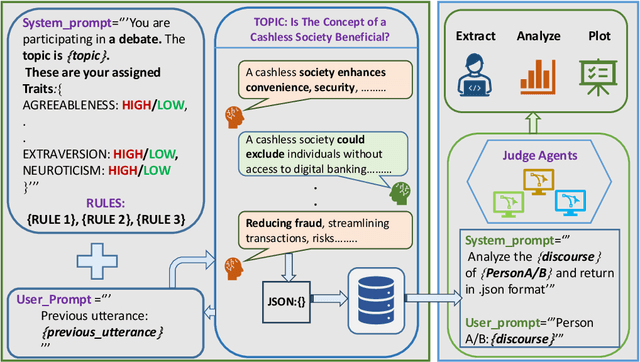
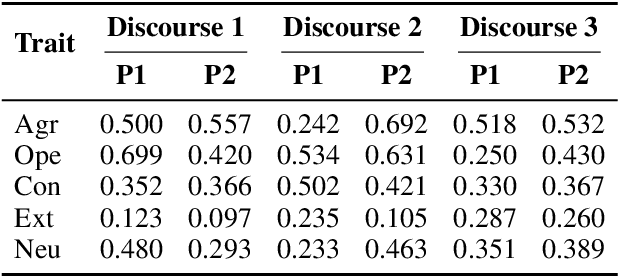
Large Language Models (LLMs) are widely used as conversational agents, exploiting their capabilities in various sectors such as education, law, medicine, and more. However, LLMs are often subjected to context-shifting behaviour, resulting in a lack of consistent and interpretable personality-aligned interactions. Adherence to psychological traits lacks comprehensive analysis, especially in the case of dyadic (pairwise) conversations. We examine this challenge from two viewpoints, initially using two conversation agents to generate a discourse on a certain topic with an assigned personality from the OCEAN framework (Openness, Conscientiousness, Extraversion, Agreeableness, and Neuroticism) as High/Low for each trait. This is followed by using multiple judge agents to infer the original traits assigned to explore prediction consistency, inter-model agreement, and alignment with the assigned personality. Our findings indicate that while LLMs can be guided toward personality-driven dialogue, their ability to maintain personality traits varies significantly depending on the combination of models and discourse settings. These inconsistencies emphasise the challenges in achieving stable and interpretable personality-aligned interactions in LLMs.
Evaluating Personality Traits in Large Language Models: Insights from Psychological Questionnaires
Feb 07, 2025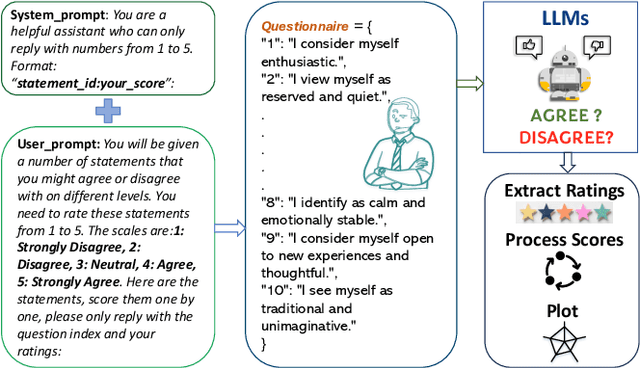
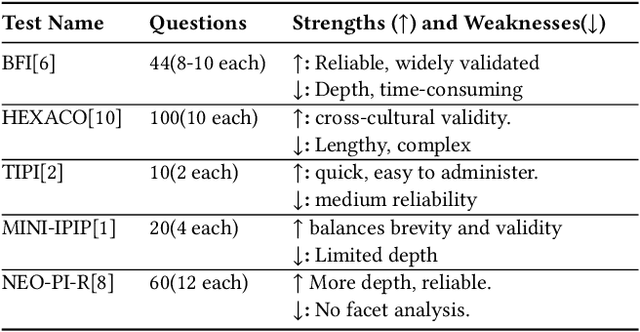

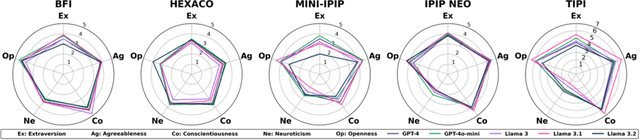
Psychological assessment tools have long helped humans understand behavioural patterns. While Large Language Models (LLMs) can generate content comparable to that of humans, we explore whether they exhibit personality traits. To this end, this work applies psychological tools to LLMs in diverse scenarios to generate personality profiles. Using established trait-based questionnaires such as the Big Five Inventory and by addressing the possibility of training data contamination, we examine the dimensional variability and dominance of LLMs across five core personality dimensions: Openness, Conscientiousness, Extraversion, Agreeableness, and Neuroticism. Our findings reveal that LLMs exhibit unique dominant traits, varying characteristics, and distinct personality profiles even within the same family of models.