 Add to Chrome
 Add to Firefox
 Add to Edge
Crop Recommendation and Agricultural Query Answering System Using Spatio-Temporal Graph Neural Networks and Hybrid Retrieval Augmentation
Jun 08, 2026
This paper presents a unified system designed to support precision agriculture by integrating advanced weather prediction, crop recommendation, and a question-answering tool for farmers. We propose two deep learning models -- a Transformer-based Graph Neural Network and a Spatio-Temporal Graph Convolutional Network (STGCN) -- to forecast weather conditions for the next 30 days using data from 1,359 locations in Nepal. The STGCN outperforms the Transformer-based model in accuracy (MSE ~0.011 vs. 0.013), effectively modeling both spatial and temporal dependencies in climate data. These predictions are combined with static soil properties such as pH, moisture, and organic content to generate localized crop recommendations through a scoring algorithm that matches each crop's optimal growing conditions. Additionally, we develop a Retrieval-Augmented Generation (RAG) chatbot that leverages domain-specific agricultural documents to answer farmers' questions in natural language. The entire system is deployed via a mobile application, offering real-time suggestions and conversational support. User feedback confirms the system's usability and relevance, especially in rural settings where personalized farming guidance is limited. Overall, our approach demonstrates how combining machine learning models with local agricultural data can empower farmers with actionable insights, promoting more informed decisions, better crop yields, and increased resilience to climate variability.

Local Herb Identification Using Transfer Learning: A CNN-Powered Mobile Application for Nepalese Flora
May 04, 2025Herb classification presents a critical challenge in botanical research, particularly in regions with rich biodiversity such as Nepal. This study introduces a novel deep learning approach for classifying 60 different herb species using Convolutional Neural Networks (CNNs) and transfer learning techniques. Using a manually curated dataset of 12,000 herb images, we developed a robust machine learning model that addresses existing limitations in herb recognition methodologies. Our research employed multiple model architectures, including DenseNet121, 50-layer Residual Network (ResNet50), 16-layer Visual Geometry Group Network (VGG16), InceptionV3, EfficientNetV2, and Vision Transformer (VIT), with DenseNet121 ultimately demonstrating superior performance. Data augmentation and regularization techniques were applied to mitigate overfitting and enhance the generalizability of the model. This work advances herb classification techniques, preserving traditional botanical knowledge and promoting sustainable herb utilization.
Consolidating and Developing Benchmarking Datasets for the Nepali Natural Language Understanding Tasks
Nov 28, 2024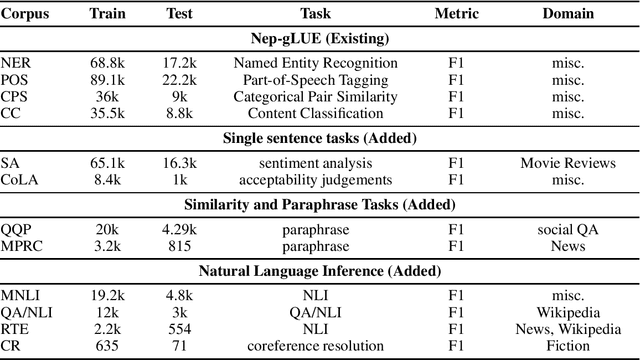

The Nepali language has distinct linguistic features, especially its complex script (Devanagari script), morphology, and various dialects, which pose a unique challenge for natural language processing (NLP) evaluation. While the Nepali Language Understanding Evaluation (Nep-gLUE) benchmark provides a foundation for evaluating models, it remains limited in scope, covering four tasks. This restricts their utility for comprehensive assessments of NLP models. To address this limitation, we introduce eight new datasets, creating a new benchmark, the Nepali Language Understanding Evaluation (NLUE) benchmark, which covers a total of 12 tasks for evaluating the performance of models across a diverse set of Natural Language Understanding (NLU) tasks. The added tasks include single-sentence classification, similarity and paraphrase tasks, and Natural Language Inference (NLI) tasks. On evaluating the models using added tasks, we observe that the existing models fall short in handling complex NLU tasks effectively. This expanded benchmark sets a new standard for evaluating, comparing, and advancing models, contributing significantly to the broader goal of advancing NLP research for low-resource languages.
Development of Pre-Trained Transformer-based Models for the Nepali Language
Nov 24, 2024


Transformer-based pre-trained language models have dominated the field of Natural Language Processing (NLP) for quite some time now. However, the Nepali language, spoken by approximately 32 million people worldwide, remains significantly underrepresented in this domain. This underrepresentation is primarily attributed to the scarcity of monolingual data corpora and limited available resources for the Nepali language. While existing efforts have predominantly concentrated on basic encoder-based models, there is a notable gap in the exploration of decoder-based architectures. To address this gap, we have collected 27.5 GB of Nepali text data, approximately 2.4x larger than any previously available Nepali language corpus. Leveraging this data, we pre-trained three different models i.e., BERT, RoBERTa, and GPT-2, exclusively for the Nepali Language. Furthermore, we performed instruction tuning and explored its potential for monolingual Nepali data, providing a foundation for future research. Our models outperformed the existing best model by 2 points on Nep-gLUE benchmark, scoring 95.60 and also outperformed existing models on text generation tasks, demonstrating improvements in both understanding and generating Nepali text.