 Add to Chrome
 Add to Firefox
 Add to Edge
NepTam: A Nepali-Tamang Parallel Corpus and Baseline Machine Translation Experiments
Mar 14, 2026
Modern Translation Systems heavily rely on high-quality, large parallel datasets for state-of-the-art performance. However, such resources are largely unavailable for most of the South Asian languages. Among them, Nepali and Tamang fall into such category, with Tamang being among the least digitally resourced languages in the region. This work addresses the gap by developing NepTam20K, a 20K gold standard parallel corpus, and NepTam80K, an 80K synthetic Nepali-Tamang parallel corpus, both sentence-aligned and designed to support machine translation. The datasets were created through a pipeline involving data scraping from Nepali news and online sources, pre-processing, semantic filtering, balancing for tense and polarity (in NepTam20K dataset), expert translation into Tamang by native speakers of the language, and verification by an expert Tamang linguist. The dataset covers five domains: Agriculture, Health, Education and Technology, Culture, and General Communication. To evaluate the dataset, baseline machine translation experiments were carried out using various multilingual pre-trained models: mBART, M2M-100, NLLB-200, and a vanilla Transformer model. The fine-tuning on the NLLB-200 achieved the highest sacreBLEU scores of 40.92 (Nepali-Tamang) and 45.26 (Tamang-Nepali).

Nwāchā Munā: A Devanagari Speech Corpus and Proximal Transfer Benchmark for Nepal Bhasha ASR
Mar 08, 2026Nepal Bhasha (Newari), an endangered language of the Kathmandu Valley, remains digitally marginalized due to the severe scarcity of annotated speech resources. In this work, we introduce Nwāchā Munā, a newly curated 5.39-hour manually transcribed Devanagari speech corpus for Nepal Bhasha, and establish the first benchmark using script-preserving acoustic modeling. We investigate whether proximal cross-lingual transfer from a geographically and linguistically adjacent language (Nepali) can rival large-scale multilingual pretraining in an ultra-low-resource Automatic Speech Recognition (ASR) setting. Fine-tuning a Nepali Conformer model reduces the Character Error Rate (CER) from a 52.54% zero-shot baseline to 17.59% with data augmentation, effectively matching the performance of the multilingual Whisper-Small model despite utilizing significantly fewer parameters. Our findings demonstrate that proximal transfer within South Asian language clusters serves as a computationally efficient alternative to massive multilingual models. We openly release the dataset and benchmarks to digitally enable the Newari community and foster further research in Nepal Bhasha.
Benchmarking BERT-based Models for Sentence-level Topic Classification in Nepali Language
Feb 27, 2026Transformer-based models such as BERT have significantly advanced Natural Language Processing (NLP) across many languages. However, Nepali, a low-resource language written in Devanagari script, remains relatively underexplored. This study benchmarks multilingual, Indic, Hindi, and Nepali BERT variants to evaluate their effectiveness in Nepali topic classification. Ten pre-trained models, including mBERT, XLM-R, MuRIL, DevBERT, HindiBERT, IndicBERT, and NepBERTa, were fine-tuned and tested on the balanced Nepali dataset containing 25,006 sentences across five conceptual domains and the performance was evaluated using accuracy, weighted precision, recall, F1-score, and AUROC metrics. The results reveal that Indic models, particularly MuRIL-large, achieved the highest F1-score of 90.60%, outperforming multilingual and monolingual models. NepBERTa also performed competitively with an F1-score of 88.26%. Overall, these findings establish a robust baseline for future document-level classification and broader Nepali NLP applications.
Consolidating and Developing Benchmarking Datasets for the Nepali Natural Language Understanding Tasks
Nov 28, 2024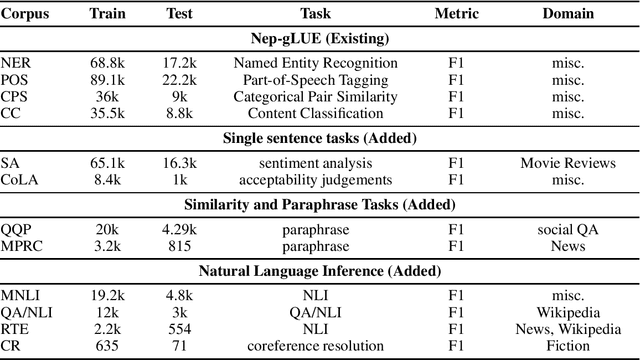

The Nepali language has distinct linguistic features, especially its complex script (Devanagari script), morphology, and various dialects, which pose a unique challenge for natural language processing (NLP) evaluation. While the Nepali Language Understanding Evaluation (Nep-gLUE) benchmark provides a foundation for evaluating models, it remains limited in scope, covering four tasks. This restricts their utility for comprehensive assessments of NLP models. To address this limitation, we introduce eight new datasets, creating a new benchmark, the Nepali Language Understanding Evaluation (NLUE) benchmark, which covers a total of 12 tasks for evaluating the performance of models across a diverse set of Natural Language Understanding (NLU) tasks. The added tasks include single-sentence classification, similarity and paraphrase tasks, and Natural Language Inference (NLI) tasks. On evaluating the models using added tasks, we observe that the existing models fall short in handling complex NLU tasks effectively. This expanded benchmark sets a new standard for evaluating, comparing, and advancing models, contributing significantly to the broader goal of advancing NLP research for low-resource languages.
Development of Pre-Trained Transformer-based Models for the Nepali Language
Nov 24, 2024


Transformer-based pre-trained language models have dominated the field of Natural Language Processing (NLP) for quite some time now. However, the Nepali language, spoken by approximately 32 million people worldwide, remains significantly underrepresented in this domain. This underrepresentation is primarily attributed to the scarcity of monolingual data corpora and limited available resources for the Nepali language. While existing efforts have predominantly concentrated on basic encoder-based models, there is a notable gap in the exploration of decoder-based architectures. To address this gap, we have collected 27.5 GB of Nepali text data, approximately 2.4x larger than any previously available Nepali language corpus. Leveraging this data, we pre-trained three different models i.e., BERT, RoBERTa, and GPT-2, exclusively for the Nepali Language. Furthermore, we performed instruction tuning and explored its potential for monolingual Nepali data, providing a foundation for future research. Our models outperformed the existing best model by 2 points on Nep-gLUE benchmark, scoring 95.60 and also outperformed existing models on text generation tasks, demonstrating improvements in both understanding and generating Nepali text.
A Comprehensive Study of the Current State-of-the-Art in Nepali Automatic Speech Recognition Systems
Feb 05, 2024In this paper, we examine the research conducted in the field of Nepali Automatic Speech Recognition (ASR). The primary objective of this survey is to conduct a comprehensive review of the works on Nepali Automatic Speech Recognition Systems completed to date, explore the different datasets used, examine the technology utilized, and take account of the obstacles encountered in implementing the Nepali ASR system. In tandem with the global trends of ever-increasing research on speech recognition based research, the number of Nepalese ASR-related projects are also growing. Nevertheless, the investigation of language and acoustic models of the Nepali language has not received adequate attention compared to languages that possess ample resources. In this context, we provide a framework as well as directions for future investigations.
Nepali Video Captioning using CNN-RNN Architecture
Nov 05, 2023
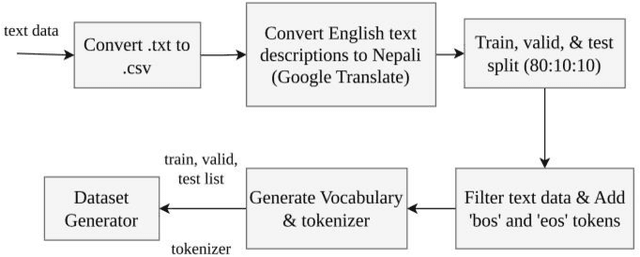


This article presents a study on Nepali video captioning using deep neural networks. Through the integration of pre-trained CNNs and RNNs, the research focuses on generating precise and contextually relevant captions for Nepali videos. The approach involves dataset collection, data preprocessing, model implementation, and evaluation. By enriching the MSVD dataset with Nepali captions via Google Translate, the study trains various CNN-RNN architectures. The research explores the effectiveness of CNNs (e.g., EfficientNetB0, ResNet101, VGG16) paired with different RNN decoders like LSTM, GRU, and BiLSTM. Evaluation involves BLEU and METEOR metrics, with the best model being EfficientNetB0 + BiLSTM with 1024 hidden dimensions, achieving a BLEU-4 score of 17 and METEOR score of 46. The article also outlines challenges and future directions for advancing Nepali video captioning, offering a crucial resource for further research in this area.
* 6 pages, 5 figures, 3 tables. Presented in the International Conference on Technologies for Computer, Electrical, Electronics & Communication (ICT-CEEL 2023), Bhaktapur, Nepal