 Add to Chrome
 Add to Firefox
 Add to Edge
Reference-Driven Multi-Speaker Audio Scene Generation from In-the-Wild Priors
Jun 17, 2026
Existing multi-speaker dialogue systems bind speakers to utterances through structured supervision: per-turn tags, multi-stream transcriptions, or learnable speaker embeddings. These systems operate within speech-only pipelines that produce clean vocal sequences without the ambient texture of real conversations. We take a different approach. Our method, ScenA, conditions a text-to-audio flow-matching foundation model, pretrained on large-scale in-the-wild data, directly on multiple reference voices and a free-form natural language prompt that describes an entire multi-speaker audio scene. Leveraging such a foundational model allows us to inherit its capacity for natural, non-studio audio: background noise, room acoustics, overlapping dialogue, and spontaneous paralinguistic events, while adding multi-speaker control without any per-turn structure. Concretely, reference latents are concatenated into the model's token sequence and distinguished by lightweight identity-aware positional encodings. However, we identify a critical obstacle to this approach: the \textit{Reference Shortcut}. During training under standard noise schedules, the model can identify the matching reference by acoustic similarity to the noisy target, bypassing the text prompt entirely. We address this with a high-noise-biased timestep distribution that forces the model to rely on the text prompt for speaker assignment. We evaluate ScenA on the CoVoMix2-Dialogue benchmark, showing that it outperforms existing multi-speaker systems on speaker-binding metrics while generating rich conversational audio with overlapping speech, emotional vocalizations, and ambient sound. Our results demonstrate the advantage of using a general-purpose audio model conditioned on a free-form scene description, rather than passing structured dialog scripts through a speech-only pipeline.

LTX-2: Efficient Joint Audio-Visual Foundation Model
Jan 06, 2026Recent text-to-video diffusion models can generate compelling video sequences, yet they remain silent -- missing the semantic, emotional, and atmospheric cues that audio provides. We introduce LTX-2, an open-source foundational model capable of generating high-quality, temporally synchronized audiovisual content in a unified manner. LTX-2 consists of an asymmetric dual-stream transformer with a 14B-parameter video stream and a 5B-parameter audio stream, coupled through bidirectional audio-video cross-attention layers with temporal positional embeddings and cross-modality AdaLN for shared timestep conditioning. This architecture enables efficient training and inference of a unified audiovisual model while allocating more capacity for video generation than audio generation. We employ a multilingual text encoder for broader prompt understanding and introduce a modality-aware classifier-free guidance (modality-CFG) mechanism for improved audiovisual alignment and controllability. Beyond generating speech, LTX-2 produces rich, coherent audio tracks that follow the characters, environment, style, and emotion of each scene -- complete with natural background and foley elements. In our evaluations, the model achieves state-of-the-art audiovisual quality and prompt adherence among open-source systems, while delivering results comparable to proprietary models at a fraction of their computational cost and inference time. All model weights and code are publicly released.
LTX-Video: Realtime Video Latent Diffusion
Dec 30, 2024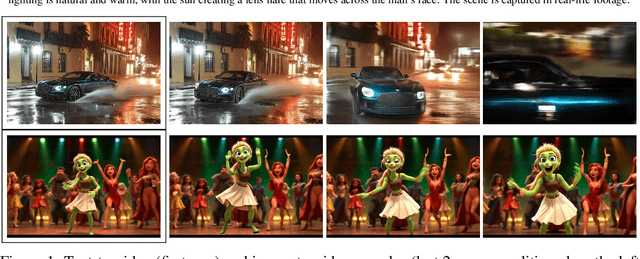

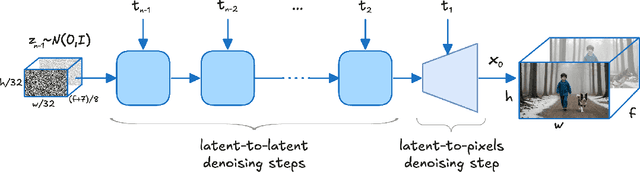
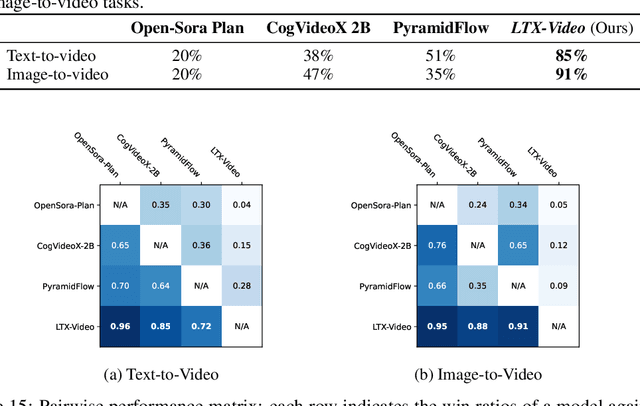
We introduce LTX-Video, a transformer-based latent diffusion model that adopts a holistic approach to video generation by seamlessly integrating the responsibilities of the Video-VAE and the denoising transformer. Unlike existing methods, which treat these components as independent, LTX-Video aims to optimize their interaction for improved efficiency and quality. At its core is a carefully designed Video-VAE that achieves a high compression ratio of 1:192, with spatiotemporal downscaling of 32 x 32 x 8 pixels per token, enabled by relocating the patchifying operation from the transformer's input to the VAE's input. Operating in this highly compressed latent space enables the transformer to efficiently perform full spatiotemporal self-attention, which is essential for generating high-resolution videos with temporal consistency. However, the high compression inherently limits the representation of fine details. To address this, our VAE decoder is tasked with both latent-to-pixel conversion and the final denoising step, producing the clean result directly in pixel space. This approach preserves the ability to generate fine details without incurring the runtime cost of a separate upsampling module. Our model supports diverse use cases, including text-to-video and image-to-video generation, with both capabilities trained simultaneously. It achieves faster-than-real-time generation, producing 5 seconds of 24 fps video at 768x512 resolution in just 2 seconds on an Nvidia H100 GPU, outperforming all existing models of similar scale. The source code and pre-trained models are publicly available, setting a new benchmark for accessible and scalable video generation.