 Add to Chrome
 Add to Firefox
 Add to Edge
CrossMed: A Multimodal Cross-Task Benchmark for Compositional Generalization in Medical Imaging
Nov 14, 2025
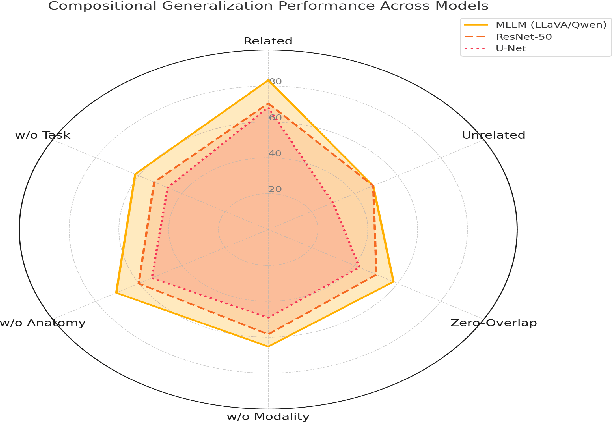
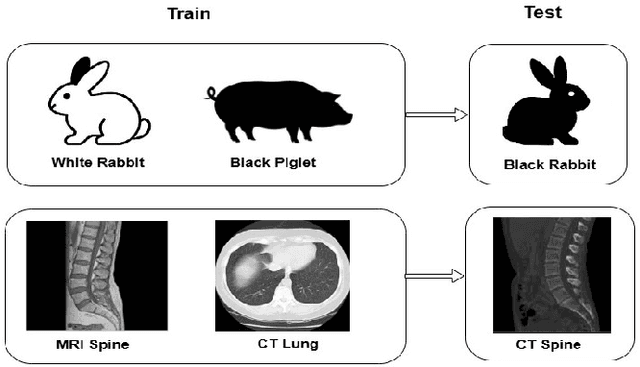
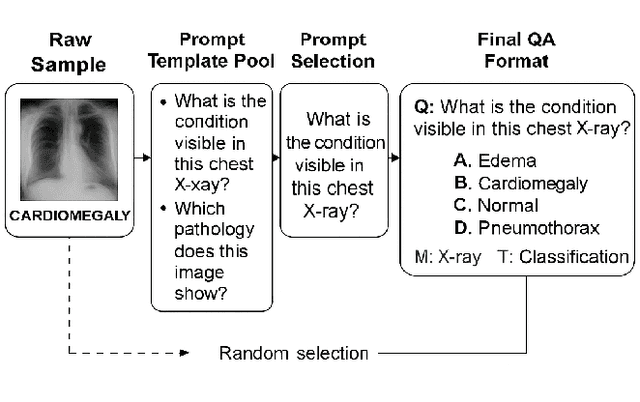
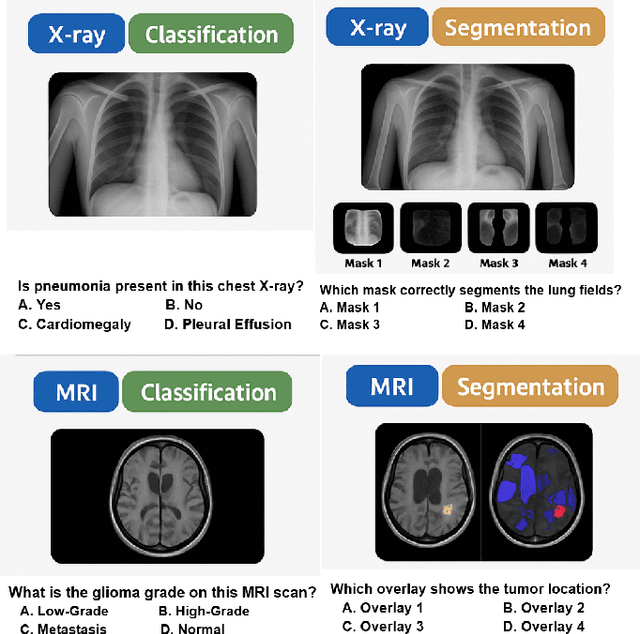
Recent advances in multimodal large language models have enabled unified processing of visual and textual inputs, offering promising applications in general-purpose medical AI. However, their ability to generalize compositionally across unseen combinations of imaging modality, anatomy, and task type remains underexplored. We introduce CrossMed, a benchmark designed to evaluate compositional generalization (CG) in medical multimodal LLMs using a structured Modality-Anatomy-Task (MAT) schema. CrossMed reformulates four public datasets, CheXpert (X-ray classification), SIIM-ACR (X-ray segmentation), BraTS 2020 (MRI classification and segmentation), and MosMedData (CT classification) into a unified visual question answering (VQA) format, resulting in 20,200 multiple-choice QA instances. We evaluate two open-source multimodal LLMs, LLaVA-Vicuna-7B and Qwen2-VL-7B, on both Related and Unrelated MAT splits, as well as a zero-overlap setting where test triplets share no Modality, Anatomy, or Task with the training data. Models trained on Related splits achieve 83.2 percent classification accuracy and 0.75 segmentation cIoU, while performance drops significantly under Unrelated and zero-overlap conditions, demonstrating the benchmark difficulty. We also show cross-task transfer, where segmentation performance improves by 7 percent cIoU even when trained using classification-only data. Traditional models (ResNet-50 and U-Net) show modest gains, confirming the broad utility of the MAT framework, while multimodal LLMs uniquely excel at compositional generalization. CrossMed provides a rigorous testbed for evaluating zero-shot, cross-task, and modality-agnostic generalization in medical vision-language models.

Benchmarking LLM powered Chatbots: Methods and Metrics
Aug 08, 2023Autonomous conversational agents, i.e. chatbots, are becoming an increasingly common mechanism for enterprises to provide support to customers and partners. In order to rate chatbots, especially ones powered by Generative AI tools like Large Language Models (LLMs) we need to be able to accurately assess their performance. This is where chatbot benchmarking becomes important. In this paper, we propose the use of a novel benchmark that we call the E2E (End to End) benchmark, and show how the E2E benchmark can be used to evaluate accuracy and usefulness of the answers provided by chatbots, especially ones powered by LLMs. We evaluate an example chatbot at different levels of sophistication based on both our E2E benchmark, as well as other available metrics commonly used in the state of art, and observe that the proposed benchmark show better results compared to others. In addition, while some metrics proved to be unpredictable, the metric associated with the E2E benchmark, which uses cosine similarity performed well in evaluating chatbots. The performance of our best models shows that there are several benefits of using the cosine similarity score as a metric in the E2E benchmark.