 Add to Chrome
 Add to Firefox
 Add to Edge
Feature-preserving Latent-EnKF for Data Assimilation of Flows with Shocks
Jun 10, 2026
The ensemble Kalman filter (EnKF) is widely adopted for sequential data assimilation, but fails for solutions with discontinuities, such as shocks in compressible flows. Uncertainty in shock location induces multimodal ensemble statistics that violate the Gaussian assumptions underlying the EnKF, producing large-scale spurious oscillations in the analysis state. We introduce a feature-preserving latent-EnKF that performs the ensemble update in a learned low-dimensional latent space, where shock and flow features admit a smooth manifold representation, thereby preserving sharp features during EnKF analysis. The updated latent state is mapped back to physical state through a shared decoder for all ensemble members. The algorithm eliminates the member-specific ordered training and positivity flooring used in prior approaches. Numerical experiments on a Sod shock tube and Mach 2 shock interaction with a 2D cylinder, using sparse and noisy observations, show accurate feature recovery of shocks and contact discontinuities without spurious oscillations.

A Jensen-Shannon Divergence Based Loss Function for Bayesian Neural Networks
Sep 23, 2022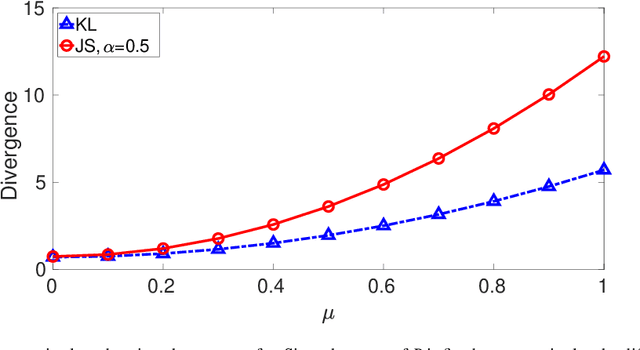
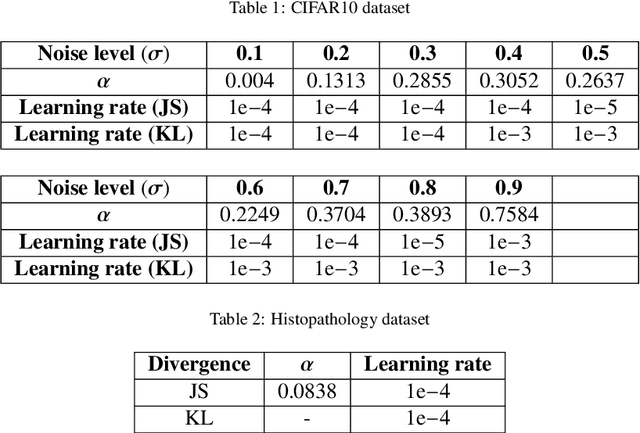
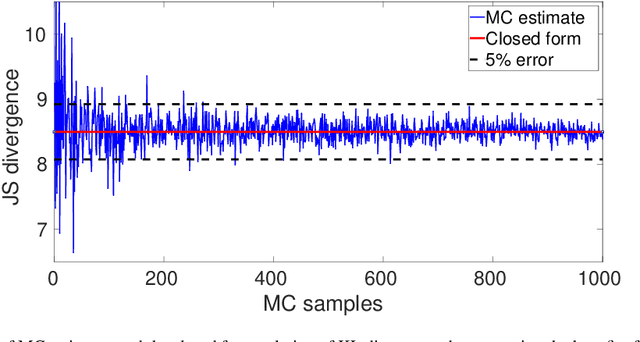
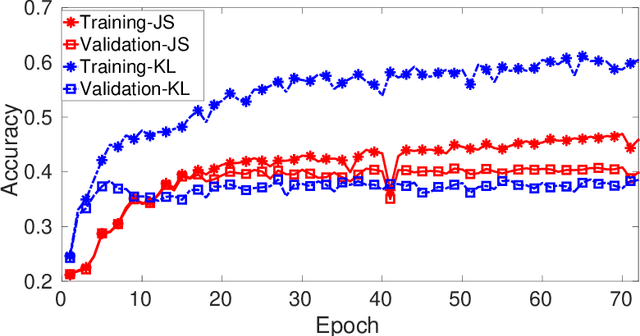
Kullback-Leibler (KL) divergence is widely used for variational inference of Bayesian Neural Networks (BNNs). However, the KL divergence has limitations such as unboundedness and asymmetry. We examine the Jensen-Shannon (JS) divergence that is more general, bounded, and symmetric. We formulate a novel loss function for BNNs based on the geometric JS divergence and show that the conventional KL divergence-based loss function is its special case. We evaluate the divergence part of the proposed loss function in a closed form for a Gaussian prior. For any other general prior, Monte Carlo approximations can be used. We provide algorithms for implementing both of these cases. We demonstrate that the proposed loss function offers an additional parameter that can be tuned to control the degree of regularisation. We derive the conditions under which the proposed loss function regularises better than the KL divergence-based loss function for Gaussian priors and posteriors. We demonstrate performance improvements over the state-of-the-art KL divergence-based BNN on the classification of a noisy CIFAR data set and a biased histopathology data set.
A modified Bayesian Convolutional Neural Network for Breast Histopathology Image Classification and Uncertainty Quantification
Oct 07, 2020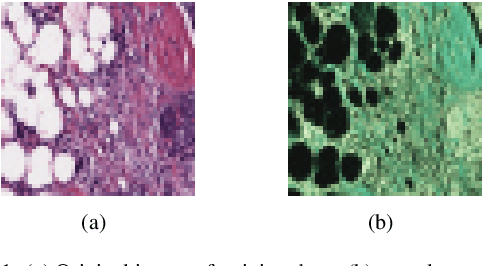
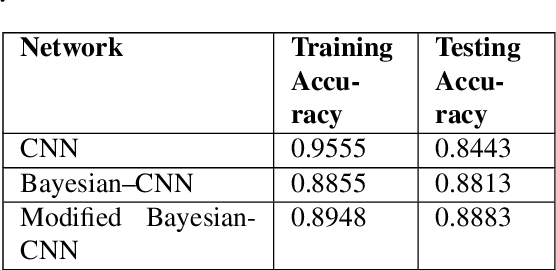
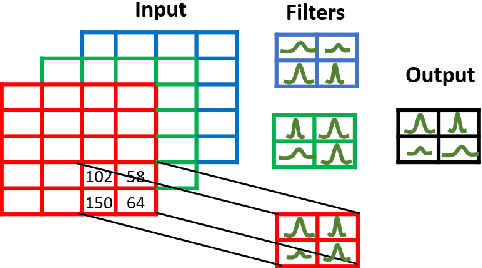
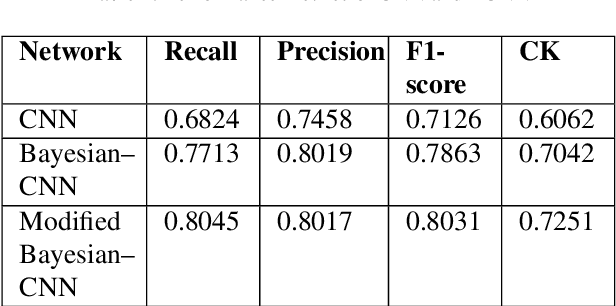
Convolutional neural network (CNN) based classification models have been successfully used on histopathological images for the detection of diseases. Despite its success, CNN may yield erroneous or overfitted results when the data is not sufficiently large or is biased. To overcome these limitations of CNN and to provide uncertainty quantification Bayesian CNN is recently proposed. However, we show that Bayesian-CNN still suffers from inaccuracies, especially in negative predictions. In the present work, we extend the Bayesian-CNN to improve accuracy and the rate of convergence. The proposed model is called modified Bayesian-CNN. The novelty of the proposed model lies in an adaptive activation function that contains a learnable parameter for each of the neurons. This adaptive activation function dynamically changes the loss function thereby providing faster convergence and better accuracy. The uncertainties associated with the predictions are obtained since the model learns a probability distribution on the network parameters. It reduces overfitting through an ensemble averaging over networks, which in turn improves accuracy on the unknown data. The proposed model demonstrates significant improvement by nearly eliminating overfitting and remarkably reducing (about 38%) the number of false-negative predictions. We found that the proposed model predicts higher uncertainty for images having features of both the classes. The uncertainty in the predictions of individual images can be used to decide when further human-expert intervention is needed. These findings have the potential to advance the state-of-the-art machine learning based automatic classification for histopathological images.