 Add to Chrome
 Add to Firefox
 Add to Edge
MAMA-Memeia! Multi-Aspect Multi-Agent Collaboration for Depressive Symptoms Identification in Memes
Dec 31, 2025
Over the past years, memes have evolved from being exclusively a medium of humorous exchanges to one that allows users to express a range of emotions freely and easily. With the ever-growing utilization of memes in expressing depressive sentiments, we conduct a study on identifying depressive symptoms exhibited by memes shared by users of online social media platforms. We introduce RESTOREx as a vital resource for detecting depressive symptoms in memes on social media through the Large Language Model (LLM) generated and human-annotated explanations. We introduce MAMAMemeia, a collaborative multi-agent multi-aspect discussion framework grounded in the clinical psychology method of Cognitive Analytic Therapy (CAT) Competencies. MAMAMemeia improves upon the current state-of-the-art by 7.55% in macro-F1 and is established as the new benchmark compared to over 30 methods.

Figurative-cum-Commonsense Knowledge Infusion for Multimodal Mental Health Meme Classification
Jan 25, 2025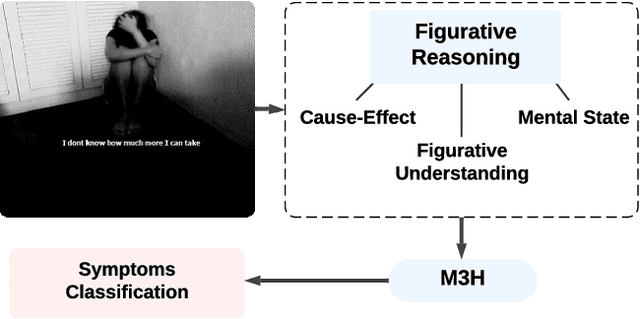

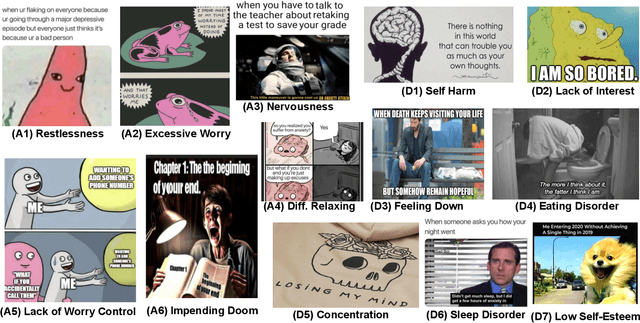
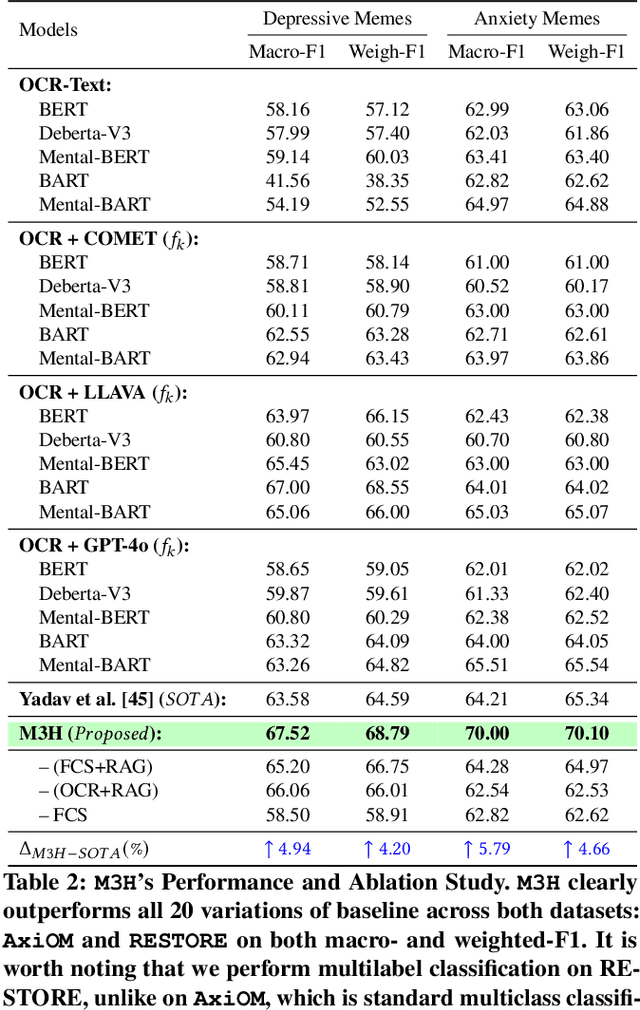
The expression of mental health symptoms through non-traditional means, such as memes, has gained remarkable attention over the past few years, with users often highlighting their mental health struggles through figurative intricacies within memes. While humans rely on commonsense knowledge to interpret these complex expressions, current Multimodal Language Models (MLMs) struggle to capture these figurative aspects inherent in memes. To address this gap, we introduce a novel dataset, AxiOM, derived from the GAD anxiety questionnaire, which categorizes memes into six fine-grained anxiety symptoms. Next, we propose a commonsense and domain-enriched framework, M3H, to enhance MLMs' ability to interpret figurative language and commonsense knowledge. The overarching goal remains to first understand and then classify the mental health symptoms expressed in memes. We benchmark M3H against 6 competitive baselines (with 20 variations), demonstrating improvements in both quantitative and qualitative metrics, including a detailed human evaluation. We observe a clear improvement of 4.20% and 4.66% on weighted-F1 metric. To assess the generalizability, we perform extensive experiments on a public dataset, RESTORE, for depressive symptom identification, presenting an extensive ablation study that highlights the contribution of each module in both datasets. Our findings reveal limitations in existing models and the advantage of employing commonsense to enhance figurative understanding.