 Add to Chrome
 Add to Firefox
 Add to Edge
Measuring What Matters!! Assessing Therapeutic Principles in Mental-Health Conversation
Apr 07, 2026
The increasing use of large language models in mental health applications calls for principled evaluation frameworks that assess alignment with psychotherapeutic best practices beyond surface-level fluency. While recent systems exhibit conversational competence, they lack structured mechanisms to evaluate adherence to core therapeutic principles. In this paper, we study the problem of evaluating AI-generated therapist-like responses for clinically grounded appropriateness and effectiveness. We assess each therapists utterance along six therapeutic principles: non-judgmental acceptance, warmth, respect for autonomy, active listening, reflective understanding, and situational appropriateness using a fine-grained ordinal scale. We introduce FAITH-M, a benchmark annotated with expert-assigned ordinal ratings, and propose CARE, a multi-stage evaluation framework that integrates intra-dialogue context, contrastive exemplar retrieval, and knowledge-distilled chain-of-thought reasoning. Experiments show that CARE achieves an F-1 score of 63.34 versus the strong baseline Qwen3 F-1 score of 38.56 which is a 64.26 improvement, which also serves as its backbone, indicating that gains arise from structured reasoning and contextual modeling rather than backbone capacity alone. Expert assessment and external dataset evaluations further demonstrate robustness under domain shift, while highlighting challenges in modelling implicit clinical nuance. Overall, CARE provides a clinically grounded framework for evaluating therapeutic fidelity in AI mental health systems.

Figurative-cum-Commonsense Knowledge Infusion for Multimodal Mental Health Meme Classification
Jan 25, 2025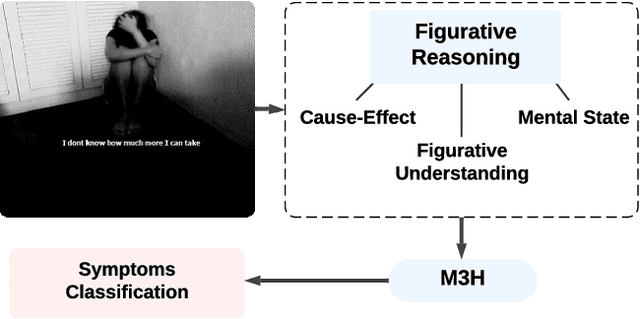

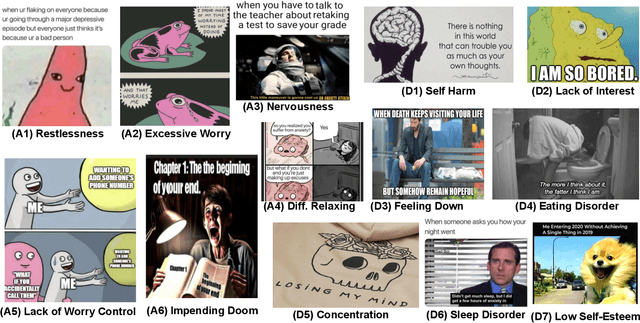
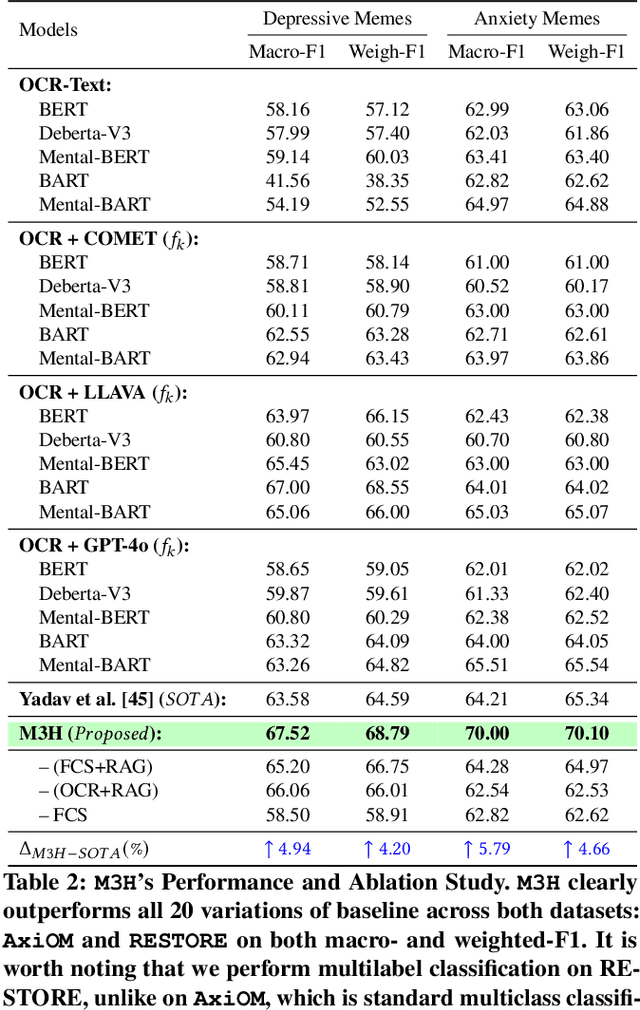
The expression of mental health symptoms through non-traditional means, such as memes, has gained remarkable attention over the past few years, with users often highlighting their mental health struggles through figurative intricacies within memes. While humans rely on commonsense knowledge to interpret these complex expressions, current Multimodal Language Models (MLMs) struggle to capture these figurative aspects inherent in memes. To address this gap, we introduce a novel dataset, AxiOM, derived from the GAD anxiety questionnaire, which categorizes memes into six fine-grained anxiety symptoms. Next, we propose a commonsense and domain-enriched framework, M3H, to enhance MLMs' ability to interpret figurative language and commonsense knowledge. The overarching goal remains to first understand and then classify the mental health symptoms expressed in memes. We benchmark M3H against 6 competitive baselines (with 20 variations), demonstrating improvements in both quantitative and qualitative metrics, including a detailed human evaluation. We observe a clear improvement of 4.20% and 4.66% on weighted-F1 metric. To assess the generalizability, we perform extensive experiments on a public dataset, RESTORE, for depressive symptom identification, presenting an extensive ablation study that highlights the contribution of each module in both datasets. Our findings reveal limitations in existing models and the advantage of employing commonsense to enhance figurative understanding.