 Add to Chrome
 Add to Firefox
 Add to Edge
The Llama 4 Herd: Architecture, Training, Evaluation, and Deployment Notes
Jan 15, 2026
This document consolidates publicly reported technical details about Metas Llama 4 model family. It summarizes (i) released variants (Scout and Maverick) and the broader herd context including the previewed Behemoth teacher model, (ii) architectural characteristics beyond a high-level MoE description covering routed/shared-expert structure, early-fusion multimodality, and long-context design elements reported for Scout (iRoPE and length generalization strategies), (iii) training disclosures spanning pre-training, mid-training for long-context extension, and post-training methodology (lightweight SFT, online RL, and lightweight DPO) as described in release materials, (iv) developer-reported benchmark results for both base and instruction-tuned checkpoints, and (v) practical deployment constraints observed across major serving environments, including provider-specific context limits and quantization packaging. The manuscript also summarizes licensing obligations relevant to redistribution and derivative naming, and reviews publicly described safeguards and evaluation practices. The goal is to provide a compact technical reference for researchers and practitioners who need precise, source-backed facts about Llama 4.

The Llama 3 Herd of Models
Jul 31, 2024Modern artificial intelligence (AI) systems are powered by foundation models. This paper presents a new set of foundation models, called Llama 3. It is a herd of language models that natively support multilinguality, coding, reasoning, and tool usage. Our largest model is a dense Transformer with 405B parameters and a context window of up to 128K tokens. This paper presents an extensive empirical evaluation of Llama 3. We find that Llama 3 delivers comparable quality to leading language models such as GPT-4 on a plethora of tasks. We publicly release Llama 3, including pre-trained and post-trained versions of the 405B parameter language model and our Llama Guard 3 model for input and output safety. The paper also presents the results of experiments in which we integrate image, video, and speech capabilities into Llama 3 via a compositional approach. We observe this approach performs competitively with the state-of-the-art on image, video, and speech recognition tasks. The resulting models are not yet being broadly released as they are still under development.
Prescriptive and Descriptive Approaches to Machine-Learning Transparency
Apr 27, 2022
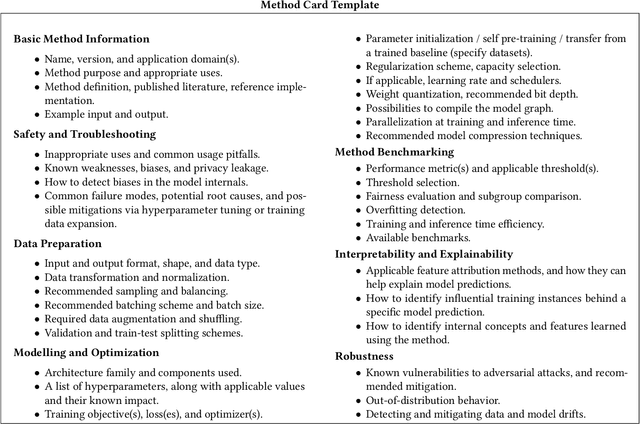
Specialized documentation techniques have been developed to communicate key facts about machine-learning (ML) systems and the datasets and models they rely on. Techniques such as Datasheets, FactSheets, and Model Cards have taken a mainly descriptive approach, providing various details about the system components. While the above information is essential for product developers and external experts to assess whether the ML system meets their requirements, other stakeholders might find it less actionable. In particular, ML engineers need guidance on how to mitigate potential shortcomings in order to fix bugs or improve the system's performance. We survey approaches that aim to provide such guidance in a prescriptive way. We further propose a preliminary approach, called Method Cards, which aims to increase the transparency and reproducibility of ML systems by providing prescriptive documentation of commonly-used ML methods and techniques. We showcase our proposal with an example in small object detection, and demonstrate how Method Cards can communicate key considerations for model developers. We further highlight avenues for improving the user experience of ML engineers based on Method Cards.