 Add to Chrome
 Add to Firefox
 Add to Edge
Benchmarking PDF Parsers on Table Extraction with LLM-based Semantic Evaluation
Mar 19, 2026
Reliably extracting tables from PDFs is essential for large-scale scientific data mining and knowledge base construction, yet existing evaluation approaches rely on rule-based metrics that fail to capture semantic equivalence of table content. We present a benchmarking framework based on synthetically generated PDFs with precise LaTeX ground truth, using tables sourced from arXiv to ensure realistic complexity and diversity. As our central methodological contribution, we apply LLM-as-a-judge for semantic table evaluation, integrated into a matching pipeline that accommodates inconsistencies in parser outputs. Through a human validation study comprising over 1,500 quality judgments on extracted table pairs, we show that LLM-based evaluation achieves substantially higher correlation with human judgment (Pearson r=0.93) compared to Tree Edit Distance-based Similarity (TEDS, r=0.68) and Grid Table Similarity (GriTS, r=0.70). Evaluating 21 contemporary PDF parsers across 100 synthetic documents containing 451 tables reveals significant performance disparities. Our results offer practical guidance for selecting parsers for tabular data extraction and establish a reproducible, scalable evaluation methodology for this critical task. Code and data: https://github.com/phorn1/pdf-parse-bench Metric study and human evaluation: https://github.com/phorn1/table-metric-study

Benchmarking Document Parsers on Mathematical Formula Extraction from PDFs
Dec 10, 2025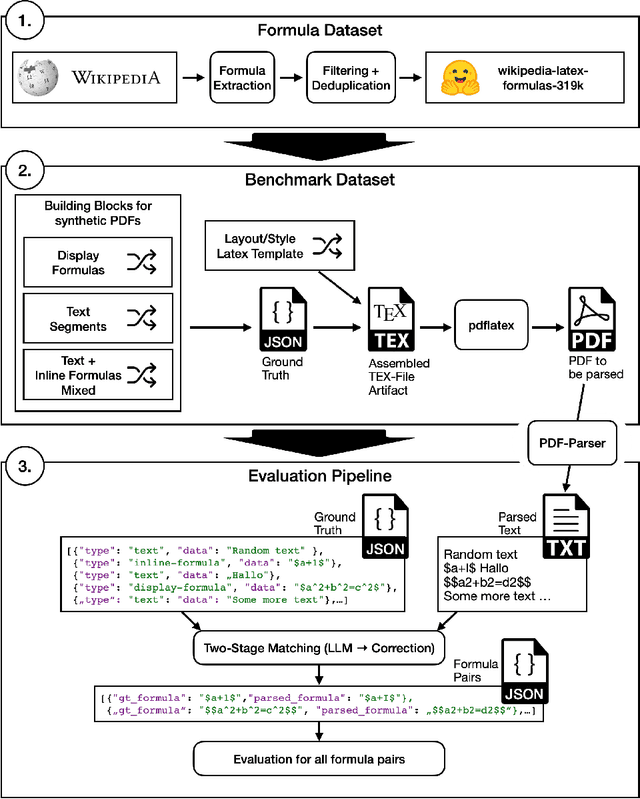
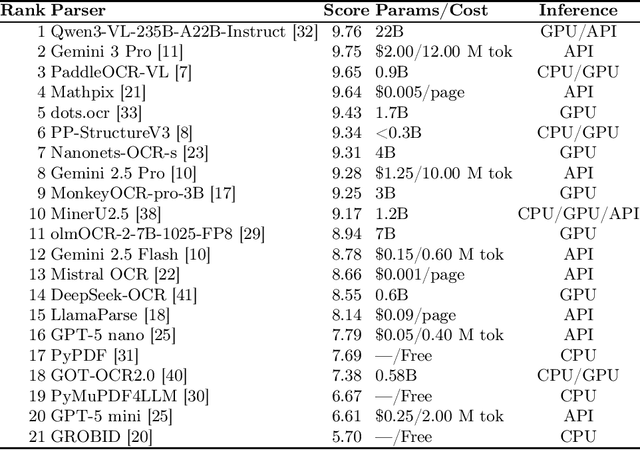
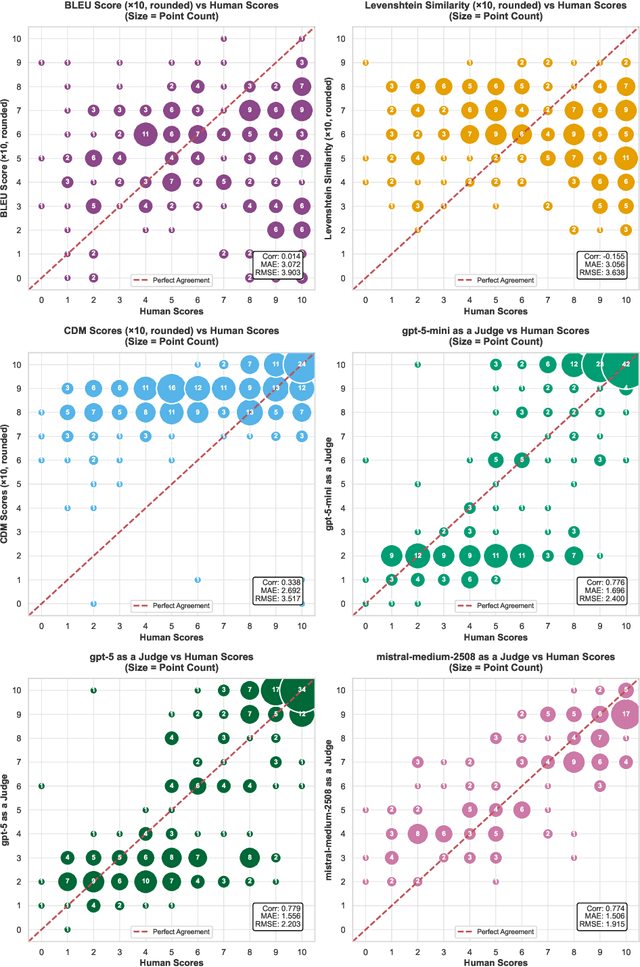
Correctly parsing mathematical formulas from PDFs is critical for training large language models and building scientific knowledge bases from academic literature, yet existing benchmarks either exclude formulas entirely or lack semantically-aware evaluation metrics. We introduce a novel benchmarking framework centered on synthetically generated PDFs with precise LaTeX ground truth, enabling systematic control over layout, formulas, and content characteristics. A key methodological contribution is pioneering LLM-as-a-judge for semantic formula assessment, combined with a robust two-stage matching pipeline that handles parser output inconsistencies. Through human validation on 250 formula pairs (750 ratings from 30 evaluators), we demonstrate that LLM-based evaluation achieves substantially higher correlation with human judgment (Pearson r=0.78) compared to CDM (r=0.34) and text similarity (r~0). Evaluating 20+ contemporary PDF parsers (including specialized OCR models, vision-language models, and rule-based approaches) across 100 synthetic documents with 2,000+ formulas reveals significant performance disparities. Our findings provide crucial insights for practitioners selecting parsers for downstream applications and establish a robust, scalable methodology that enables reproducible evaluation of PDF formula extraction quality. Code and benchmark data: https://github.com/phorn1/pdf-parse-bench