 Add to Chrome
 Add to Firefox
 Add to Edge
A Family of LLMs Liberated from Static Vocabularies
Mar 16, 2026
Tokenization is a central component of natural language processing in current large language models (LLMs), enabling models to convert raw text into processable units. Although learned tokenizers are widely adopted, they exhibit notable limitations, including their large, fixed vocabulary sizes and poor adaptability to new domains or languages. We present a family of models with up to 70 billion parameters based on the hierarchical autoregressive transformer (HAT) architecture. In HAT, an encoder transformer aggregates bytes into word embeddings and then feeds them to the backbone, a classical autoregressive transformer. The outputs of the backbone are then cross-attended by the decoder and converted back into bytes. We show that we can reuse available pre-trained models by converting the Llama 3.1 8B and 70B models into the HAT architecture: Llama-3.1-8B-TFree-HAT and Llama-3.1-70B-TFree-HAT are byte-level models whose encoder and decoder are trained from scratch, but where we adapt the pre-trained Llama backbone, i.e., the transformer blocks with the embedding matrix and head removed, to handle word embeddings instead of the original tokens. We also provide a 7B HAT model, Llama-TFree-HAT-Pretrained, trained entirely from scratch on nearly 4 trillion words. The HAT architecture improves text compression by reducing the number of required sequence positions and enhances robustness to intra-word variations, e.g., spelling differences. Through pre-training, as well as subsequent supervised fine-tuning and direct preference optimization in English and German, we show strong proficiency in both languages, improving on the original Llama 3.1 in most benchmarks. We release our models (including 200 pre-training checkpoints) on Hugging Face.

SOMBRERO: Measuring and Steering Boundary Placement in End-to-End Hierarchical Sequence Models
Jan 30, 2026Hierarchical sequence models replace fixed tokenization with learned segmentations that compress long byte sequences for efficient autoregressive modeling. While recent end-to-end methods can learn meaningful boundaries from the language-modeling objective alone, it remains difficult to quantitatively assess and systematically steer where compute is spent. We introduce a router-agnostic metric of boundary quality, boundary enrichment B, which measures how strongly chunk starts concentrate on positions with high next-byte surprisal. Guided by this metric, we propose Sombrero, which steers boundary placement toward predictive difficulty via a confidence-alignment boundary loss and stabilizes boundary learning by applying confidence-weighted smoothing at the input level rather than on realized chunks. On 1B scale, across UTF-8 corpora covering English and German text as well as code and mathematical content, Sombrero improves the accuracy-efficiency trade-off and yields boundaries that more consistently align compute with hard-to-predict positions.
Hierarchical Autoregressive Transformers: Combining Byte-~and Word-Level Processing for Robust, Adaptable Language Models
Jan 17, 2025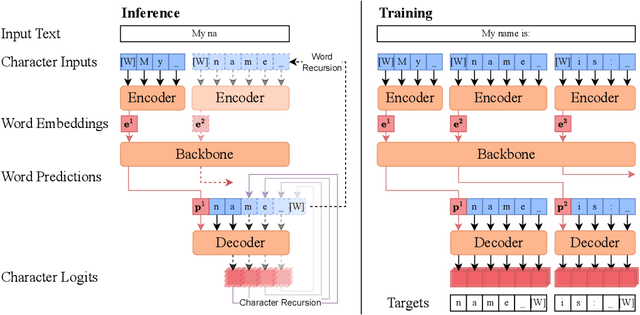


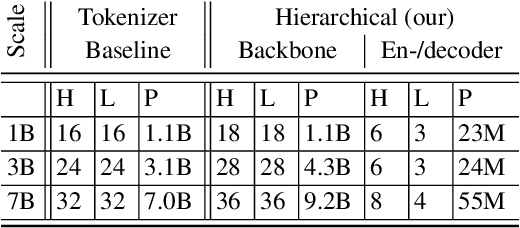
Tokenization is a fundamental step in natural language processing, breaking text into units that computational models can process. While learned subword tokenizers have become the de-facto standard, they present challenges such as large vocabularies, limited adaptability to new domains or languages, and sensitivity to spelling errors and variations. To overcome these limitations, we investigate a hierarchical architecture for autoregressive language modelling that combines character-level and word-level processing. It employs a lightweight character-level encoder to convert character sequences into word embeddings, which are then processed by a word-level backbone model and decoded back into characters via a compact character-level decoder. This method retains the sequence compression benefits of word-level tokenization without relying on a rigid, predefined vocabulary. We demonstrate, at scales up to 7 billion parameters, that hierarchical transformers match the downstream task performance of subword-tokenizer-based models while exhibiting significantly greater robustness to input perturbations. Additionally, during continued pretraining on an out-of-domain language, our model trains almost twice as fast, achieves superior performance on the target language, and retains more of its previously learned knowledge. Hierarchical transformers pave the way for NLP systems that are more robust, flexible, and generalizable across languages and domains.