 Add to Chrome
 Add to Firefox
 Add to Edge
Tools Are Not Islands: Set-Level Tool Retrieval for LLM Agents via Query-Conditioned Hyperedge Prediction
Jul 29, 2026
Large language model (LLM) agents increasingly rely on invoking external tools to complete real-world tasks. Tool retrieval, which selects a small task-relevant subset from a library of thousands of tools before the agent acts, has therefore become a critical component of LLM agent pipelines. However, existing retrievers either score each tool in isolation or assemble the tool set sequentially, so the joint utility of a candidate set is never evaluated as a whole. In this paper, we propose HYSET, short for HYperedge-based SEt-level Tool retrieval. Our contributions are threefold: (i) we formulate tool retrieval as query-conditioned hyperedge prediction on a tool co-invocation hypergraph, under which the tool set itself becomes the unit of scoring and most existing retrieval paradigms reduce to restricted instances; (ii) we capture size-dependent tool compatibility through cardinality-specific interactions; and (iii) we design HYSET as a pre-selection module requiring no modification to the downstream agent. Experiments on ToolBench demonstrate that HYSET consistently outperforms state-of-the-art baselines in both tool retrieval performance and end-to-end task success. Beyond the in-domain setting, HYSET further supports zero-shot/few-shot transfer, generalizing to held-out tools/categories and unseen domains with minimal supervision.

Statistical ranking with dynamic covariates
Jun 24, 2024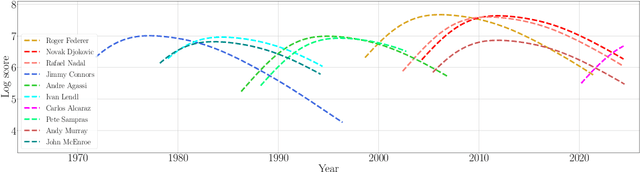

We consider a covariate-assisted ranking model grounded in the Plackett--Luce framework. Unlike existing works focusing on pure covariates or individual effects with fixed covariates, our approach integrates individual effects with dynamic covariates. This added flexibility enhances realistic ranking yet poses significant challenges for analyzing the associated estimation procedures. This paper makes an initial attempt to address these challenges. We begin by discussing the sufficient and necessary condition for the model's identifiability. We then introduce an efficient alternating maximization algorithm to compute the maximum likelihood estimator (MLE). Under suitable assumptions on the topology of comparison graphs and dynamic covariates, we establish a quantitative uniform consistency result for the MLE with convergence rates characterized by the asymptotic graph connectivity. The proposed graph topology assumption holds for several popular random graph models under optimal leading-order sparsity conditions. A comprehensive numerical study is conducted to corroborate our theoretical findings and demonstrate the application of the proposed model to real-world datasets, including horse racing and tennis competitions.