 Add to Chrome
 Add to Firefox
 Add to Edge
TEAM: Temporal-Spatial Consistency Guided Expert Activation for MoE Diffusion Language Model Acceleration
Feb 09, 2026
Diffusion large language models (dLLMs) have recently gained significant attention due to their inherent support for parallel decoding. Building on this paradigm, Mixture-of-Experts (MoE) dLLMs with autoregressive (AR) initialization have further demonstrated strong performance competitive with mainstream AR models. However, we identify a fundamental mismatch between MoE architectures and diffusion-based decoding. Specifically, a large number of experts are activated at each denoising step, while only a small subset of tokens is ultimately accepted, resulting in substantial inference overhead and limiting their deployment in latency-sensitive applications. In this work, we propose TEAM, a plug-and-play framework that accelerates MoE dLLMs by enabling more accepted tokens with fewer activated experts. TEAM is motivated by the observation that expert routing decisions exhibit strong temporal consistency across denoising levels as well as spatial consistency across token positions. Leveraging these properties, TEAM employs three complementary expert activation and decoding strategies, conservatively selecting necessary experts for decoded and masked tokens and simultaneously performing aggressive speculative exploration across multiple candidates. Experimental results demonstrate that TEAM achieves up to 2.2x speedup over vanilla MoE dLLM, with negligible performance degradation. Code is released at https://github.com/PKU-SEC-Lab/TEAM-MoE-dLLM.

Breaking the Blocks: Continuous Low-Rank Decomposed Scaling for Unified LLM Quantization and Adaptation
Jan 30, 2026Current quantization methods for LLMs predominantly rely on block-wise structures to maintain efficiency, often at the cost of representational flexibility. In this work, we demonstrate that element-wise quantization can be made as efficient as block-wise scaling while providing strictly superior expressive power by modeling the scaling manifold as continuous low-rank matrices ($S = BA$). We propose Low-Rank Decomposed Scaling (LoRDS), a unified framework that rethinks quantization granularity through this low-rank decomposition. By "breaking the blocks" of spatial constraints, LoRDS establishes a seamless efficiency lifecycle: it provides high-fidelity PTQ initialization refined via iterative optimization, enables joint QAT of weights and scaling factors, and facilitates high-rank multiplicative PEFT adaptation. Unlike additive PEFT approaches such as QLoRA, LoRDS enables high-rank weight updates within a low-rank budget while incurring no additional inference overhead. Supported by highly optimized Triton kernels, LoRDS consistently outperforms state-of-the-art baselines across various model families in both quantization and downstream fine-tuning tasks. Notably, on Llama3-8B, our method achieves up to a 27.0% accuracy improvement at 3 bits over NormalFloat quantization and delivers a 1.5x inference speedup on NVIDIA RTX 4090 while enhancing PEFT performance by 9.6% on downstream tasks over 4bit QLoRA, offering a robust and integrated solution for unified compression and adaptation of LLMs.
Knowledge is Not Enough: Injecting RL Skills for Continual Adaptation
Jan 16, 2026Large Language Models (LLMs) face the "knowledge cutoff" challenge, where their frozen parametric memory prevents direct internalization of new information. While Supervised Fine-Tuning (SFT) is commonly used to update model knowledge, it often updates factual content without reliably improving the model's ability to use the newly incorporated information for question answering or decision-making. Reinforcement Learning (RL) is essential for acquiring reasoning skills; however, its high computational cost makes it impractical for efficient online adaptation. We empirically observe that the parameter updates induced by SFT and RL are nearly orthogonal. Based on this observation, we propose Parametric Skill Transfer (PaST), a framework that supports modular skill transfer for efficient and effective knowledge adaptation. By extracting a domain-agnostic Skill Vector from a source domain, we can linearly inject knowledge manipulation skills into a target model after it has undergone lightweight SFT on new data. Experiments on knowledge-incorporation QA (SQuAD, LooGLE) and agentic tool-use benchmarks (ToolBench) demonstrate the effectiveness of our method. On SQuAD, PaST outperforms the state-of-the-art self-editing SFT baseline by up to 9.9 points. PaST further scales to long-context QA on LooGLE with an 8.0-point absolute accuracy gain, and improves zero-shot ToolBench success rates by +10.3 points on average with consistent gains across tool categories, indicating strong scalability and cross-domain transferability of the Skill Vector.
HD-PiSSA: High-Rank Distributed Orthogonal Adaptation
May 24, 2025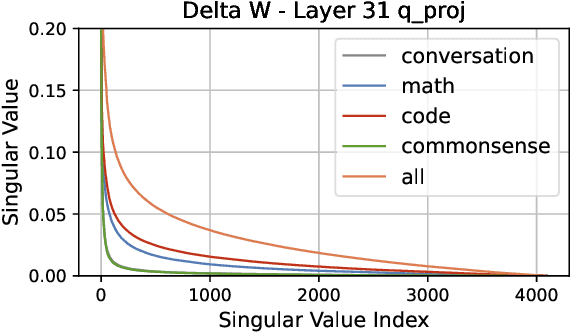
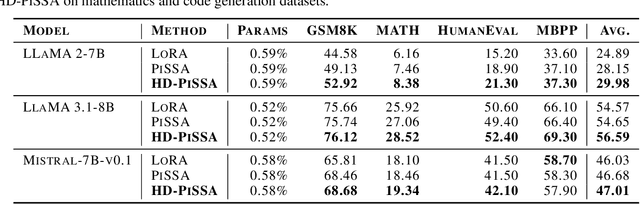
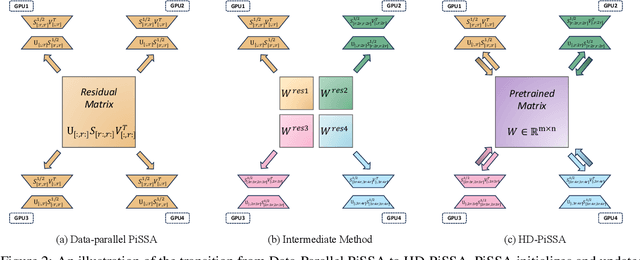
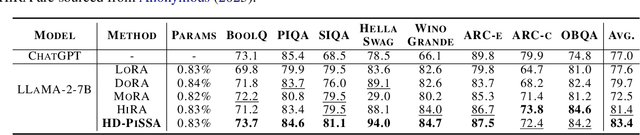
Existing parameter-efficient fine-tuning (PEFT) methods for large language models (LLMs), such as LoRA and PiSSA, constrain model updates to low-rank subspaces, limiting their expressiveness and leading to suboptimal performance on complex tasks. To address this, we introduce High-rank Distributed PiSSA (HD-PiSSA), a distributed PEFT approach that initializes orthogonal adapters across different devices and aggregates their delta updates collectively on W for fine-tuning. Unlike Data Parallel LoRA or PiSSA, which maintain identical adapters across all devices, HD-PiSSA assigns different principal components of the pre-trained weights to each GPU, significantly expanding the range of update directions. This results in over 16x higher effective updated ranks than data-parallel LoRA or PiSSA when fine-tuning on 8 GPUs with the same per-device adapter rank. Empirically, we evaluate HD-PiSSA across various challenging downstream tasks, including mathematics, code generation, and multi-task learning. In the multi-task setting, HD-PiSSA achieves average gains of 10.0 absolute points (14.63%) over LoRA and 4.98 points (6.60%) over PiSSA across 12 benchmarks, demonstrating its benefits from the extra optimization flexibility.