 Add to Chrome
 Add to Firefox
 Add to Edge
Incremental, inconsistency-resilient reasoning over Description Logic Abox streams
Mar 02, 2026
More and more, data is being produced in a streaming fashion. This has led to increased interest into how actionable insights can be extracted in real time from data streams through Stream Reasoning. Reasoning over data streams raises multiple challenges, notably the high velocity of data, the real time requirement of the reasoning, and the noisy and volatile nature of streams. This paper proposes novel semantics for incremental reasoning over streams of Description Logic ABoxes, in order to tackle these challenges. To address the first two challenges, our semantics for reasoning over sliding windows on streams allow for incrementally computing the materialization of the window based on the materialization of the previous window. Furthermore, to deal with the volatile nature of streams, we present novel semantics for inconsistency repair on such windows, based on preferred repair semantics. We then detail our proposed semi-naive algorithms for incremental materialization maintenance in the case of OWL2 RL, both in the presence of inconsistencies and without.

Walk Extraction Strategies for Node Embeddings with RDF2Vec in Knowledge Graphs
Sep 09, 2020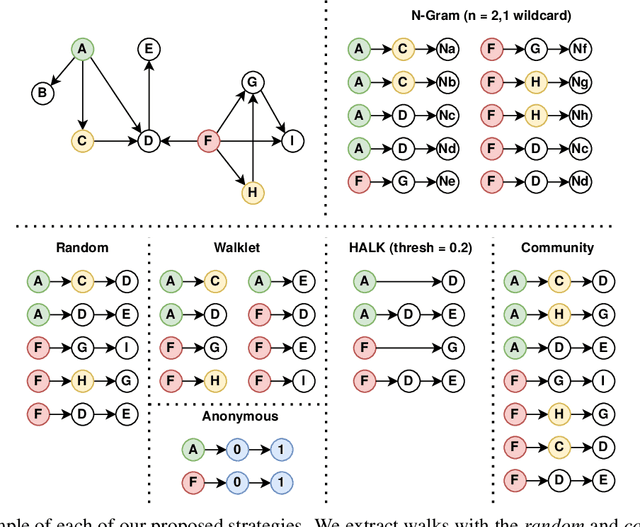
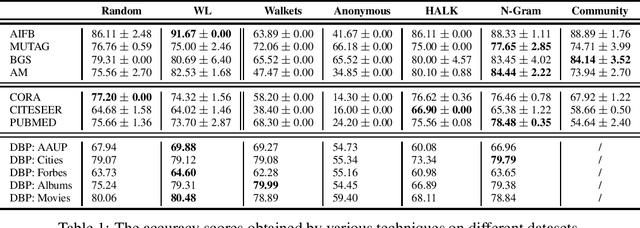
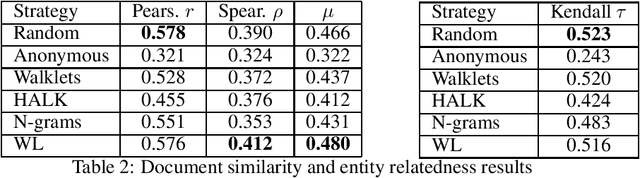
As KGs are symbolic constructs, specialized techniques have to be applied in order to make them compatible with data mining techniques. RDF2Vec is an unsupervised technique that can create task-agnostic numerical representations of the nodes in a KG by extending successful language modelling techniques. The original work proposed the Weisfeiler-Lehman (WL) kernel to improve the quality of the representations. However, in this work, we show both formally and empirically that the WL kernel does little to improve walk embeddings in the context of a single KG. As an alternative to the WL kernel, we propose five different strategies to extract information complementary to basic random walks. We compare these walks on several benchmark datasets to show that the \emph{n-gram} strategy performs best on average on node classification tasks and that tuning the walk strategy can result in improved predictive performances.