 Add to Chrome
 Add to Firefox
 Add to Edge
Build on Priors: Vision--Language--Guided Neuro-Symbolic Imitation Learning for Data-Efficient Real-World Robot Manipulation
Apr 04, 2026
Enabling robots to learn long-horizon manipulation tasks from a handful of demonstrations remains a central challenge in robotics. Existing neuro-symbolic approaches often rely on hand-crafted symbolic abstractions, semantically labeled trajectories or large demonstration datasets, limiting their scalability and real-world applicability. We present a scalable neuro-symbolic framework that autonomously constructs symbolic planning domains and data-efficient control policies from as few as one to thirty unannotated skill demonstrations, without requiring manual domain engineering. Our method segments demonstrations into skills and employs a Vision-Language Model (VLM) to classify skills and identify equivalent high-level states, enabling automatic construction of a state-transition graph. This graph is processed by an Answer Set Programming solver to synthesize a PDDL planning domain, which an oracle function exploits to isolate the minimal, task-relevant and target relative observation and action spaces for each skill policy. Policies are learned at the control reference level rather than at the raw actuator signal level, yielding a smoother and less noisy learning target. Known controllers can be leveraged for real-world data augmentation by projecting a single demonstration onto other objects in the scene, simultaneously enriching the graph construction process and the dataset for imitation learning. We validate our framework primarily on a real industrial forklift across statistically rigorous manipulation trials, and demonstrate cross-platform generality on a Kinova Gen3 robotic arm across two standard benchmarks. Our results show that grounding control learning, VLM-driven abstraction, and automated planning synthesis into a unified pipeline constitutes a practical path toward scalable, data-efficient, expert-free and interpretable neuro-symbolic robotics.

Novelty Adaptation Through Hybrid Large Language Model (LLM)-Symbolic Planning and LLM-guided Reinforcement Learning
Mar 11, 2026In dynamic open-world environments, autonomous agents often encounter novelties that hinder their ability to find plans to achieve their goals. Specifically, traditional symbolic planners fail to generate plans when the robot's planning domain lacks the operators that enable it to interact appropriately with novel objects in the environment. We propose a neuro-symbolic architecture that integrates symbolic planning, reinforcement learning, and a large language model (LLM) to learn how to handle novel objects. In particular, we leverage the common sense reasoning capability of the LLM to identify missing operators, generate plans with the symbolic AI planner, and write reward functions to guide the reinforcement learning agent in learning control policies for newly identified operators. Our method outperforms the state-of-the-art methods in operator discovery as well as operator learning in continuous robotic domains.
The Price Is Not Right: Neuro-Symbolic Methods Outperform VLAs on Structured Long-Horizon Manipulation Tasks with Significantly Lower Energy Consumption
Feb 22, 2026Vision-Language-Action (VLA) models have recently been proposed as a pathway toward generalist robotic policies capable of interpreting natural language and visual inputs to generate manipulation actions. However, their effectiveness and efficiency on structured, long-horizon manipulation tasks remain unclear. In this work, we present a head-to-head empirical comparison between a fine-tuned open-weight VLA model π0 and a neuro-symbolic architecture that combines PDDL-based symbolic planning with learned low-level control. We evaluate both approaches on structured variants of the Towers of Hanoi manipulation task in simulation while measuring both task performance and energy consumption during training and execution. On the 3-block task, the neuro-symbolic model achieves 95% success compared to 34% for the best-performing VLA. The neuro-symbolic model also generalizes to an unseen 4-block variant (78% success), whereas both VLAs fail to complete the task. During training, VLA fine-tuning consumes nearly two orders of magnitude more energy than the neuro-symbolic approach. These results highlight important trade-offs between end-to-end foundation-model approaches and structured reasoning architectures for long-horizon robotic manipulation, emphasizing the role of explicit symbolic structure in improving reliability, data efficiency, and energy efficiency. Code and models are available at https://price-is-not-right.github.io
Few-Shot Neuro-Symbolic Imitation Learning for Long-Horizon Planning and Acting
Aug 29, 2025Imitation learning enables intelligent systems to acquire complex behaviors with minimal supervision. However, existing methods often focus on short-horizon skills, require large datasets, and struggle to solve long-horizon tasks or generalize across task variations and distribution shifts. We propose a novel neuro-symbolic framework that jointly learns continuous control policies and symbolic domain abstractions from a few skill demonstrations. Our method abstracts high-level task structures into a graph, discovers symbolic rules via an Answer Set Programming solver, and trains low-level controllers using diffusion policy imitation learning. A high-level oracle filters task-relevant information to focus each controller on a minimal observation and action space. Our graph-based neuro-symbolic framework enables capturing complex state transitions, including non-spatial and temporal relations, that data-driven learning or clustering techniques often fail to discover in limited demonstration datasets. We validate our approach in six domains that involve four robotic arms, Stacking, Kitchen, Assembly, and Towers of Hanoi environments, and a distinct Automated Forklift domain with two environments. The results demonstrate high data efficiency with as few as five skill demonstrations, strong zero- and few-shot generalizations, and interpretable decision making.
Curiosity-Driven Imagination: Discovering Plan Operators and Learning Associated Policies for Open-World Adaptation
Mar 06, 2025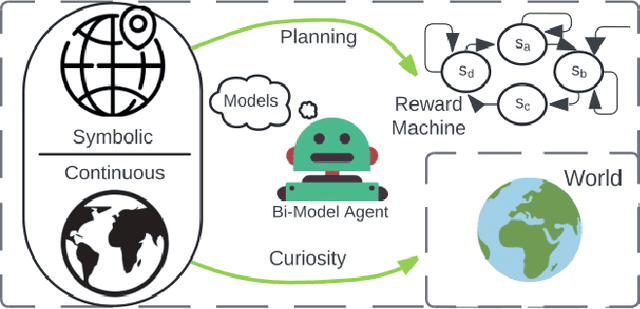

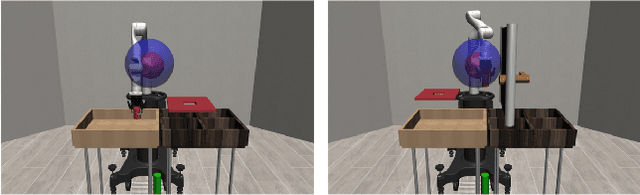
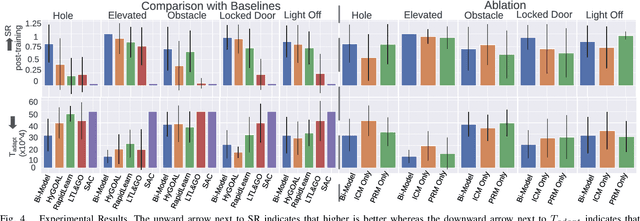
Adapting quickly to dynamic, uncertain environments-often called "open worlds"-remains a major challenge in robotics. Traditional Task and Motion Planning (TAMP) approaches struggle to cope with unforeseen changes, are data-inefficient when adapting, and do not leverage world models during learning. We address this issue with a hybrid planning and learning system that integrates two models: a low level neural network based model that learns stochastic transitions and drives exploration via an Intrinsic Curiosity Module (ICM), and a high level symbolic planning model that captures abstract transitions using operators, enabling the agent to plan in an "imaginary" space and generate reward machines. Our evaluation in a robotic manipulation domain with sequential novelty injections demonstrates that our approach converges faster and outperforms state-of-the-art hybrid methods.