 Add to Chrome
 Add to Firefox
 Add to Edge
Bayes-MICE: A Bayesian Approach to Multiple Imputation for Time Series Data
Mar 28, 2026
Time-series analysis is often affected by missing data, a common problem across several fields, including healthcare and environmental monitoring. Multiple Imputation by Chained Equations (MICE) has been prominent for imputing missing values through "fully conditional specification". We extend MICE using the Bayesian framework (Bayes-MICE), utilising Bayesian inference to impute missing values via Markov Chain Monte Carlo (MCMC) sampling to account for uncertainty in MICE model parameters and imputed values. We also include temporally informed initialisation and time-lagged features in the model to respect the sequential nature of time-series data. We evaluate the Bayes-MICE method using two real-world datasets (AirQuality and PhysioNet), and using both the Random Walk Metropolis (RWM) and the Metropolis-Adjusted Langevin Algorithm (MALA) samplers. Our results demonstrate that Bayes-MICE reduces imputation errors relative to the baseline methods over all variables and accounts for uncertainty in the imputation process, thereby providing a more accurate measure of imputation error. We also found that MALA converges faster than RWM, achieving comparable accuracy while providing more consistent posterior exploration. Overall, these findings suggest that the Bayes-MICE framework represents a practical and efficient approach to time-series imputation, balancing increased accuracy with meaningful quantification of uncertainty in various environmental and clinical settings.

Manifold Dimension Estimation: An Empirical Study
Sep 19, 2025The manifold hypothesis suggests that high-dimensional data often lie on or near a low-dimensional manifold. Estimating the dimension of this manifold is essential for leveraging its structure, yet existing work on dimension estimation is fragmented and lacks systematic evaluation. This article provides a comprehensive survey for both researchers and practitioners. We review often-overlooked theoretical foundations and present eight representative estimators. Through controlled experiments, we analyze how individual factors such as noise, curvature, and sample size affect performance. We also compare the estimators on diverse synthetic and real-world datasets, introducing a principled approach to dataset-specific hyperparameter tuning. Our results offer practical guidance and suggest that, for a problem of this generality, simpler methods often perform better.
A Machine Learning Framework for Handling Unreliable Absence Label and Class Imbalance for Marine Stinger Beaching Prediction
Jan 20, 2025
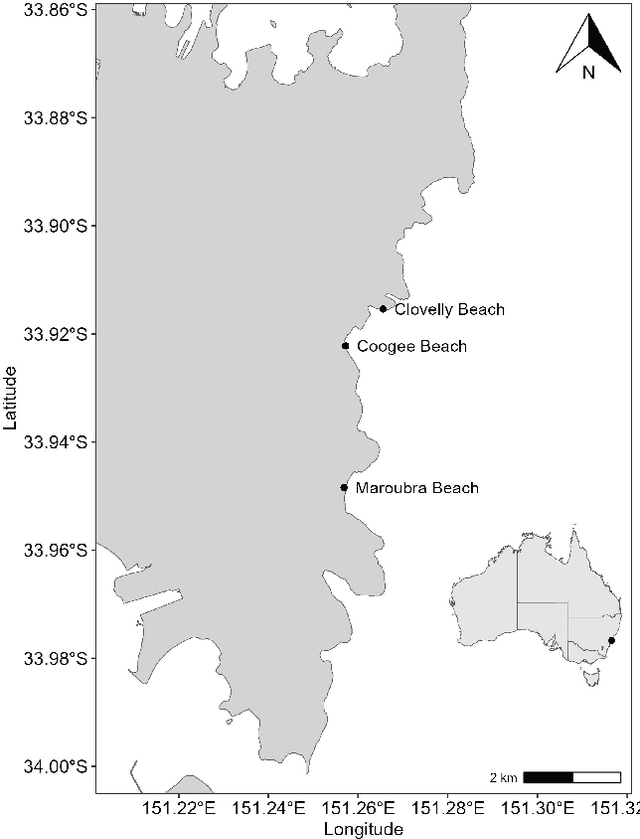
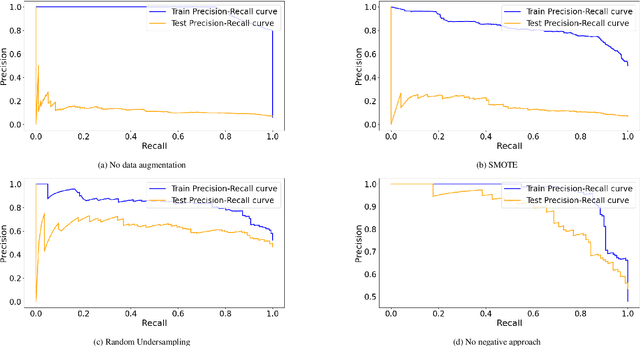
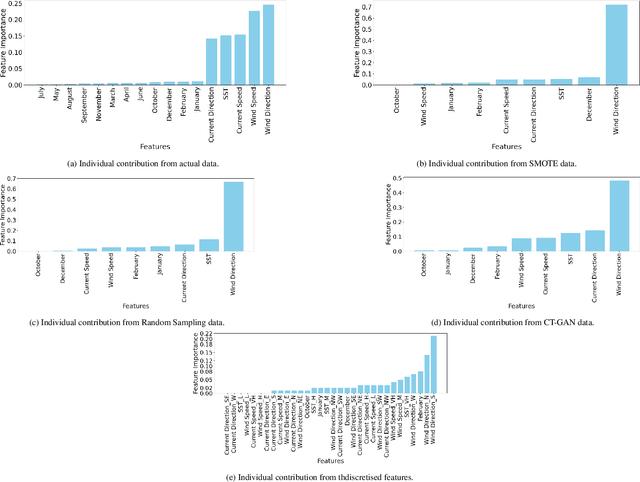
Bluebottles (\textit{Physalia} spp.) are marine stingers resembling jellyfish, whose presence on Australian beaches poses a significant public risk due to their venomous nature. Understanding the environmental factors driving bluebottles ashore is crucial for mitigating their impact, and machine learning tools are to date relatively unexplored. We use bluebottle marine stinger presence/absence data from beaches in Eastern Sydney, Australia, and compare machine learning models (Multilayer Perceptron, Random Forest, and XGBoost) to identify factors influencing their presence. We address challenges such as class imbalance, class overlap, and unreliable absence data by employing data augmentation techniques, including the Synthetic Minority Oversampling Technique (SMOTE), Random Undersampling, and Synthetic Negative Approach that excludes the negative class. Our results show that SMOTE failed to resolve class overlap, but the presence-focused approach effectively handled imbalance, class overlap, and ambiguous absence data. The data attributes such as the wind direction, which is a circular variable, emerged as a key factor influencing bluebottle presence, confirming previous inference studies. However, in the absence of population dynamics, biological behaviours, and life cycles, the best predictive model appears to be Random Forests combined with Synthetic Negative Approach. This research contributes to mitigating the risks posed by bluebottles to beachgoers and provides insights into handling class overlap and unreliable negative class in environmental modelling.
A Unified Parallel Algorithm for Regularized Group PLS Scalable to Big Data
Feb 23, 2017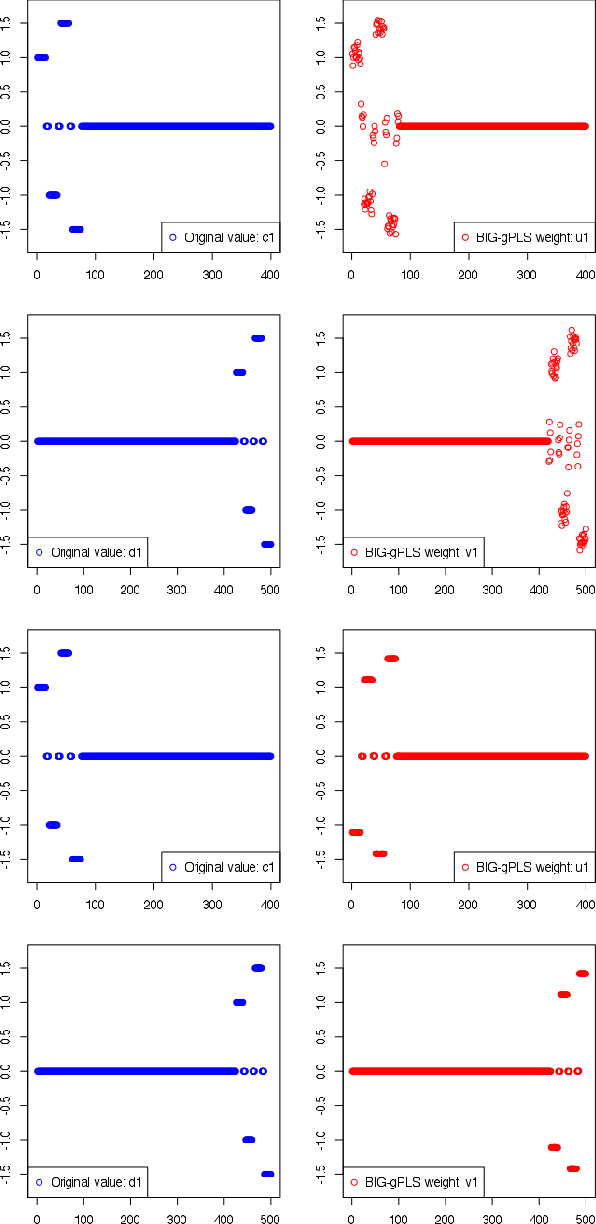
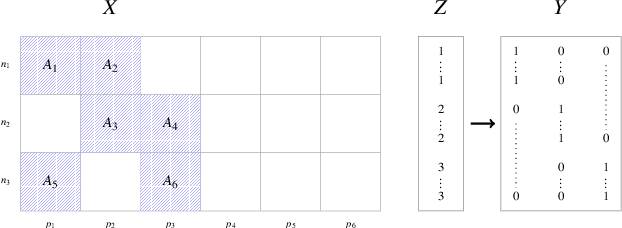
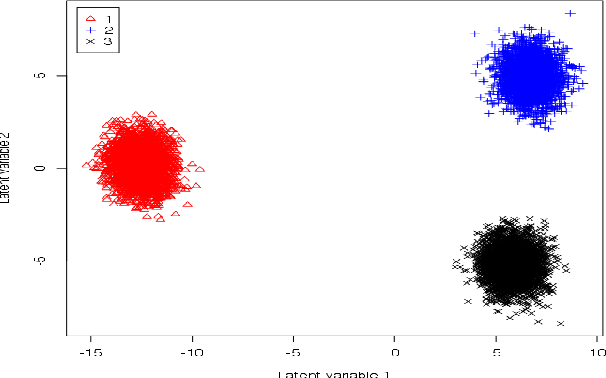
Partial Least Squares (PLS) methods have been heavily exploited to analyse the association between two blocs of data. These powerful approaches can be applied to data sets where the number of variables is greater than the number of observations and in presence of high collinearity between variables. Different sparse versions of PLS have been developed to integrate multiple data sets while simultaneously selecting the contributing variables. Sparse modelling is a key factor in obtaining better estimators and identifying associations between multiple data sets. The cornerstone of the sparsity version of PLS methods is the link between the SVD of a matrix (constructed from deflated versions of the original matrices of data) and least squares minimisation in linear regression. We present here an accurate description of the most popular PLS methods, alongside their mathematical proofs. A unified algorithm is proposed to perform all four types of PLS including their regularised versions. Various approaches to decrease the computation time are offered, and we show how the whole procedure can be scalable to big data sets.