 Add to Chrome
 Add to Firefox
 Add to Edge
Continuous-time nonlinear closed-loop in-memory computing for high-accuracy massive MIMO detection
Jul 03, 2026
Analog in-memory computing (IMC) has emerged as a promising approach for accelerating matrix operations by exploiting the intrinsic physics of memory arrays. To date, however, most IMC architectures have focused on linear algebra workloads in which computation is encoded in the equilibrium state of a physical system. Extending these principles to nonlinear optimization remains challenging and typically relies on iterative algorithms composed of repeated linear operations. Here, we introduce a continuous-time nonlinear closed-loop IMC architecture for box-constrained zero-forcing (BCZF) decoding in massive multiple-input multiple-output (MIMO) systems. The proposed architecture embeds the decoding problem directly within the dynamics of a nonlinear feedback network of memory arrays and supply-limited operational amplifiers, allowing solutions to emerge through continuous-time physical optimization. We derive a compact analytical model of the circuit and show that its trajectories minimize an equivalent energy function. Experimental emulation using a fabricated IMC chip confirms the predicted dynamics under realistic hardware nonidealities for up to 16x16 MIMO systems. To overcome the finite precision of analog hardware, we extend mixed-precision iterative refinement from linear algebra to nonlinear continuous-time optimization, enabling reliable detection of high-order modulation formats including 256-QAM. Benchmark projections indicate operation from ultra-low-energy approximate decoding to high-accuracy massive MIMO detection. Together, these results extend closed-loop IMC from equilibrium-based linear algebra to continuous-time nonlinear optimization and establish a pathway toward efficient physical accelerators for high-accuracy wireless communications.

Modern analog computing for solving differential and matrix equations
Jun 11, 2026In recent years, driven by the computational demands of data-intensive applications such as artificial intelligence and scientific computing, analog computing has gained renewed interest. Given the diversity of computational tasks and recent advancements in analog CMOS circuits and resistive memory technologies, we refer to the evolving landscape as modern analog computing. In this context, we identify three core computational primitives: solving differential equations, solving matrix equations, and performing matrix-vector multiplications, and we explore the connections among them. We also examine various hardware implementations of these analog computing operators, including those built with discrete components, integrated circuits, and resistive memory devices. Among these, resistive memory arrays emerge as particularly promising due to their implementation efficiency. The paper then surveys recent progress in leveraging modern analog computing to solve differential and matrix equations using both advanced analog CMOS circuits and resistive memory arrays. Finally, we discuss the applications of these circuits, the precision and scalability issues and their potential solutions, the relationship with in-memory computing, and the unique computational complexity of analog computing. This paper provides a unified perspective on analog computing, highlighting its strengths, current developments, and challenges, and positioning it as a pivotal enabler of next-generation computational frontiers.
Roadmap to Neuromorphic Computing with Emerging Technologies
Jul 02, 2024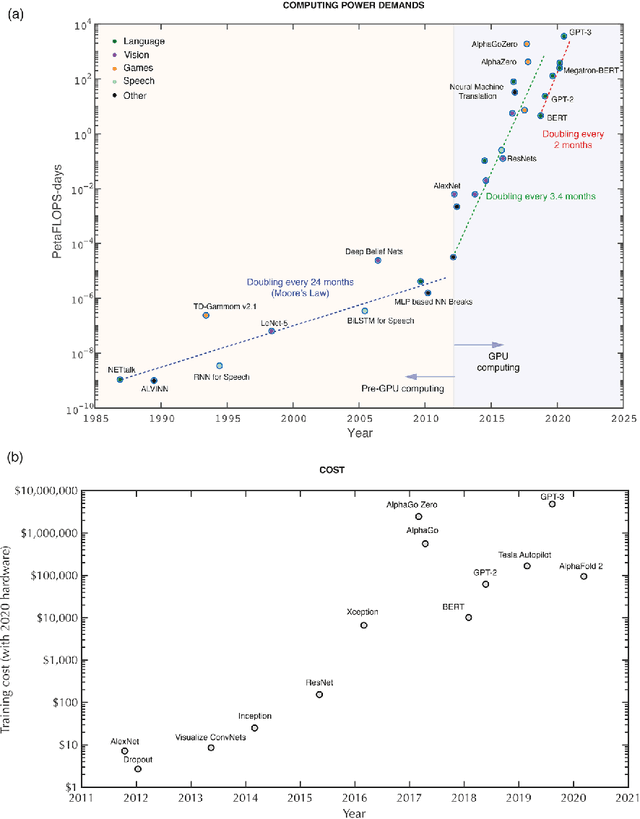


The roadmap is organized into several thematic sections, outlining current computing challenges, discussing the neuromorphic computing approach, analyzing mature and currently utilized technologies, providing an overview of emerging technologies, addressing material challenges, exploring novel computing concepts, and finally examining the maturity level of emerging technologies while determining the next essential steps for their advancement.