 Add to Chrome
 Add to Firefox
 Add to Edge
Beyond Cross-Reconstruction: Probing-Based Disentanglement Evaluation for Acoustic Teleportation Codecs
Jun 30, 2026
Some neural audio codecs disentangle speech into latent subspaces encoding content, speaker identity, and acoustics, enabling acoustic teleportation and voice conversion. Existing evaluations rely on cross-reconstruction quality, which cannot reliably detect leakage across partitions. We extend a probing based framework to assess disentanglement by regressing room-acoustic parameters (reverberation time, clarity, and direct-to-reverberant ratio) and classifying speaker identity, using the gap between intended and unintended partitions as the disentanglement measure. Applied to an acoustic teleportation codec, we find speaker identity is largely confined to its partition, while acoustics leak into the speech embeddings due to the training objective. Acoustic embeddings blindly estimate room parameters within 0.02 s of supervised baselines, indicating physically meaningful structure emerges without explicit supervision.

Robust Speech Activity Detection in the Presence of Singing Voice
Dec 10, 2025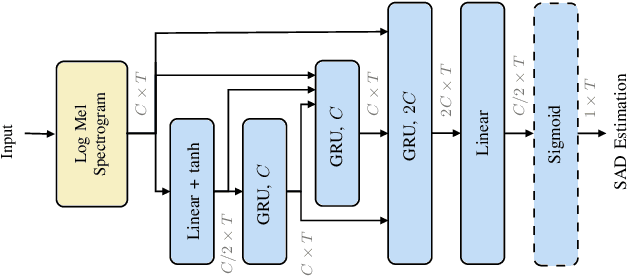
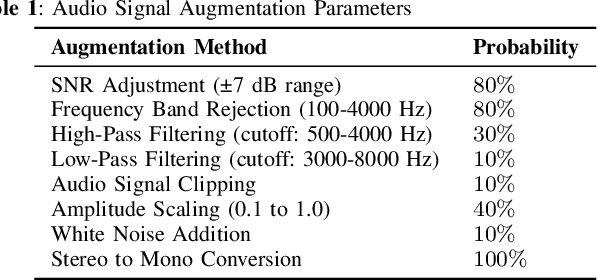
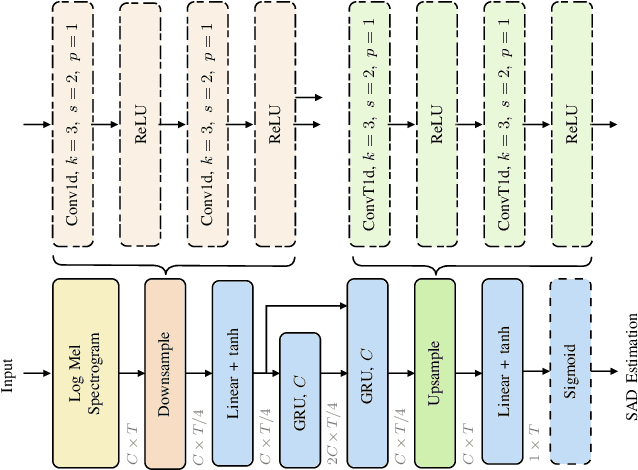
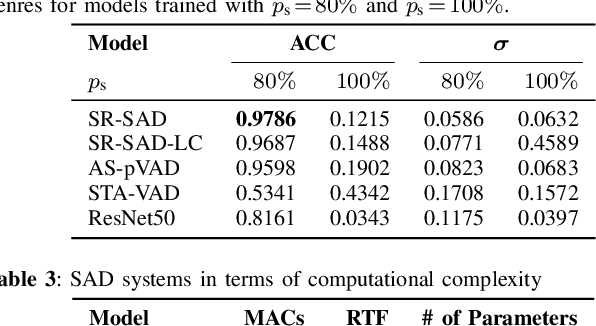
Speech Activity Detection (SAD) systems often misclassify singing as speech, leading to degraded performance in applications such as dialogue enhancement and automatic speech recognition. We introduce Singing-Robust Speech Activity Detection ( SR-SAD ), a neural network designed to robustly detect speech in the presence of singing. Our key contributions are: i) a training strategy using controlled ratios of speech and singing samples to improve discrimination, ii) a computationally efficient model that maintains robust performance while reducing inference runtime, and iii) a new evaluation metric tailored to assess SAD robustness in mixed speech-singing scenarios. Experiments on a challenging dataset spanning multiple musical genres show that SR-SAD maintains high speech detection accuracy (AUC = 0.919) while rejecting singing. By explicitly learning to distinguish between speech and singing, SR-SAD enables more reliable SAD in mixed speech-singing scenarios.
* This paper has been published in: 2025 IEEE Workshop on Applications of Signal Processing to Audio and Acoustics (WASPAA)
On the Relation Between Speech Quality and Quantized Latent Representations of Neural Codecs
Mar 05, 2025Neural audio signal codecs have attracted significant attention in recent years. In essence, the impressive low bitrate achieved by such encoders is enabled by learning an abstract representation that captures the properties of encoded signals, e.g., speech. In this work, we investigate the relation between the latent representation of the input signal learned by a neural codec and the quality of speech signals. To do so, we introduce Latent-representation-to-Quantization error Ratio (LQR) measures, which quantify the distance from the idealized neural codec's speech signal model for a given speech signal. We compare the proposed metrics to intrusive measures as well as data-driven supervised methods using two subjective speech quality datasets. This analysis shows that the proposed LQR correlates strongly (up to 0.9 Pearson's correlation) with the subjective quality of speech. Despite being a non-intrusive metric, this yields a competitive performance with, or even better than, other pre-trained and intrusive measures. These results show that LQR is a promising basis for more sophisticated speech quality measures.