 Add to Chrome
 Add to Firefox
 Add to Edge
OOD Detection for EEG-based Machine Learning in High-Risk Environments
Aug 18, 2026
Machine learning models for electroencephalography (EEG) analysis show great promise across a wide range of applications, but their deployment in high-risk domains is hindered by their vulnerability to distribution shifts. Encountering out-of-distribution (OOD) data can lead to catastrophic, overconfident predictive failures. While OOD detection methods can mitigate these risks, they remain heavily under-explored for EEG. Moreover, evaluations in the broader literature typically evaluate OOD detection performance in isolation, ignoring their practical impact on downstream applications. To bridge this gap, we introduce a benchmark for EEG OOD detection, evaluate a broad range of methods, and furthermore evaluate their value in two clinical downstream prediction task. Our results disentangle OOD detection and model uncertainty estimation capabilities, which are frequently conflated in the literature, provide actionable insights about the current state of the art for EEG OOD detection and model uncertainty estimation, and demonstrate how complementary methods for both aspects can be combined to form a robust safety net for the deployment of EEG-based machine learning models in real-world applications.

The Signal in the Noise: OOD Detection Through Goodness-of-Fit Testing in Factorised Latent Spaces
May 21, 2026Deep generative models offer a natural foundation for out-of-distribution (OOD) detection, yet prior work has shown that their assigned likelihoods are notoriously unreliable indicators for in- vs out-of-distribution data. In this paper, we address this problem by leveraging the diffeomorphic and mass-preserving properties of continuous normalising flows. Our analysis shows that OOD samples are mapped to noise samples that are highly atypical under the noise prior in ways not captured by the likelihood. Based on this observation, we propose a new method -- Signal in the Noise (SITN) -- for OOD detection on the single-sample level. SITN requires no access to OOD data, incurs minimal computational overhead, and provides strict control of false positive rates. Comprehensive evaluations through standard benchmarks and synthetic perturbations highlight the method's effectiveness and the absence of the complexity bias inherent to likelihood-based methods.
When Pigs Fly: Contextual Reasoning in Synthetic and Natural Scenes
Apr 06, 2021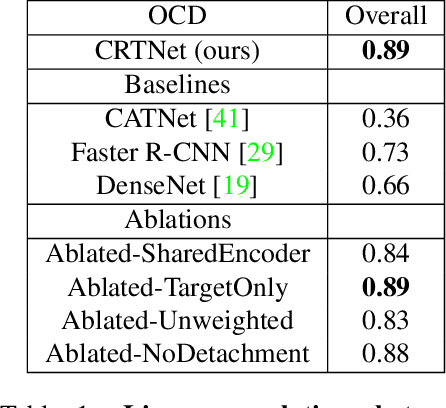
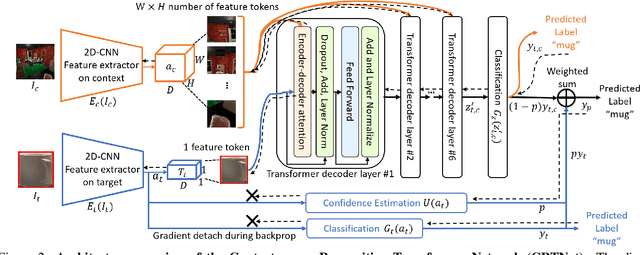
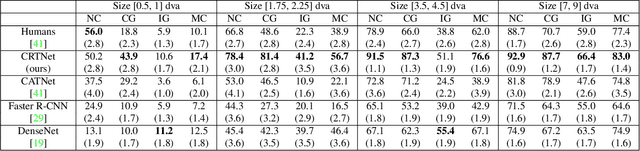
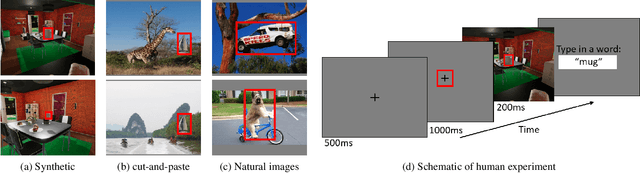
Context is of fundamental importance to both human and machine vision -- an object in the air is more likely to be an airplane, than a pig. The rich notion of context incorporates several aspects including physics rules, statistical co-occurrences, and relative object sizes, among others. While previous works have crowd-sourced out-of-context photographs from the web to study scene context, controlling the nature and extent of contextual violations has been an extremely daunting task. Here we introduce a diverse, synthetic Out-of-Context Dataset (OCD) with fine-grained control over scene context. By leveraging a 3D simulation engine, we systematically control the gravity, object co-occurrences and relative sizes across 36 object categories in a virtual household environment. We then conduct a series of experiments to gain insights into the impact of contextual cues on both human and machine vision using OCD. First, we conduct psycho-physics experiments to establish a human benchmark for out-of-context recognition, and then compare it with state-of-the-art computer vision models to quantify the gap between the two. Finally, we propose a context-aware recognition transformer model, fusing object and contextual information via multi-head attention. Our model captures useful information for contextual reasoning, enabling human-level performance and significantly better robustness in out-of-context conditions compared to baseline models across OCD and other existing out-of-context natural image datasets. All source code and data are publicly available https://github.com/kreimanlab/WhenPigsFlyContext.