 Add to Chrome
 Add to Firefox
 Add to Edge
Image-Based Whole-Heart Cardiac Flow Simulations in Health and Congenital Heart Disease
May 10, 2026
Intracardiac flow patterns are shaped by the coupled motion of the cardiac chambers and heart valves and provide important information about cardiac function. However, clinical flow imaging remains limited by exam times, noise, resolution, and incomplete details of the three-dimensional flow. Computational fluid dynamics (CFD) can potentially provide detailed flow quantification and predictive insight into treatment outcomes, but clinical translation requires frameworks that reproduce patient-specific measurements while balancing physiological realism, computational cost, and modeling effort. Herein, we present an image-based, patient-specific computational framework for simulating whole-heart intracardiac hemodynamics that balances physiological fidelity with computational efficiency. The framework first employs machine learning-based segmentation and mesh propagation to reconstruct moving cardiac anatomies from time-resolved images. CFD simulations are then performed to resolve blood flow in deforming domains, while resistive immersed surfaces (RIS) are used to model all four cardiac valves with physiologically realistic opening and closing dynamics. The framework was applied to model hemodynamics in a healthy adult and a pediatric patient with complex congenital heart disease (CHD). In the healthy case, the simulations reproduced physiologic pressure-volume behavior, valve timing, and ventricular vortex formation. In the CHD case, simulated chamber and vessel pressures showed agreement with cardiac catheterization measurements. Simulated flow fields were qualitatively consistent with 4D-Flow MRI, while providing higher-resolution visualization of flow structures that were partially obscured by imaging artifacts. Comparison between the healthy and CHD cases further revealed altered diastolic flow organization and elevated normalized viscous dissipation in the CHD heart.

SDF4CHD: Generative Modeling of Cardiac Anatomies with Congenital Heart Defects
Nov 08, 2023

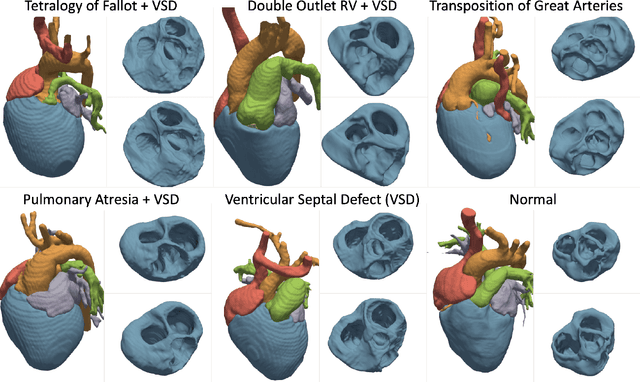

Congenital heart disease (CHD) encompasses a spectrum of cardiovascular structural abnormalities, often requiring customized treatment plans for individual patients. Computational modeling and analysis of these unique cardiac anatomies can improve diagnosis and treatment planning and may ultimately lead to improved outcomes. Deep learning (DL) methods have demonstrated the potential to enable efficient treatment planning by automating cardiac segmentation and mesh construction for patients with normal cardiac anatomies. However, CHDs are often rare, making it challenging to acquire sufficiently large patient cohorts for training such DL models. Generative modeling of cardiac anatomies has the potential to fill this gap via the generation of virtual cohorts; however, prior approaches were largely designed for normal anatomies and cannot readily capture the significant topological variations seen in CHD patients. Therefore, we propose a type- and shape-disentangled generative approach suitable to capture the wide spectrum of cardiac anatomies observed in different CHD types and synthesize differently shaped cardiac anatomies that preserve the unique topology for specific CHD types. Our DL approach represents generic whole heart anatomies with CHD type-specific abnormalities implicitly using signed distance fields (SDF) based on CHD type diagnosis, which conveniently captures divergent anatomical variations across different types and represents meaningful intermediate CHD states. To capture the shape-specific variations, we then learn invertible deformations to morph the learned CHD type-specific anatomies and reconstruct patient-specific shapes. Our approach has the potential to augment the image-segmentation pairs for rarer CHD types for cardiac segmentation and generate cohorts of CHD cardiac meshes for computational simulation.