 Add to Chrome
 Add to Firefox
 Add to Edge
Hierarchical Dual-Change Collaborative Learning for UAV Scene Change Captioning
Mar 13, 2026
This paper proposes a novel task for UAV scene understanding - UAV Scene Change Captioning (UAV-SCC) - which aims to generate natural language descriptions of semantic changes in dynamic aerial imagery captured from a movable viewpoint. Unlike traditional change captioning that mainly describes differences between image pairs captured from a fixed camera viewpoint over time, UAV scene change captioning focuses on image-pair differences resulting from both temporal and spatial scene variations dynamically captured by a moving camera. The key challenge lies in understanding viewpoint-induced scene changes from UAV image pairs that share only partially overlapping scene content due to viewpoint shifts caused by camera rotation, while effectively exploiting the relative orientation between the two images. To this end, we propose a Hierarchical Dual-Change Collaborative Learning (HDC-CL) method for UAV scene change captioning. In particular, a novel transformer, \emph{i.e.} Dynamic Adaptive Layout Transformer (DALT) is designed to adaptively model diverse spatial layouts of the image pair, where the interrelated features derived from the overlapping and non-overlapping regions are learned within the flexible and unified encoding layer. Furthermore, we propose a Hierarchical Cross-modal Orientation Consistency Calibration (HCM-OCC) method to enhance the model's sensitivity to viewpoint shift directions, enabling more accurate change captioning. To facilitate in-depth research on this task, we construct a new benchmark dataset, named UAV-SCC dataset, for UAV scene change captioning. Extensive experiments demonstrate that the proposed method achieves state-of-the-art performance on this task. The dataset and code will be publicly released upon acceptance of this paper.

Multimodal Sentiment Analysis Based on Causal Reasoning
Dec 10, 2024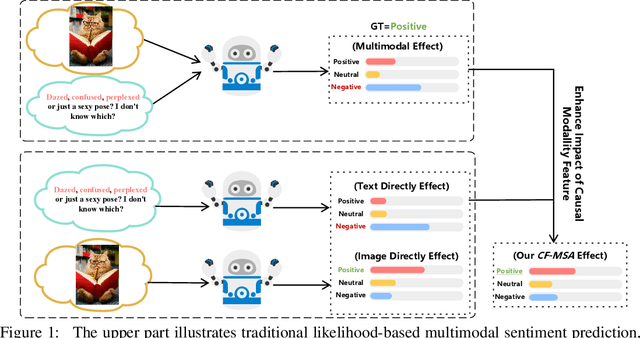

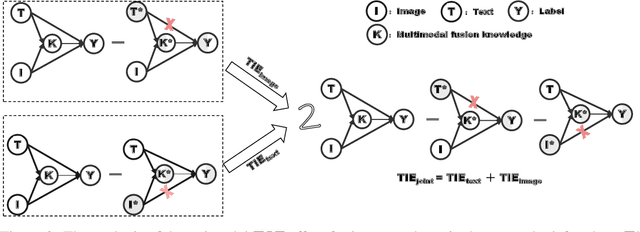

With the rapid development of multimedia, the shift from unimodal textual sentiment analysis to multimodal image-text sentiment analysis has obtained academic and industrial attention in recent years. However, multimodal sentiment analysis is affected by unimodal data bias, e.g., text sentiment is misleading due to explicit sentiment semantic, leading to low accuracy in the final sentiment classification. In this paper, we propose a novel CounterFactual Multimodal Sentiment Analysis framework (CF-MSA) using causal counterfactual inference to construct multimodal sentiment causal inference. CF-MSA mitigates the direct effect from unimodal bias and ensures heterogeneity across modalities by differentiating the treatment variables between modalities. In addition, considering the information complementarity and bias differences between modalities, we propose a new optimisation objective to effectively integrate different modalities and reduce the inherent bias from each modality. Experimental results on two public datasets, MVSA-Single and MVSA-Multiple, demonstrate that the proposed CF-MSA has superior debiasing capability and achieves new state-of-the-art performances. We will release the code and datasets to facilitate future research.