 Add to Chrome
 Add to Firefox
 Add to Edge
Pareto-Conditioned Diffusion Models for Offline Multi-Objective Optimization
Jan 31, 2026
Multi-objective optimization (MOO) arises in many real-world applications where trade-offs between competing objectives must be carefully balanced. In the offline setting, where only a static dataset is available, the main challenge is generalizing beyond observed data. We introduce Pareto-Conditioned Diffusion (PCD), a novel framework that formulates offline MOO as a conditional sampling problem. By conditioning directly on desired trade-offs, PCD avoids the need for explicit surrogate models. To effectively explore the Pareto front, PCD employs a reweighting strategy that focuses on high-performing samples and a reference-direction mechanism to guide sampling towards novel, promising regions beyond the training data. Experiments on standard offline MOO benchmarks show that PCD achieves highly competitive performance and, importantly, demonstrates greater consistency across diverse tasks than existing offline MOO approaches.

Pruned Lightweight Encoders for Computer Vision
Nov 23, 2022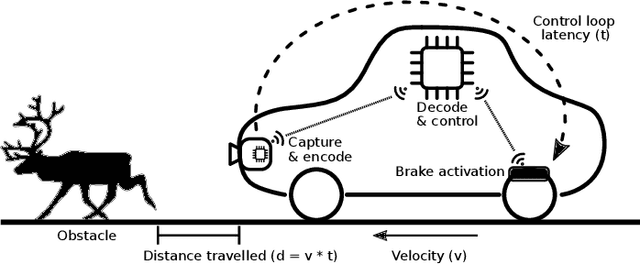
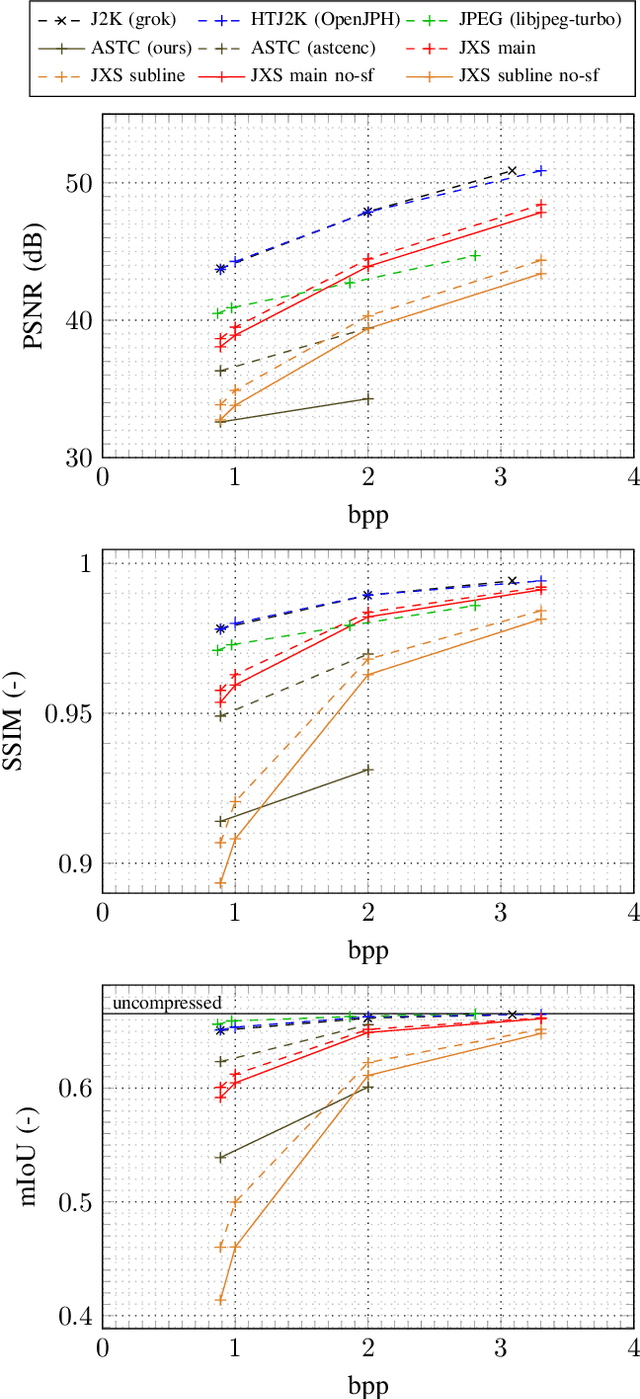
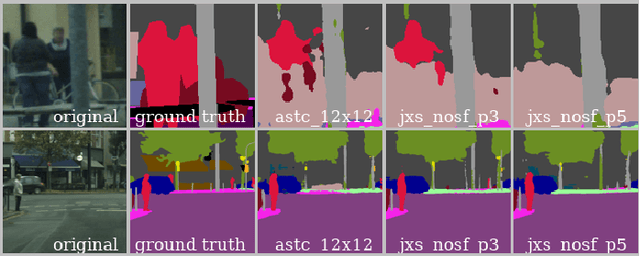
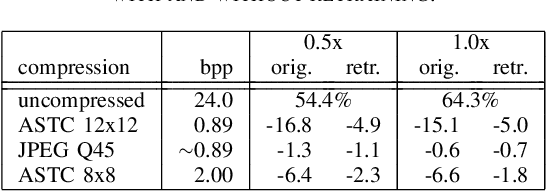
Latency-critical computer vision systems, such as autonomous driving or drone control, require fast image or video compression when offloading neural network inference to a remote computer. To ensure low latency on a near-sensor edge device, we propose the use of lightweight encoders with constant bitrate and pruned encoding configurations, namely, ASTC and JPEG XS. Pruning introduces significant distortion which we show can be recovered by retraining the neural network with compressed data after decompression. Such an approach does not modify the network architecture or require coding format modifications. By retraining with compressed datasets, we reduced the classification accuracy and segmentation mean intersection over union (mIoU) degradation due to ASTC compression to 4.9-5.0 percentage points (pp) and 4.4-4.0 pp, respectively. With the same method, the mIoU lost due to JPEG XS compression at the main profile was restored to 2.7-2.3 pp. In terms of encoding speed, our ASTC encoder implementation is 2.3x faster than JPEG. Even though the JPEG XS reference encoder requires optimizations to reach low latency, we showed that disabling significance flag coding saves 22-23% of encoding time at the cost of 0.4-0.3 mIoU after retraining.