 Add to Chrome
 Add to Firefox
 Add to Edge
Maximizing Incremental Information Entropy for Contrastive Learning
Mar 13, 2026
Contrastive learning has achieved remarkable success in self-supervised representation learning, often guided by information-theoretic objectives such as mutual information maximization. Motivated by the limitations of static augmentations and rigid invariance constraints, we propose IE-CL (Incremental-Entropy Contrastive Learning), a framework that explicitly optimizes the entropy gain between augmented views while preserving semantic consistency. Our theoretical framework reframes the challenge by identifying the encoder as an information bottleneck and proposes a joint optimization of two components: a learnable transformation for entropy generation and an encoder regularizer for its preservation. Experiments on CIFAR-10/100, STL-10, and ImageNet demonstrate that IE-CL consistently improves performance under small-batch settings. Moreover, our core modules can be seamlessly integrated into existing frameworks. This work bridges theoretical principles and practice, offering a new perspective in contrastive learning.

From Pretext to Purpose: Batch-Adaptive Self-Supervised Learning
Nov 16, 2023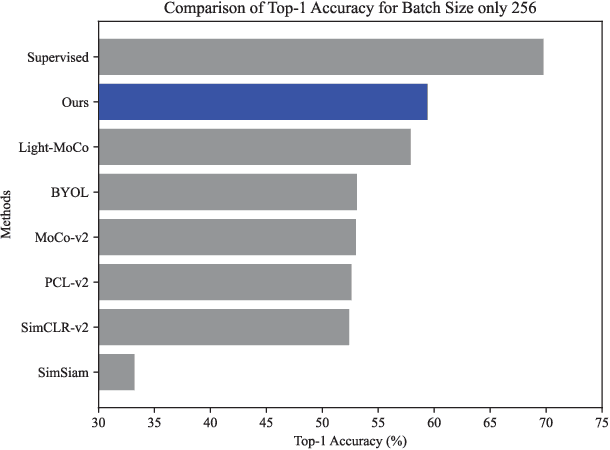
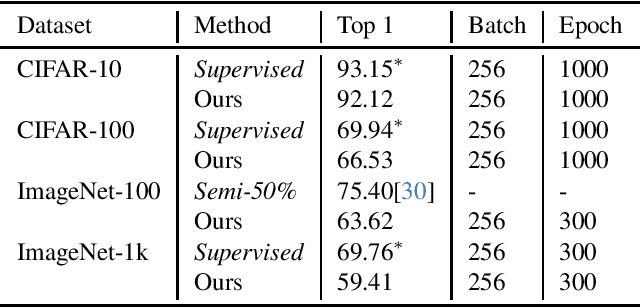
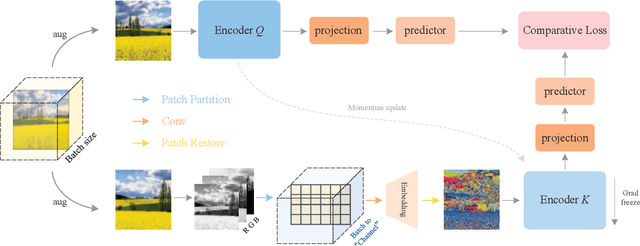
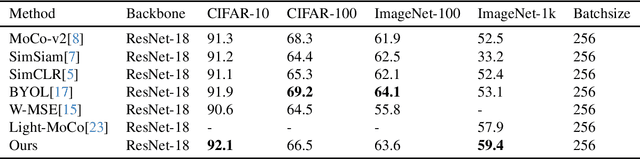
In recent years, self-supervised contrastive learning has emerged as a distinguished paradigm in the artificial intelligence landscape. It facilitates unsupervised feature learning through contrastive delineations at the instance level. However, crafting an effective self-supervised paradigm remains a pivotal challenge within this field. This paper delves into two crucial factors impacting self-supervised contrastive learning-bach size and pretext tasks, and from a data processing standpoint, proposes an adaptive technique of batch fusion. The proposed method, via dimensionality reduction and reconstruction of batch data, enables formerly isolated individual data to partake in intra-batch communication through the Embedding Layer. Moreover, it adaptively amplifies the self-supervised feature encoding capability as the training progresses. We conducted a linear classification test of this method based on the classic contrastive learning framework on ImageNet-1k. The empirical findings illustrate that our approach achieves state-of-the-art performance under equitable comparisons. Benefiting from its "plug-and-play" characteristics, we further explored other contrastive learning methods. On the ImageNet-100, compared to the original performance, the top1 has seen a maximum increase of 1.25%. We suggest that the proposed method may contribute to the advancement of data-driven self-supervised learning research, bringing a fresh perspective to this community.