 Add to Chrome
 Add to Firefox
 Add to Edge
Learning to Evolve: Multi-modal Interactive Fields for Robust Humanoid Navigation in Dynamic Environments
May 21, 2026
Safe manipulation-oriented navigation for humanoid robots requires scene memory that remains reliable under locomotion-induced perceptual distortion, environmental changes, and interaction-level geometric safety constraints. Existing semantic mapping and scene-graph systems are difficult to deploy directly in this setting because they often assume stable camera trajectories, static environments, or coarse object geometry. We introduce the Multi-modal Interactive Field (MIF), a humanoid-oriented system that integrates confidence-aware semantic 3D Gaussian Splatting, discrepancy-triggered spatial memory updates, and task-driven geometric reconstruction within a closed-loop perception-adaptation pipeline. MIF couples three fields: an uncertainty-aware 3DGS Appearance Field that suppresses gait-induced blur, a Spatial Field that maintains topological memory, and a Geometry Field that supports Interaction Pose Safety (IPS) before manipulation. A discrepancy detection score is introduced to separate locomotion-induced false-positive changes from persistent changes and updates only locally inconsistent regions. On a Unitree-G1 humanoid in a real dynamic office, MIF improves relocation success in non-static environments from 12% to 94% compared with static scene-graph memory, while reducing semantic memory footprint by 91.4% through feature distillation for practical online operation. Project page and code: https://ziya-jiang.github.io/MIF-homepage/

TAMBRIDGE: Bridging Frame-Centered Tracking and 3D Gaussian Splatting for Enhanced SLAM
May 30, 2024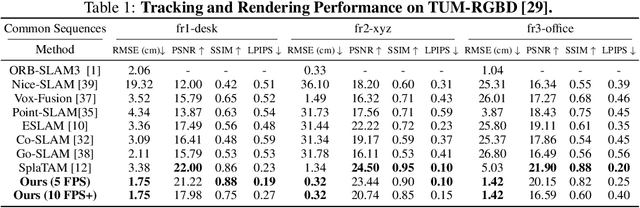
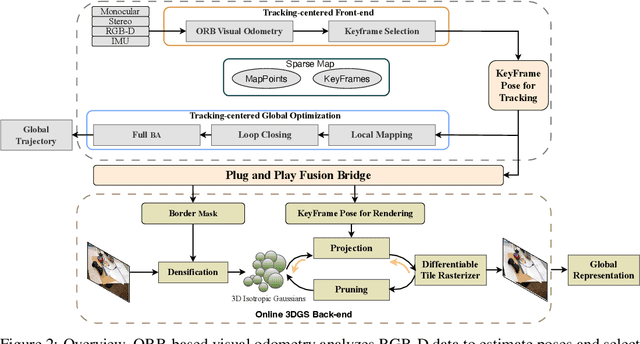

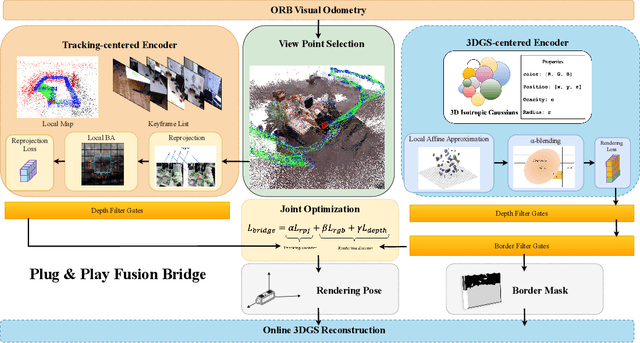
The limited robustness of 3D Gaussian Splatting (3DGS) to motion blur and camera noise, along with its poor real-time performance, restricts its application in robotic SLAM tasks. Upon analysis, the primary causes of these issues are the density of views with motion blur and the cumulative errors in dense pose estimation from calculating losses based on noisy original images and rendering results, which increase the difficulty of 3DGS rendering convergence. Thus, a cutting-edge 3DGS-based SLAM system is introduced, leveraging the efficiency and flexibility of 3DGS to achieve real-time performance while remaining robust against sensor noise, motion blur, and the challenges posed by long-session SLAM. Central to this approach is the Fusion Bridge module, which seamlessly integrates tracking-centered ORB Visual Odometry with mapping-centered online 3DGS. Precise pose initialization is enabled by this module through joint optimization of re-projection and rendering loss, as well as strategic view selection, enhancing rendering convergence in large-scale scenes. Extensive experiments demonstrate state-of-the-art rendering quality and localization accuracy, positioning this system as a promising solution for real-world robotics applications that require stable, near-real-time performance. Our project is available at https://ZeldaFromHeaven.github.io/TAMBRIDGE/