 Add to Chrome
 Add to Firefox
 Add to Edge
Flatness-Preserving Residual Learning for Real-Time Tight Quadrotor Formation Flight
Jul 14, 2026
Quadrotors flying in tight formations are severely affected by turbulent aerodynamic interactions, such as downwash, that can cause catastrophic collisions if left unmodeled. To compensate for these effects, we propose a physics-informed residual dynamics learning framework that captures complex aerodynamic interactions while ensuring the joint multi-quadrotor system remains differentially flat. We leverage this preserved flatness to design a computationally efficient feedback linearization controller that is easily tunable with linear control techniques and cancels aerodynamic disturbances via feedforward compensation. Hardware experiments demonstrate our framework reduces average tracking errors by 31% compared to nominal baselines. Crucially, our lightweight approach matches the tracking performance of state-of-the-art nonlinear model predictive control (NMPC) while requiring an order of magnitude less computation. We are the first to show that stable, tight formation flight can be achieved with under 30 seconds of training data and a 5ms loop rate, unlocking high-fidelity aerodynamic compensation for compute-constrained flight stacks.

Neural Navigation Functions for Zero-Shot Generalizable Motion Planning
Jun 02, 2026We introduce Neural Navigation Functions (Neural-NF), a learned reactive navigation function capable of zero-shot transfer across unseen environment geometries. Neural-NF places data-driven adaptation within a structured elliptic planner, where the navigation objective is learned while planner structure is preserved by construction. Specifically, intrinsic Laplacian-derived features are mapped to local PDE coefficients, and solving the resulting boundary value problem produces a globally consistent value function on each target domain. For every admissible learned model, the resulting policy is collision-free, provides monotonic descent and a global minimum at the goal by construction. This admits a linearly-solvable optimal-control interpretation for any parameter setting. Empirically, Neural-NF achieves strong zero-shot transfer across diverse geometries and outperforms learned planners that directly predict the value function by up to a $5\times$ improvement.
Flying Quadrotors in Tight Formations using Learning-based Model Predictive Control
Oct 13, 2024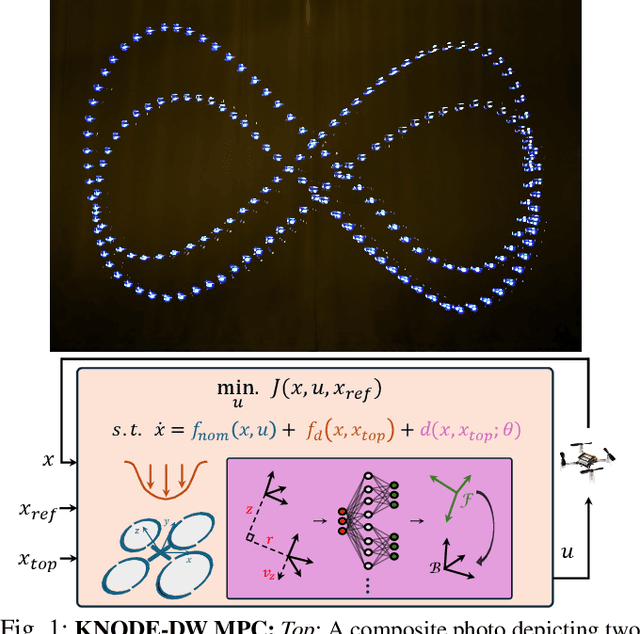
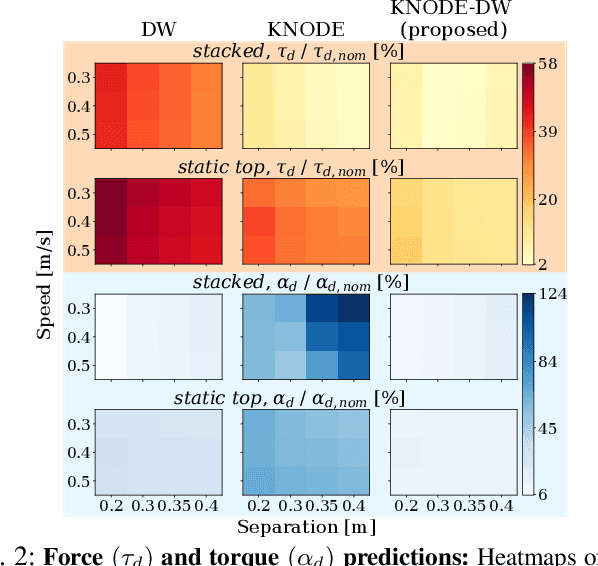
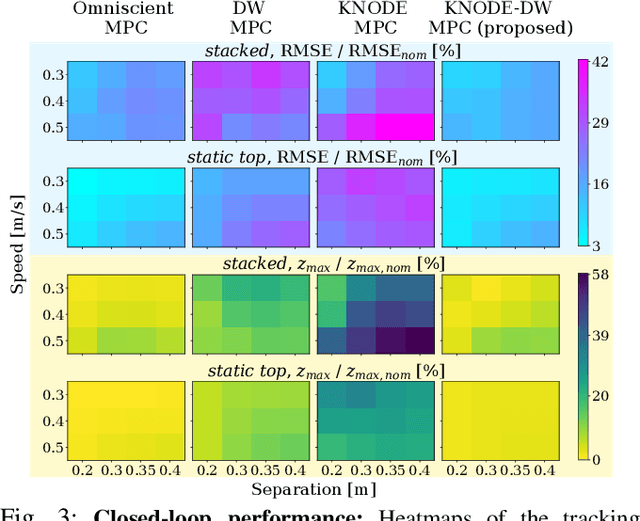
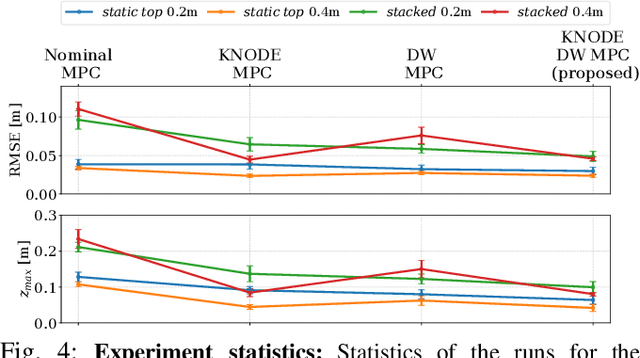
Flying quadrotors in tight formations is a challenging problem. It is known that in the near-field airflow of a quadrotor, the aerodynamic effects induced by the propellers are complex and difficult to characterize. Although machine learning tools can potentially be used to derive models that capture these effects, these data-driven approaches can be sample inefficient and the resulting models often do not generalize as well as their first-principles counterparts. In this work, we propose a framework that combines the benefits of first-principles modeling and data-driven approaches to construct an accurate and sample efficient representation of the complex aerodynamic effects resulting from quadrotors flying in formation. The data-driven component within our model is lightweight, making it amenable for optimization-based control design. Through simulations and physical experiments, we show that incorporating the model into a novel learning-based nonlinear model predictive control (MPC) framework results in substantial performance improvements in terms of trajectory tracking and disturbance rejection. In particular, our framework significantly outperforms nominal MPC in physical experiments, achieving a 40.1% improvement in the average trajectory tracking errors and a 57.5% reduction in the maximum vertical separation errors. Our framework also achieves exceptional sample efficiency, using only a total of 46 seconds of flight data for training across both simulations and physical experiments. Furthermore, with our proposed framework, the quadrotors achieve an exceptionally tight formation, flying with an average separation of less than 1.5 body lengths throughout the flight. A video illustrating our framework and physical experiments is given here: https://youtu.be/Hv-0JiVoJGo