 Add to Chrome
 Add to Firefox
 Add to Edge
Contraction-Gauge Preconditioning for Quantized Matrix Multiplication
Jul 21, 2026
We study low-precision computation of C=AB with both factors quantized. We derive an exact finite-dimensional identity for the expected squared product error under independent, zero-mean entrywise errors with known variance fields; it holds exactly for non-overloading subtractive dither and for independent stochastic rounding, and we empirically assess deterministic round-to-nearest (RTN). Using the product-preserving equivalence AB=(AT)(T^{-1}B), we formulate contraction-gauge preconditioning: jointly choosing a factor representation and its sharing pattern before quantization. Preconditioning can reduce product error but may require extra transformed, quantized copies of the opposite operand: a shared transform needs one copy, a block-specific transform up to one per block. Within the bounded family of positive diagonal gauges (folds), a geometric program computes a globally optimal shared fold and a linear program decides whether the identity fold is already optimal. For other families we derive computable selection statistics -- tail index for scaling, profile spread for partitioning, coherence and weighted-Gram energy for rotations, slice-energy covariance for hierarchy depth -- with upper bounds for ranking heuristic candidates. Across twelve linear products from a trained three-block image classifier, median within-product rank correlations between dither-model predictions and deterministic-RTN errors are 0.937 at 8 bits and 0.918 at 4 bits. The GP fold cuts held-out product error over the identity fold by 18.0% (8-bit) and 20.5% (4-bit) in geometric mean, beats a SmoothQuant-style grid baseline at both precisions and on ten of twelve products, and lowers composed logit MSE by 15.4% and 26.4%. We thus provide exact stochastic product-error accounting, certified selection within the diagonal family, and a common objective for evaluating reusable transform candidates under RTN.

Leveraging AI for Productive and Trustworthy HPC Software: Challenges and Research Directions
May 13, 2025We discuss the challenges and propose research directions for using AI to revolutionize the development of high-performance computing (HPC) software. AI technologies, in particular large language models, have transformed every aspect of software development. For its part, HPC software is recognized as a highly specialized scientific field of its own. We discuss the challenges associated with leveraging state-of-the-art AI technologies to develop such a unique and niche class of software and outline our research directions in the two US Department of Energy--funded projects for advancing HPC Software via AI: Ellora and Durban.
Comparing Llama-2 and GPT-3 LLMs for HPC kernels generation
Sep 12, 2023
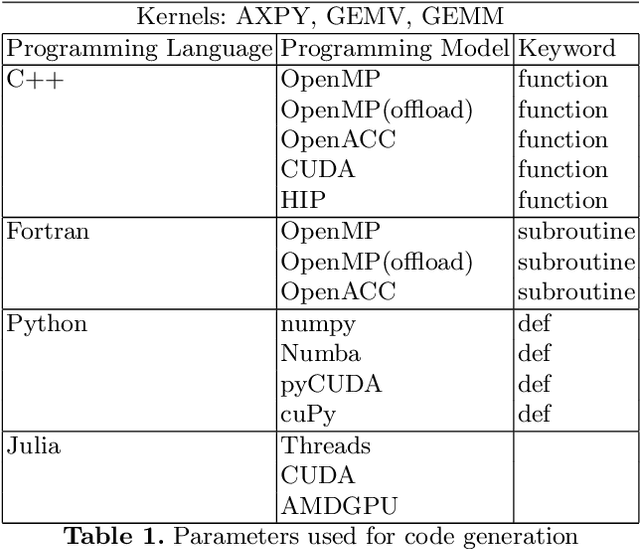

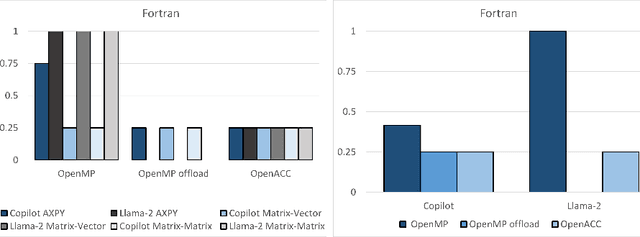
We evaluate the use of the open-source Llama-2 model for generating well-known, high-performance computing kernels (e.g., AXPY, GEMV, GEMM) on different parallel programming models and languages (e.g., C++: OpenMP, OpenMP Offload, OpenACC, CUDA, HIP; Fortran: OpenMP, OpenMP Offload, OpenACC; Python: numpy, Numba, pyCUDA, cuPy; and Julia: Threads, CUDA.jl, AMDGPU.jl). We built upon our previous work that is based on the OpenAI Codex, which is a descendant of GPT-3, to generate similar kernels with simple prompts via GitHub Copilot. Our goal is to compare the accuracy of Llama-2 and our original GPT-3 baseline by using a similar metric. Llama-2 has a simplified model that shows competitive or even superior accuracy. We also report on the differences between these foundational large language models as generative AI continues to redefine human-computer interactions. Overall, Copilot generates codes that are more reliable but less optimized, whereas codes generated by Llama-2 are less reliable but more optimized when correct.
Evaluation of OpenAI Codex for HPC Parallel Programming Models Kernel Generation
Jun 27, 2023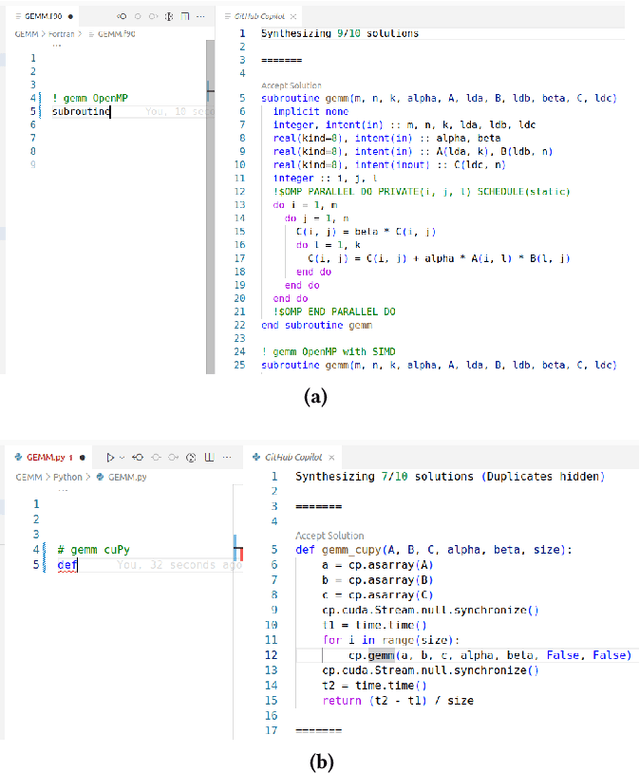

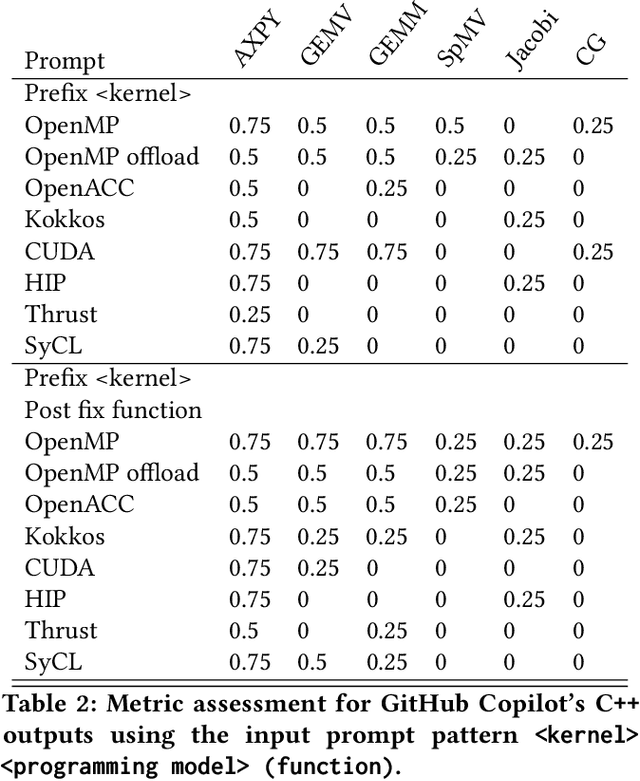
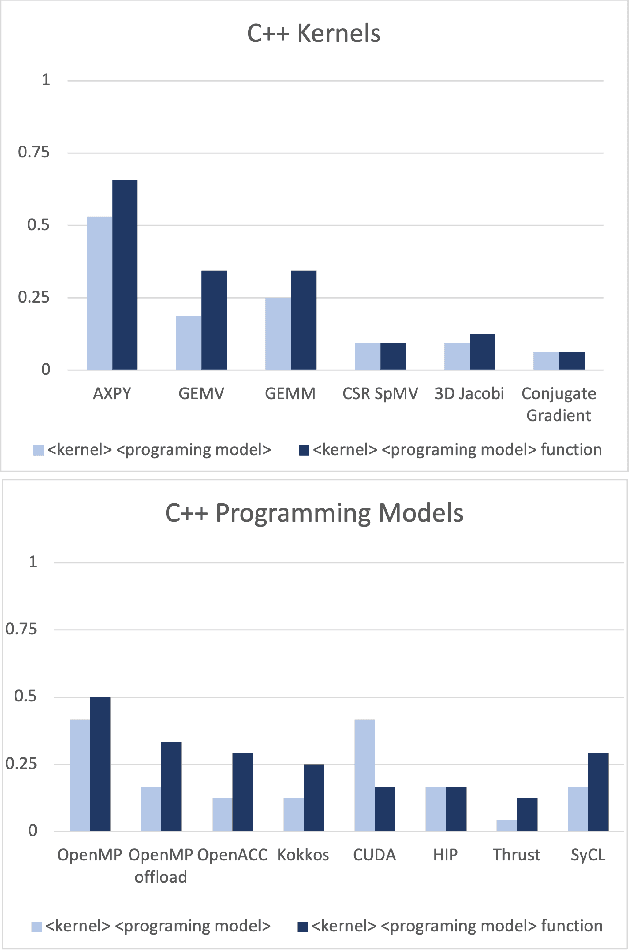
We evaluate AI-assisted generative capabilities on fundamental numerical kernels in high-performance computing (HPC), including AXPY, GEMV, GEMM, SpMV, Jacobi Stencil, and CG. We test the generated kernel codes for a variety of language-supported programming models, including (1) C++ (e.g., OpenMP [including offload], OpenACC, Kokkos, SyCL, CUDA, and HIP), (2) Fortran (e.g., OpenMP [including offload] and OpenACC), (3) Python (e.g., numba, Numba, cuPy, and pyCUDA), and (4) Julia (e.g., Threads, CUDA.jl, AMDGPU.jl, and KernelAbstractions.jl). We use the GitHub Copilot capabilities powered by OpenAI Codex available in Visual Studio Code as of April 2023 to generate a vast amount of implementations given simple <kernel> + <programming model> + <optional hints> prompt variants. To quantify and compare the results, we propose a proficiency metric around the initial 10 suggestions given for each prompt. Results suggest that the OpenAI Codex outputs for C++ correlate with the adoption and maturity of programming models. For example, OpenMP and CUDA score really high, whereas HIP is still lacking. We found that prompts from either a targeted language such as Fortran or the more general-purpose Python can benefit from adding code keywords, while Julia prompts perform acceptably well for its mature programming models (e.g., Threads and CUDA.jl). We expect for these benchmarks to provide a point of reference for each programming model's community. Overall, understanding the convergence of large language models, AI, and HPC is crucial due to its rapidly evolving nature and how it is redefining human-computer interactions.
cuConv: A CUDA Implementation of Convolution for CNN Inference
Mar 30, 2021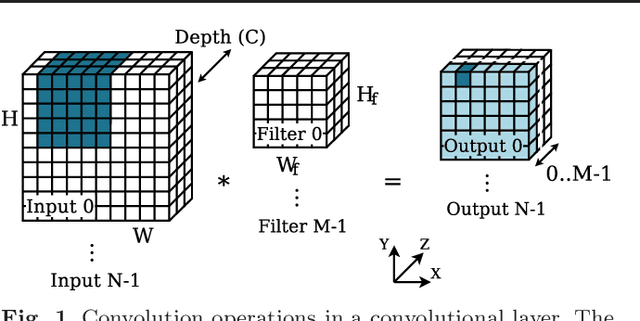

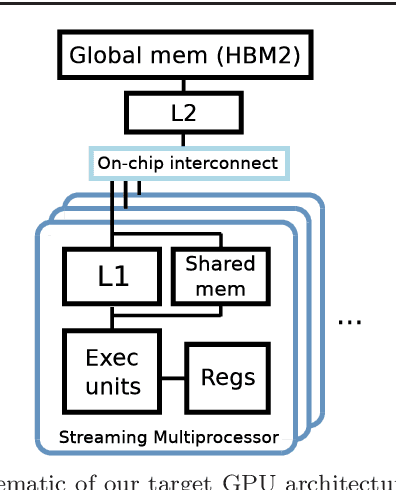
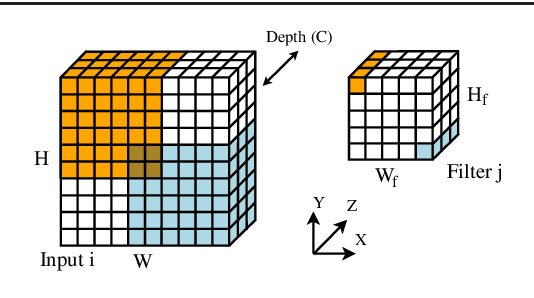
Convolutions are the core operation of deep learning applications based on Convolutional Neural Networks (CNNs). Current GPU architectures are highly efficient for training and deploying deep CNNs, and hence, these are largely used in production for this purpose. State-of-the-art implementations, however, present a lack of efficiency for some commonly used network configurations. In this paper we propose a GPU-based implementation of the convolution operation for CNN inference that favors coalesced accesses, without requiring prior data transformations. Our experiments demonstrate that our proposal yields notable performance improvements in a range of common CNN forward propagation convolution configurations, with speedups of up to 2.29x with respect to the best implementation of convolution in cuDNN, hence covering a relevant region in currently existing approaches.