 Add to Chrome
 Add to Firefox
 Add to Edge
Which Directions Matter? Sparse Design for Affine Robust Optimization
Jun 12, 2026
Robust machine learning and optimization rely on the uncertainty model choice. We investigate which uncertainty directions a model must cover when defined by a finite dictionary and a budget constraint. Selecting a subset forms an atomic uncertainty set with a closed form support function, yielding tractable robust programs for affine objectives. We propose a data driven selection rule based on a coverage objective over evaluation directions, including gradients, adversarial perturbations, or shifts observed on held out data. We prove this objective is monotone and submodular, supporting a greedy method with a $(1-1/e)$ approximation guarantee and a matching hardness barrier. We also provide a certificate bounding the loss from the selected subset and a radius calibration rule with out of sample control.

PASS: Ambiguity Guided Subsets for Scalable Classical and Quantum Constrained Clustering
Jan 28, 2026Pairwise-constrained clustering augments unsupervised partitioning with side information by enforcing must-link (ML) and cannot-link (CL) constraints between specific samples, yielding labelings that respect known affinities and separations. However, ML and CL constraints add an extra layer of complexity to the clustering problem, with current methods struggling in data scalability, especially in niche applications like quantum or quantum-hybrid clustering. We propose PASS, a pairwise-constraints and ambiguity-driven subset selection framework that preserves ML and CL constraints satisfaction while allowing scalable, high-quality clustering solution. PASS collapses ML constraints into pseudo-points and offers two selectors: a constraint-aware margin rule that collects near-boundary points and all detected CL violations, and an information-geometric rule that scores points via a Fisher-Rao distance derived from soft assignment posteriors, then selects the highest-information subset under a simple budget. Across diverse benchmarks, PASS attains competitive SSE at substantially lower cost than exact or penalty-based methods, and remains effective in regimes where prior approaches fail.
QIBONN: A Quantum-Inspired Bilevel Optimizer for Neural Networks on Tabular Classification
Nov 12, 2025Hyperparameter optimization (HPO) for neural networks on tabular data is critical to a wide range of applications, yet it remains challenging due to large, non-convex search spaces and the cost of exhaustive tuning. We introduce the Quantum-Inspired Bilevel Optimizer for Neural Networks (QIBONN), a bilevel framework that encodes feature selection, architectural hyperparameters, and regularization in a unified qubit-based representation. By combining deterministic quantum-inspired rotations with stochastic qubit mutations guided by a global attractor, QIBONN balances exploration and exploitation under a fixed evaluation budget. We conduct systematic experiments under single-qubit bit-flip noise (0.1\%--1\%) emulated by an IBM-Q backend. Results on 13 real-world datasets indicate that QIBONN is competitive with established methods, including classical tree-based methods and both classical/quantum-inspired HPO algorithms under the same tuning budget.
A Scalable Global Optimization Algorithm For Constrained Clustering
Oct 26, 2025Constrained clustering leverages limited domain knowledge to improve clustering performance and interpretability, but incorporating pairwise must-link and cannot-link constraints is an NP-hard challenge, making global optimization intractable. Existing mixed-integer optimization methods are confined to small-scale datasets, limiting their utility. We propose Sample-Driven Constrained Group-Based Branch-and-Bound (SDC-GBB), a decomposable branch-and-bound (BB) framework that collapses must-linked samples into centroid-based pseudo-samples and prunes cannot-link through geometric rules, while preserving convergence and guaranteeing global optimality. By integrating grouped-sample Lagrangian decomposition and geometric elimination rules for efficient lower and upper bounds, the algorithm attains highly scalable pairwise k-Means constrained clustering via parallelism. Experimental results show that our approach handles datasets with 200,000 samples with cannot-link constraints and 1,500,000 samples with must-link constraints, which is 200 - 1500 times larger than the current state-of-the-art under comparable constraint settings, while reaching an optimality gap of less than 3%. In providing deterministic global guarantees, our method also avoids the search failures that off-the-shelf heuristics often encounter on large datasets.
qc-kmeans: A Quantum Compressive K-Means Algorithm for NISQ Devices
Oct 26, 2025Clustering on NISQ hardware is constrained by data loading and limited qubits. We present \textbf{qc-kmeans}, a hybrid compressive $k$-means that summarizes a dataset with a constant-size Fourier-feature sketch and selects centroids by solving small per-group QUBOs with shallow QAOA circuits. The QFF sketch estimator is unbiased with mean-squared error $O(\varepsilon^2)$ for $B,S=\Theta(\varepsilon^{-2})$, and the peak-qubit requirement $q_{\text{peak}}=\max\{D,\lceil \log_2 B\rceil + 1\}$ does not scale with the number of samples. A refinement step with elitist retention ensures non-increasing surrogate cost. In Qiskit Aer simulations (depth $p{=}1$), the method ran with $\le 9$ qubits on low-dimensional synthetic benchmarks and achieved competitive sum-of-squared errors relative to quantum baselines; runtimes are not directly comparable. On nine real datasets (up to $4.3\times 10^5$ points), the pipeline maintained constant peak-qubit usage in simulation. Under IBM noise models, accuracy was similar to the idealized setting. Overall, qc-kmeans offers a NISQ-oriented formulation with shallow, bounded-width circuits and competitive clustering quality in simulation.
SPOT: Scalable Policy Optimization with Trees for Markov Decision Processes
Oct 22, 2025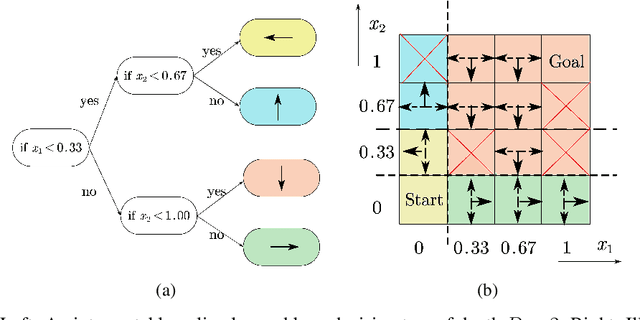
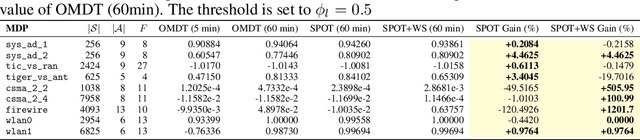
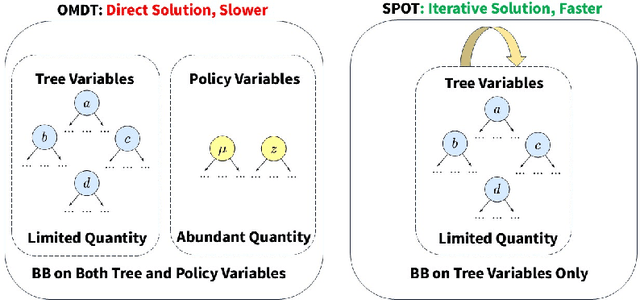
Interpretable reinforcement learning policies are essential for high-stakes decision-making, yet optimizing decision tree policies in Markov Decision Processes (MDPs) remains challenging. We propose SPOT, a novel method for computing decision tree policies, which formulates the optimization problem as a mixed-integer linear program (MILP). To enhance efficiency, we employ a reduced-space branch-and-bound approach that decouples the MDP dynamics from tree-structure constraints, enabling efficient parallel search. This significantly improves runtime and scalability compared to previous methods. Our approach ensures that each iteration yields the optimal decision tree. Experimental results on standard benchmarks demonstrate that SPOT achieves substantial speedup and scales to larger MDPs with a significantly higher number of states. The resulting decision tree policies are interpretable and compact, maintaining transparency without compromising performance. These results demonstrate that our approach simultaneously achieves interpretability and scalability, delivering high-quality policies an order of magnitude faster than existing approaches.