 Add to Chrome
 Add to Firefox
 Add to Edge
Evaluating Four FPGA-accelerated Space Use Cases based on Neural Network Algorithms for On-board Inference
Mar 14, 2026
Space missions increasingly deploy high-fidelity sensors that produce data volumes exceeding onboard buffering and downlink capacity. This work evaluates FPGA acceleration of neural networks (NNs) across four space use cases on the AMD ZCU104 board. We use Vitis AI (AMD DPU) and Vitis HLS to implement inference, quantify throughput and energy, and expose toolchain and architectural constraints relevant to deployment. Vitis AI achieves up to 34.16$\times$ higher inference rate than the embedded ARM CPU baseline, while custom HLS designs reach up to 5.4$\times$ speedup and add support for operators (e.g., sigmoids, 3D layers) absent in the DPU. For these implementations, measured MPSoC inference power spans 1.5-6.75 W, reducing energy per inference versus CPU execution in all use cases. These results show that NN FPGA acceleration can enable onboard filtering, compression, and event detection, easing downlink pressure in future missions.

AIvailable: A Software-Defined Architecture for LLM-as-a-Service on Heterogeneous and Legacy GPUs
Nov 06, 2025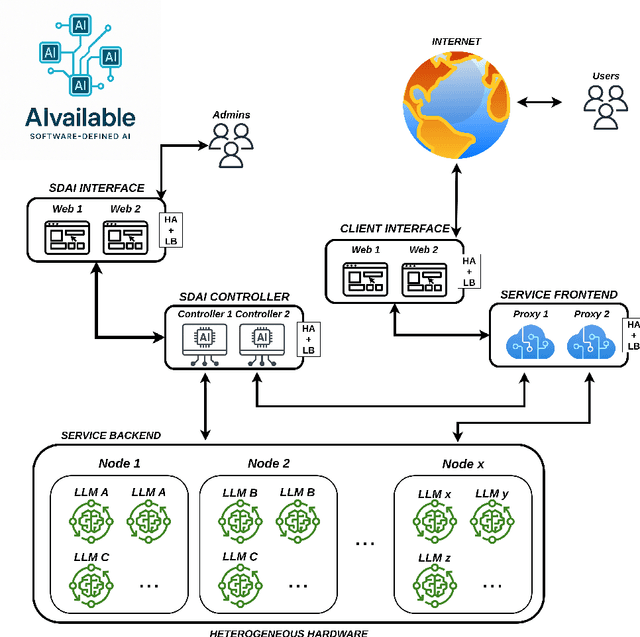
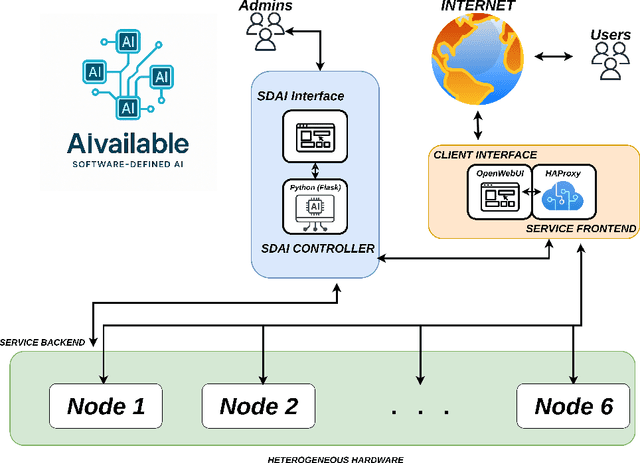
The rise of Large Language Models (LLM) has increased the need for scalable, high-performance inference systems, yet most existing frameworks assume homogeneous, resource-rich hardware, often unrealistic in academic, or resource-constrained settings. We introduce AIvailable, a low-cost, highly available LLM-as-a-Service (LLMaaS) platform, that uses a software-defined approach for running LLMs across heterogeneous and legacy GPU nodes, including NVIDIA and AMD devices, with a focus on fully utilizing each node's VRAM. AIvailable operates as a fully GPU-accelerated inference without CPU fallbacks, featuring a unified client interface that allows seamless interaction with all deployed LLMs through a single logical unit. The architecture comprises four main components: the Client Interface for user access, the Service Frontend for secure request routing and load balancing, the SDAI Controller for orchestration, deployment, and monitoring, and the Service Backend of heterogeneous GPU nodes executing workloads. By abstracting GPU-specific details and providing dynamic, VRAM-aware allocation and reallocation of models, AIvailable ensures efficient use of resources and resilience against failures or workload fluctuations. Targeting academic labs, private companies, and other constrained organizations, it supports diverse open LLMs helping democratize generative AI through the repurposing of legacy GPUs.
FPGA-Based Neural Network Accelerators for Space Applications: A Survey
Apr 24, 2025Space missions are becoming increasingly ambitious, necessitating high-performance onboard spacecraft computing systems. In response, field-programmable gate arrays (FPGAs) have garnered significant interest due to their flexibility, cost-effectiveness, and radiation tolerance potential. Concurrently, neural networks (NNs) are being recognized for their capability to execute space mission tasks such as autonomous operations, sensor data analysis, and data compression. This survey serves as a valuable resource for researchers aiming to implement FPGA-based NN accelerators in space applications. By analyzing existing literature, identifying trends and gaps, and proposing future research directions, this work highlights the potential of these accelerators to enhance onboard computing systems.